
BETWEEN FEBRUARY 22nd and 26th the Sarah, a 20-year-old tanker flagged in Hong Kong, temporarily turned off its transponders to pick up three loads of Russian oil from smaller ships off the Omani coast. It then headed towards Singapore, where it had probably planned to pass on the cargo to another “shadow” ship, bound for China. But on March 6th, the day after America issued a 30-day sanctions waiver allowing Indian refiners to buy Russian crude, the Sarah abruptly changed course. It is now due to arrive at a refinery in western India on March 14th.
The ship’s U-turn is a metaphor for the dramatic reversal in the fortunes of Russia’s energy industry since the start of the Iran war. The de facto closure of the Strait of Hormuz has trapped around 15% of the world’s oil in the Gulf. In December Brent crude, the global oil-price benchmark, touched a five-year low of $59 a barrel, and the industry predicted a “superglut”; now it hovers around $100. That has made Russian barrels harder to shun. On March 12th the Trump administration extended its waiver to enable all countries to buy Russian oil already loaded on tankers.
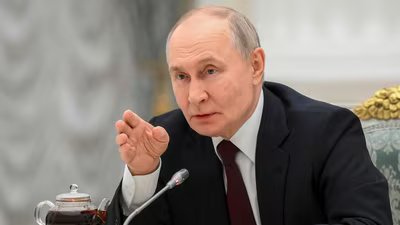
The reprieve could not come at a better time for Vladimir Putin. Before the Iran war it had seemed as if Russia’s oil revenues—and its economy—were at last sinking. Many refiners in India and China, the country’s biggest customers, stopped buying around November, before American sanctions on Rosneft and Lukoil, its two largest producers, came into force. By February, export volumes had slumped by a fifth; that, together with lower prices, meant the Kremlin’s oil-and-gas revenues were 44% lower than a year ago (see chart 1). In just two months its budget deficit hit 3.4trn roubles, nine-tenths of the target for the whole of 2026 (see chart 2).
Now Brent is back to where it was on average in the year of Russia’s full-scale invasion of Ukraine. Should Hormuz stay closed for much longer, Russia could reap another “2022-style windfall”—enough to make up for the $300bn in central-bank reserves frozen by the West that year, reckons Robin Brooks of the Brookings Institution, a think-tank.
The most immediate benefit of the Gulf crisis for Russia is the chance to clear the vast shipment backlog which, for want of buyers, had accumulated at sea. India has already increased its purchases by roughly half, helping reduce Russia’s inventory on water by over 10%, to 122m barrels (see chart 3). China’s imports have also risen. This helps traders rather than Russia’s finances, because the shipments have already been sold. But it looks likely that the Trump administration, officially or not, will adopt a permissive attitude towards Russia’s new barrels, too. That would benefit Russia on three fronts: higher prices for its wares; degraded Western sanctions; and potential Chinese backing for new projects.
Take prices first. The absence of Gulf oil has triggered a dash for alternative crude. Russia’s is more attractive than most: it is similar in quality to most Middle Eastern oil, and therefore cheaper and easier to process for Asian refiners (the Gulf’s main customers). Supply is now so sought-after that Urals crude delivered to India, once severely discounted, is priced at a premium to Brent (see chart 4).
Even that may understate how much sellers of Russian crude can hope to profit today. China’s independent “teapot” refineries, which buy a lot of it, use “trigger pricing” to pay for imports. Suppliers may give them up to two months after delivery to fix the price, indexed on Brent, allowing buyers time to raise cash through product sales. Meanwhile refiners must post a margin based on the cargo’s spot value. Brent is now soaring so fast that many teapots have struggled to meet margin calls, says Tom Reed of Argus Media, a price-reporting agency. That gives suppliers the option to “force trigger” deals at peak prices.
Sergey Vakulenko, formerly of Gazprom Neft, a Russian oil firm, estimates that every $10 increase in the Brent price over a month boosts Russia’s energy exports by $2.8bn, some $1.6bn of which goes to the Kremlin. Higher gas prices provide a little pocket change (most of Russia’s LNG is sold by a private firm, and piped exports are well below 2022 volumes). That will help pad Russia’s budget for 2026, which had assumed oil prices of $59 a barrel, buying extra time to wage the war. It will also mechanically boost GDP.
The energy crisis is meanwhile making it harder for Western countries to tighten sanctions—a second bonus for Mr Putin. Before it, the Trump administration had seemed willing to get a little tougher on Russia by imposing “secondary tariffs” and pursuing its shadow fleet. With the latest easing, however, America’s credibility is weakened, says Rachel Ziemba of Centre for a New American Security, a think-tank. It also widens the divide with the European Commission, which had proposed a full ban on maritime services for Russian oil exports, meant to be co-ordinated with America and other G7 members. That sanctions package, since opposed by Hungary and Slovakia, now looks even less likely to pass.
More alarming still, a looming gas crunch may convince European countries to renege on commitments to stop buying Russian LNG from next year. Hungary and Slovakia, which are also due to stop receiving piped gas from Russia in 2027, may push back, too. “We cannot afford to fight two wars at the same time,” says a European official.
The war in the Gulf is also worrying China, which usually receives one-third of its LNG from the region. That may bring it closer still to Russia—the third benefit. The crisis has made China acutely aware of its vulnerability to maritime chokepoints. The country holds vast reserves of crude—1.3bn barrels, equivalent to nearly four months’ imports—but its gas stockpiles, which are harder to store, cover only 40 days. Drawing on those reserves now will force restocking over the summer, when China may have to compete fiercely against Europe, Japan and other buyers for spot LNG cargoes.
That makes overland gas-supply options attractive—and Russia offers one. In recent years the Kremlin has lobbied hard for China to back Power of Siberia 2, a 2,600km pipeline that could more than double Russia’s gas exports to the country. The two governments signed a memorandum of understanding last year, but negotiations on price, volume commitments and take-or-pay terms have stalled, as China has played hardball. It is possible China will now offer a slightly better price, improving the project’s chances. In time it may also buy more from Russia’s mammoth LNG projects in the Arctic.
Luck that may not last
Russia’s remarkable turn of fortune may yet prove to be a “sugar high” that does little to solve its deeper problems, says Thane Gustafson of Georgetown University. Ukraine’s relentless attacks on Russian oil facilities have forced energy firms to divert the little capital earmarked for new drilling towards repairs. Sanctions, lower prices and a rapacious taxman have further degraded the industry’s ability to invest in new production. Analysts reckon Russia has only 300,000 barrels per day of spare capacity, making it unlikely to replace much of the Gulf’s missing 10m-15m b/d in the near term. “There is every incentive for Ukraine to double down on its attacks to ensure Russian production remains at risk,” says John Kennedy, a former British trade official in Russia. It cannot produce much more LNG either.
Could high prices give Russia’s oil firms the firepower to raise output over the longer run? Perhaps, but the industry faces a dilemma. Companies make large investments only if prices are expected to stay high enough for long enough—meaning the Gulf war lasts well beyond March. But a protracted crisis could push Brent beyond $150 a barrel, destroying demand and accelerating a shift away from petroleum, negating the gains from higher prices. The Kremlin may in any case raid the bounty for rearmament, leaving little room for a production increase. Meanwhile chaos in the Gulf may cause OPEC to implode, turning Russia and its erstwhile allies, not least Saudi Arabia, into competitors.
The Iran war is therefore no game-changer for Russia. It was far better off before 2022, when it could sell hydrocarbons to the entire world, its oil firms could partner with Western majors and its energy infrastructure had not been degraded by strikes and sanctions. Higher oil prices and a little more leverage will undo perhaps 20% of that damage, reckons Mr Vakulenko. But, he says, they will not prevent Russia’s oil output from declining by 3% a year. As money and manpower have been shovelled into the war machine, the civilian economy has been sucked dry. Nor will more money translate into military success on the battlefield: Russia’s lack of progress is not that it lacks financial firepower, but that it cannot project military force. Hormuz has brought Russia a sugar high. But that cannot fix all its troubles.