
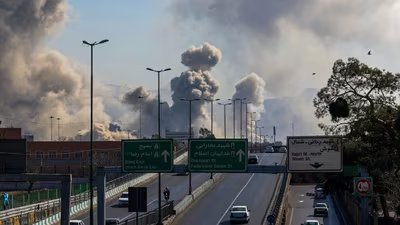
Shaia Hosseinzadeh bet that a war in the Middle East would upend global markets.
This was the week his wager paid off.
His OnyxPoint Global Management had already been snapping up shares in liquefied natural-gas companies, rare-earth firms and energy producers when missiles and drones started to fly to and from Iran. Wall Street’s initially sanguine response to conflict, Hosseinzadeh said, “gave us more conviction to lean in to the trade.”
Just last month, when the hedge fund founder was discussing opportunities and risks ahead with investors at the Ritz-Carlton South Beach in Florida, U.S. oil prices had largely languished below $65 a barrel for months. Some forecasters projected more declines to come, leaving oil bulls on the outside looking in. But as U.S. warships massed near the Middle East and rumors swirled of huge trades for pricier oil, Hosseinzadeh saw one risk that loomed large.
Now, the widening regional war has sent benchmark U.S. crude futures near $100 a barrel and lifted his bets, while setting off a race from Wall Street to Main Street for shelter from what many fear could be a doomsday scenario for the global economy. OnyxPoint employees canceled weekend plans after strikes began to phone contacts in Washington and the Middle East to help separate fact from fiction. Big banks held emergency webinars.
“We’re sort of in a regime change,” Hosseinzadeh said, pointing to a world with more geopolitical turmoil, resource nationalism and uncertainty. “It’s going to change the way people think about risk. It’s going to change the way people think about inflation.”
And it’s already reshaping markets.
The U.S. and Israeli war against Iran sparked some of the wildest commodity trading on record and raised the likelihood of higher-for-longer energy costs. Oil prices whipsawed in recent days between $75 and $120 a barrel—a level suggesting the conflict will get even messier. A phone interview from President Trump and an errant tweet from a cabinet secretary were enough to fuel massive market swings and catch investors on the wrong side of million-dollar bets.
The volatility has spilled into a stock market already showing signs of strain, with all three major indexes in the red this year. Investors who previously struggled to parse headlines about the latest advances in artificial intelligence—and even speculative blog posts about AI’s impact—are now boning up on the supply chain for fertilizer and combing through satellite imagery of tanker traffic in the Strait of Hormuz.
The outlook has been “changing hourly, if not minute by minute. It’s the fog of war. It’s hard to know what’s going on,” said John Love, chief executive of USCF Investments, which manages the U.S. Oil Fund.
Linked to crude futures, America’s largest exchange-traded fund for oil has jumped 46% this month. Investors’ options bets on price swings have surged in recent days to their highest levels in years, according to Cboe Global Markets data, far surpassing when markets went haywire after Russia’s full-on invasion of Ukraine.
“It’s nerve-racking because it’s affecting all markets,” Love added. “As an investor, you’re like, ‘How bad is this gonna get?”
The difference from past ruptures is that Americans have collectively plowed more of their wealth into markets than ever before, meaning any extended downturn could hit consumer spending that powers the U.S. economy. And this one is shaking up every market—stocks, bonds, commodities and precious metals.
That rush into stocks swept up John Bevis, a 33-year-old day trader, who has been spending longer hours at his desk in the living room of his home in Clemson, South Carolina.
His morning routine lately: Check the markets on his phone from bed and head straight to the computer around 7:30 a.m. Only after he scans news and stock futures does he step away to make his first cup of coffee.
Bevis stays glued for hours at a time to one 49-inch monitor flickering with stock charts and another screen with a constant stream of headlines. “Personally, I love volatility,” he said.
His trading strategy—which has included buying the dip in energy stocks when oil prices drop, and trading one exchange-traded fund that triples the return of the Nasdaq composite—has paid off. On Wednesday, he treated himself to an oat-milk macchiato from the coffee shop down the street. “It’s been a good year.”
The wartime moves have sparked interest in parts of the market otherwise overlooked by the day-trading crowd. At online brokerage WeBull, trading volumes for U.S. crude futures surged more than 1,100% month over month, while volumes for typically-less-popular gasoline futures exploded 1,227% higher.
Traders are snapping up defense stocks and buying more shares of leveraged ETFs that multiply the impact of market moves, said Webull CEO Anthony Denier.
“A headline could literally make or break you,” Denier said.
The Trump administration in recent days signaled willingness to help protect ships in the Strait of Hormuz. But two weeks into the conflict, traffic remains at a trickle. Western governments and their allies are releasing emergency oil reserves in shipments that could take weeks to get where they are needed. Futures markets nevertheless suggest oil prices will fall by the end of the year, underscoring the confusion.
The choppiness is scrambling the outlook for traditional market havens. Gold has risen some days of the war but fallen on others. And bonds aren’t serving as much of a safety valve, falling in price amid jitters about a rise in inflation.
Bullish investors are placing trades, too, anticipating an end to the war, taking advantage of the market’s weakness. Marco Pabst, chief investment officer at Arbion, a London firm that manages money for wealthy families and others, said his firm is selling gold and other precious metals and “closing equity hedges.”
He put out a list of investments to buy in the weeks ahead that includes British home builders, Turkish and Eastern European banks, along with some U.S. software and other stocks.
“We are transitioning” from looking for investments providing protection to those with more upside, he said.
In one example, investors are pouring money into companies producing fertilizer. Shares of CF Industries have surged 75% so far this year. Some hedge funds say they’re going a step beyond these moves, eyeing what impact a shutdown will have on agricultural products, such as corn.
Because so much fertilizer moves through the strait and farmers across the Northern Hemisphere are starting to plan for the spring planting season, the funds anticipate lower corn yields and higher prices in the next year.
Gains in prices for aluminum, natural gas and other commodities hold the potential to slam the Asian and European economies that drive much of global trade. The ripple effects could even hit the globe-spanning build-out of energy hungry data centers needed for AI.
Some hedge funds are shorting shares that at first blush don’t seem very related to the fighting, such as Taiwan Semiconductor Manufacturing. The reason: Taiwan relies on liquefied natural gas for its energy needs. Others are betting against the debt of some Gulf states, including Qatar, Bahrain and the United Arab Emirates, energy exporters facing difficulties getting their supplies to market. An extended war could also hurt tourism.
“It’s difficult trading oil or rates or other markets based on the latest press conference or piece of news on the war,” says Drew Newton, a co-founder of FourSixThree Capital, a New York hedge fund. “But individual investments are as volatile as any time since the Great Financial Crisis…overreactions in security prices in both directions are providing incredible opportunities.”
Write to David Uberti at david.uberti@wsj.com, Hannah Erin Lang at hannaherin.lang@wsj.com and Gregory Zuckerman at Gregory.Zuckerman@wsj.com