
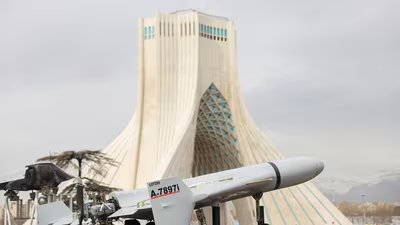
Fifteen days into the military conflict between the United States, backed by Israel, and Iran, bombing has continued across the Islamic Republic as well as West Asia. Tehran has responded by sending a swarm of low-cost Shahed drones across Israel and the Gulf states, targeting military installations and energy infrastructure in the region.
These drones are easier to deploy but difficult to destroy on the ground.
The United States has claimed that it is degrading Iran’s capacity to launch attacks is being weakened day by day.
Even so, the barrage of drone strikes has forced the US and its allies to use protection systems designed primarily to counter more advanced weapons.
Follow | Iran-US war live updates
ALSO READ | Why is Kharg Island crucial to Iran’s oil network? Inside ‘crown jewel’ struck by US as war escalates
Seemingly, the US did not fully expect the scale of Iran’s retaliation to strikes that have killed more than 1,400 people in the country, including former supreme leader Ayatollah Ali Khamenei.
Trump has been pressing Iran for “unconditional surrender”, yet Tehran has refused to give in. Instead, it has expanded the conflict into the Gulf, slowed the movement of oil and gas through the Strait of Hormuz, and pushed global energy prices sharply higher.
Former US officials and military specialists told the Financial Times that Iran has managed this by using intelligence inputs, lessons taken from Russia, satellite images and its geographical closeness to target American bases.
And the low-cost drones have played a big role in its retaliation so far.
Iran’s Shahed drones: Backbone of retaliation
Iranian forces have launched more than 3,000 missiles and drones towards US allies in the Gulf, along with hundreds directed at Israel.
Earlier this week, attacks struck tankers and merchant ships, an Omani port, areas near Dubai’s airport, an oil refinery in Abu Dhabi and Kuwait’s airport.
Many of these operations involve Iran’s one-way attack drones, including the Shaheds. These drones cost far less than the missiles that advanced US defence systems were built to intercept.
The drones run on motorcycle engines and carry warheads weighing between 25 and 50kg. In some cases, they are made using materials such as styrofoam.
They are much cheaper than missiles, easier to launch, and difficult to destroy on the ground, since launch rails can be fixed onto pickup trucks and moved quickly from one location to another. Experts told FT that these drones can strike precise targets using satellite navigation or even computer vision.
Unlike ballistic missiles, these drones fly close to the ground and do not follow fixed flight trajectories. They can move just above the surface of the Gulf, reducing their radar visibility, according to the report.
Yuri Lyamin, from the Moscow-based Centre for Analysis of Strategies and Technologies, told the publication that Iran’s early attacks appeared to be aimed “primarily at blinding US forces and their allies in the region by destroying various radars”.
ALSO READ | US made a ‘tactical error’ that is costing them heavily in war against Iran
Fighting US-Israel’s expensive systems
The relatively low price and accurate targeting of Iranian suicide drones make it easier for Iran to deploy them in large numbers. The US and its regional partners use a network of THAAD, Patriot and other air defence systems to shoot down missiles, drones and rockets launched by Iran and its allied militias across the region.
These air defence systems depend on radar to detect incoming threats. The equipment involved is often rare and extremely costly. The conflict has also used up a large number of US interceptor missiles deployed to stop incoming attacks, The Wall Street Journal reported.
Let’s talk numbers
A Shahed-136 costs around $20,000.
In comparison, a Patriot missile used by the US for defence costs about $4 million, according to the Council on Foreign Relations in the US.
This means that even when an Iranian drone is shot down, the cost of interception places a heavy financial burden on the country’s enemies. This has been described as “using a bazooka to kill a fly”.
One of the major strikes targeted an advanced early warning radar system at Qatar’s Al-Udeid, which hosts the largest American military base in the region. The strike damaged the AN/FPS-132 radar and affected how it operates, WSJ reported citing satellite images and a US official.
Notably, the AN/FPS-132 is a wide-aperture radar that can track multiple targets simultaneously.
The US has five of these fixed radar systems as part of its North American warning network, which is meant to protect the country from possible incoming missiles, according to the International Institute for Strategic Studies, a defence think tank.
Each of these systems can cost up to a billion dollars.
Iran is now launching fewer missiles compared to the first wave of attacks carried out after the US and Israeli offensive. However, its drone strikes have largely continued at a steady pace.
During the first two days of the conflict, Iran launched more than 500 drones. After that, the UAE has continued to face over 100 drone attacks each day, according to its defence ministry.
Iran is believed to be capable of producing thousands of drones. It has also exported these drones to Russia. Moscow has used Iranian drones, along with similar versions produced in Russia, in its strikes on Ukraine.
Russia’s experience with drones also helping Iran?
Experts say Iran has learned from Russia’s wartime use of a version of the Shahed drones in Ukraine.
Lyamin told FT that Iran learned to launch drones toward the same target along different paths rather than sending them in tight groups, making them harder to intercept.
Some Iranian drones also appear to include Russian technology that helps them resist jamming, Fabian Hoffman, a missile warfare expert at the University of Oslo, told the publication.
Experts say, and Iran has also repeatedly warned, that some of Tehran’s most advanced missiles and drones have not yet been used in the conflict. This includes the Qassem Basir, a hypersonic missile that uses optical guidance, although Iran is believed to have only a small number of them.
With inputs from agencies