
If you’re going to make a darkly comic television show about seemingly wholesome people thrust into lives of escalating criminality in response to the desperate state of the American Dream, becoming the next Breaking Bad is a logical aspiration.
But maybe you don’t want to pay homage as early and aggressively as director Trent O’Donnell does in Sunny Nights, a new Australian/American crime comedy premiering on Hulu.
Sunny Nights
The Bottom Line
Violent, funny and energetic, if not always fresh.
Airdate: Wednesday, March 11 (Hulu)
Cast: Will Forte, D’Arcy Carden, Rachel House, Jessica De Gouw, Megan Wilding, Ra Chapman, Willie Mason
Creators: Nick Keetch and Ty Freer
Multiple early episodes of Sunny Nights, which premiered on Australia’s Stan in December, have cold opens that practically force the Breaking Bad comparison — including an elaborate POV sequence inside the mouth of a character we know is about to have a tooth forcibly extracted for an unpaid debt, as well as a cheeky montage set to the retro hopefulness of Hal David and Burt Bacharach’s “Wishin’ and Hopin’.”
It’s just not a comparison in which Sunny Nights is likely to come out on top.
The Gilligan-esque cold opens prove not to be a consistent stylistic choice after those initial episodes, allowing Sunny Nights to carve out a place not with Breaking Bad itself, but with the more recent heirs to Breaking Bad (possibly even the heirs to the heirs of Breaking Bad, since TV rushes through generations at a precarious pace) — shows like Peacock’s Killing It and Hulu’s Deli Boys, blending anarchic comedy, sympathetic characterization and unavoidable self-awareness.
Perhaps not as smart or as scathing as the best of this group, Sunny Nights has a pair of likable leads in Will Forte and D’Arcy Carden, a nicely utilized Sydney setting and, dipping into the Australian casting pool, a deep ensemble of fresh and interesting faces.
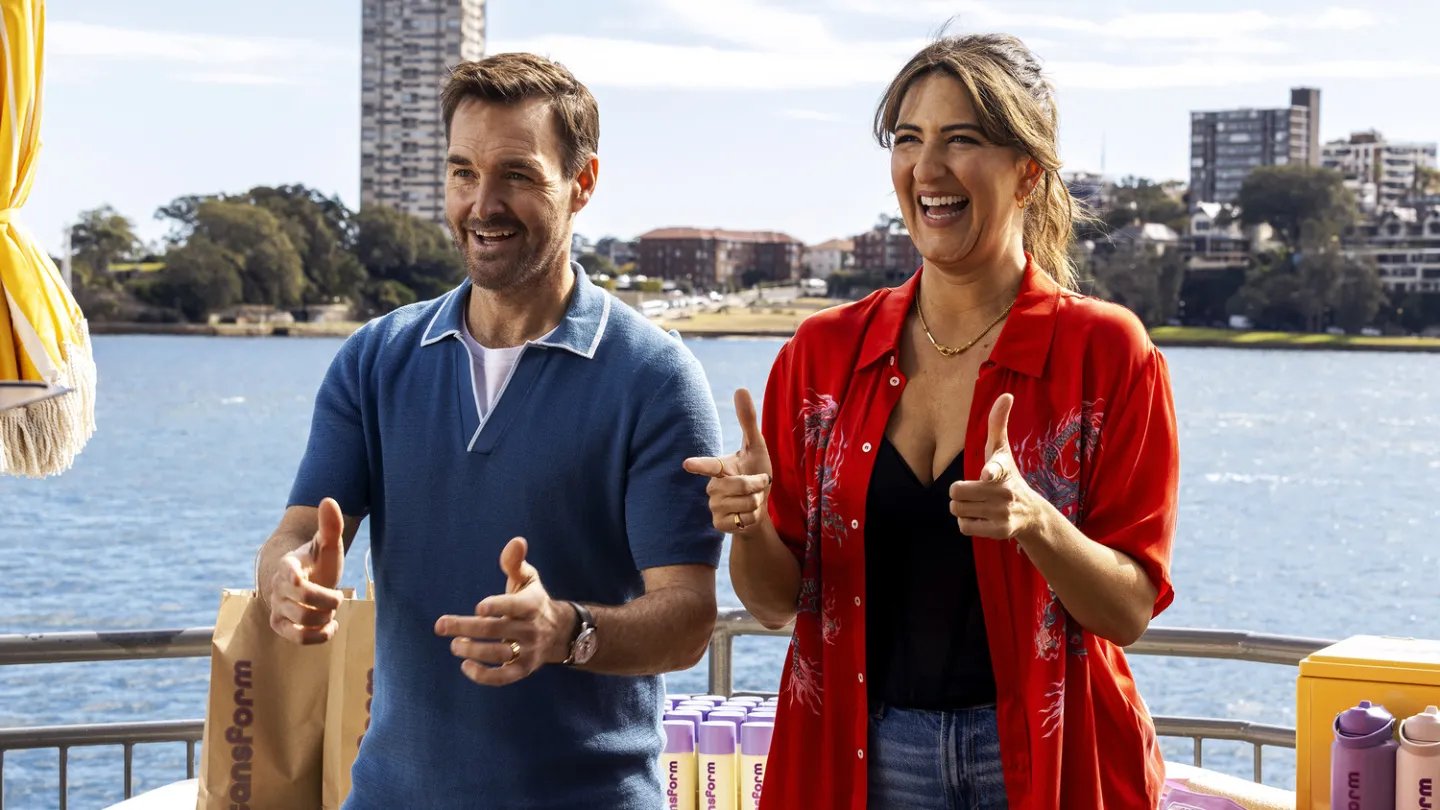
Forte and Carden play Martin and Vicki Marvin, weirdly co-dependent siblings who move from Indiana to Sydney to help launch a new spray-tan product produced from the maqui berry. They’re pitching Tansform with the tagline “Transform with Tansform and be the best version of yourself,” an appropriately on-the-nose slogan for a series in which every character is, with increased desperation, attempting to be the best version of themselves.
Martin has transitioned into the beauty space after a 20-year career as a risk analyst. This is, as the Vocational Irony Narrative format requires, the first time he has taken a real risk in his life. They’re in Australia because of the potent Australian sun, but also because this is where Martin’s wife (Ra Chapman’s Joyce) returned after convincing herself that he would never reach the life they once aspired to.
The family’s black sheep, Vicki has a complicated past, dabbling in various petty crimes, but she’s hoping that if Tansform succeeds, she might finally win the respect of their largely off-screen (minus one worthy phone cameo) mother.
Martin and Vicki are a strange pairing. People are either confusing them for a married couple or else being a bit grossed out by their closeness, but they’re a solid business partnership. Just as they make their first in-roads, Martin falls for Susi (Jessica De Gouw), a honey trap working with low-level mobster Kash (Miritana Hughes), which leads to blackmail and then an act of shocking violence.
Soon, Martin and Vicki are scoring small victories at business, while dealing with escalating threats from Kash’s unhinged sister (Rachel House‘s Mony) and uneasy alliances with Susi, who dreams of reacquiring the old family hotel, and Terry (Willie Mason), a former rugby star turned opioid addicted enforcer.
Meanwhile, Joyce, a reporter stuck doing clickbait listicles for a bubbly Gen Z boss, begins poking around into a story about an exploding crocodile, an unexpected phenomenon that could put our desperately striving protagonists in further jeopardy.
Can Martin and Vicki make it out alive in time to strike it rich?
Sunny Nights, which takes its name from the dingy, pink stucco-coated motel that’s a base of operations for the siblings and various less savory types, was created by Nick Keetch and Ty Freer and, with the exception of a confusing shared credit on one of eight episodes, directed entirely by O’Donnell.
It obviously isn’t a wholly fresh concept. In addition to Killing It (comparisons made more obvious by the reptilian element, as well as an appearance in the first episode by Claudia O’Doherty) and Deli Boys (Poorna Jagannathan’s Lucky and House’s Mony would wreak havoc if their paths ever intersected), comparisons could include FX’s Sydney-set Mr. Inbetween, as well as more mystery-driven dark comedies like Netflix’s recent How to Get to Heaven from Belfast and Amazon’s Deadloch. They’re all shows that aim to make you laugh, while at the same time adding the discomfort of bursts of extreme violence.
Here, you have exploding crocodiles, forcible tooth removal, waterboarding and miscellaneous bludgeonings and brandings. The joke, though, is that the consumer world is every bit as vicious. Vicki and Martin are able to face several kinds of torture, but they’re not prepared to fall victim to a rival beauty company’s BOGO deal. They’re much more frustrated by the demands of unscrupulous bankers and loan officers than nefarious money lenders.
The transplanting of the story to Australia strips away some of the specificity that American-set shows in the genre have had. Sunny Nights picks and chooses which aspects of Tansform’s business plan are “realistic” for two Yanks working abroad, much less in the series’ allotment of time. But the show makes up for those failings with scenes set on Bondi Beach or references to Tim Tams. It’s a lived-in version of Australia, one unencumbered by tourist-y location hunting — approximately zero shots of the Sydney Opera House across eight hours — or dumb American tourist stereotypes. Instead, it’s all very matter-of-fact, from the heavily Indigenous cast to the fleeting appearances from O’Doherty or Colin From Accounts star Patrick Brammall.
The two American stars, the reason for Hulu to be giving this one a push, are both very good, using their respective comic personae to humorous effect but not schtick. Forte’s most recent hour-long was Netflix’s Bodkin, a decent mystery-comedy without many laughs or thrills, in which he was underplaying to the point of practically muting moments that might have read like punchlines in a script. He’s more comfortable with Martin’s good-natured Midwestern charm, pushing for laughs here and there, but going just as frequently for Everyman appeal and even notes of a convincing love story opposite Chapman. Carden gets to be more overtly funny as the live-wire Vicki, making her foolish, but usually foolish in a way that’s grounded in her youthful damage. It’s a good central collaboration.
The supporting cast is peppered with very good supporting performances led by De Gouw, amusing, striking and always more at ease in roles that don’t require an American accent, and Mason, like his character a former rugby star but delivering ample screen presence in his first acting role.
House, a Kiwi familiar from various Taika Waititi projects including the recent TV adaptation of Time Bandits, is a constance source of unexpected danger, while Hughes, George Mason and Matuse all get good moments as her variably bumbling henchmen.
Stealing more and more scenes as the show progresses is Megan Wilding as Nova, an animal control nepo-baby — she works for her uncle — who latches onto Joyce and becomes a dogged reporter herself. In a show filled with a wide range of morally and ethically questionable characters, Wilding makes Nova into possibly the story’s purest hero, single-handedly pushing the plot forward at certain points. Without ever using Tansform, she is transforming and becoming the best version of herself.
Sunny Nights needs a character like Nova because, especially in the middle of the season, the crime side of the narrative begins to spin its wheels, showing the strain of a story that might have been better-suited for six half-hour episodes instead of eight hour-longs.
The repetitive cycles of debt are presumably part of the show’s point, but it feels like Sunny Nights is playing some of the same beats over and over again, without necessarily raising dramatic or comedic stakes. The season picks up with a home stretch that’s characterized more by cynicism and looming threats than anything overt, setting up promising storylines for what I hope will be future installments.