
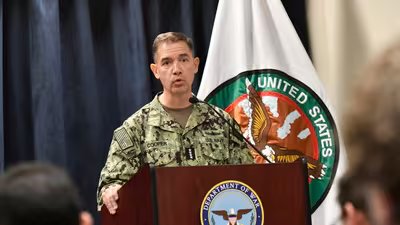
As a senior U.S. military leader in the Middle East in recent years, Adm. Brad Cooper has had Shabbat dinner with Israel’s military leader Eyal Zamir. He has been hosted by Mohamed bin Zayed Al Nahyan, the president of the U.A.E. And he has played basketball with Syrian President Ahmed al-Sharaa.
Described by his associates as a diplomat in uniform, the four-star commander, who is one of the most decorated officers in the U.S. military, is now leaning on relationships he has spent years cultivating across the region as he leads President Trump’s war against Iran—the most complex and high-risk U.S. military operation in a generation.
At a press conference last Thursday, Defense Secretary Pete Hegseth praised Cooper, 58 years old, for his leadership and focus. “This is the kind of no-nonsense, results-driven warfighting that America demands, and you’re delivering it in spades,” Hegseth said. “You are the man for this moment.”
In video releases giving operational updates, Cooper has listed Operation Epic Fury’s latest achievements: striking more than 5,500 targets, sinking more than 60 Iranian ships and smashing Tehran’s ballistic missiles and drone programs.
“U.S. combat power is building. Iranian combat power is declining,” Cooper said in a video message Wednesday. “We remain centered on very clear military objectives in eliminating Iran’s ability to project power against Americans and against its neighbors.”
As the war continues, public polling shows most Americans oppose the operation. Seven American servicemembers have been killed and eight seriously wounded in Iran’s retaliatory strikes. U.S. military investigators believe it is likely that American forces were the cause of a deadly attack on a girls’ school in southern Iran in the earliest waves of strikes, which Iranian authorities say killed dozens of children. Trump advisers have privately urged the president to find a quick exit amid spiking oil prices and concerns that the war could hurt Republicans in November’s midterms.
For his part, Cooper, who declined to be interviewed for this article, is staying out of the politics of the war and remains focused on waging it, his associates say. He talks constantly with Gen. Dan Caine, the chairman of the Joint Chiefs of Staff and the president’s most senior military adviser, according to a U.S. official. He squeezes in short workouts and meetings, and still manages to appear upbeat and well-rested despite getting very little sleep, the official said.
Those who have served alongside him in the Middle East and other parts of the world say Cooper is thoughtful, decisive and cool under pressure.
“When Brad Cooper calls you in the middle of the night with a problem, he will have thought it through, he will be able to explain it, and he will have a solution,” said retired Gen. Frank McKenzie, who served as head of U.S. Central Command, which oversees the U.S. military in the Middle East, while Cooper commanded naval forces in the region in 2021.
Others say his upbeat personality can give the impression that Cooper is overly optimistic.
“He doesn’t show any signs of the pressure. He’s not tired. He’s not out of shape. I think he almost thrives in the pressure,” said retired Navy Capt. Michael Brasseur, who led a robotics and AI task force under Cooper in the Middle East and is now chief strategy officer at Saab, Inc. “He does not hand-wave the critics in the room, he takes everything into account and adjusts the plan. But personally, that [optimism] is one of my favorite qualities about him.”
The son of an Army officer who fought in the Vietnam War, Cooper was well acquainted with military strategy from a young age, friends and former classmates say.
During his first year at the U.S. Naval Academy, he impressed his peers when he was being grilled on the concept of a battlegroup in the dining hall. Cooper climbed onto a table and began moving ketchup bottles, utensils and cups around as if they were different types of ships and military equipment engaged in a real-world scenario.
“He was a very sharp plebe, a very intelligent young man,” said retired Navy officer Gregory Glaros, the company commander often quizzing Cooper at the academy. “The dining table scenario showed his acuity and his knowledge of the use of force from a very young age.”
After graduating in 1989, Cooper participated in the 1991 Gulf War, three counter-narcotic deployments off the coast of South America, a deployment to the North Arabian Sea immediately after the Sept. 11, 2001 attacks, and operations against the Taliban in Afghanistan. He has served in every military theater of operations, from Africa to the Pacific, and in the Pentagon as the Navy’s chief of legislative affairs.
In 2021, he was confirmed as the commander of U.S. naval forces in the Middle East, a position that put him in Bahrain just 150 miles from Iran’s coast. There, he got a front-row seat to the Iranian regime’s tactics, capabilities and threats—an understanding that is helping to inform his decisions today, his associates say.
While in the Middle East, Cooper led efforts to intercept military equipment that Iran was smuggling to its proxy groups throughout the region. He worked to deepen military cooperation between Gulf states and Israel following the Abraham Accords. And he led a maritime coalition of more than 30 nations, which allowed him to foster relationships with leaders across the region.
In the early days of the Biden administration, Dana Stroul, who oversaw Middle East policy in the Pentagon, recalled attending a dinner at Cooper’s home in Bahrain with local defense and military officials. He served an Indian-style meal, with a mixed grill and a variety of curries, and no alcohol. Alcohol is illegal for Muslims.
“It was clear he had mastered how to build ties and create an atmosphere where people could break bread together and felt like they were getting access to him,” Stroul said. “He just catered to the cultural context.”
When the Iran-backed Houthis first fired drones and missiles into the Red Sea from Yemen in 2023, opening up a new front in the conflict between Hamas and Israel, it was Cooper who made the call for a U.S. warship to shoot down the attack. A Navy officer who worked alongside him that night said that Cooper stayed with his team for the 10-hour standoff, and that he wanted to personally assume the risk in case the situation deteriorated or the conflict expanded.
Cooper has also embraced cutting-edge technologies to counter Iran. In Bahrain, he championed an effort known as Task Force 59, which paired uncrewed boats and other drones with artificial intelligence to expand the Navy’s eyes and ears in the Gulf.
Cooper brought that instinct to Centcom’s headquarters in Florida last summer when he took over the command. One of his first initiatives was to deploy a new squadron of one-way attack drones copied from a widely used Iranian version, the Shahed-136. Cooper said the U.S. used the drones in the opening hours of Epic Fury, turning Iran’s own design against the regime.
Cooper has also touted the use of artificial intelligence and space tools to fight Iran. In the Wednesday video, he said AI is being used to sift through vast amounts of data in seconds so that U.S. leaders can make decisions faster than the enemy can react.
“Brad has figured out how to work with the most innovative parts of the Defense Department,” said Doug Beck, a former Apple executive who led the Pentagon’s Defense Innovation Unit. “Get that talent, figure out the operational problem, use the technology to solve that problem, and build it into operations so that you’re actually doing it rather than just talking about it.”
Not all of the operations Cooper has been involved with have succeeded. When the Biden administration asked Centcom to find a way to get more humanitarian aid to Gaza in 2024, Cooper, then the deputy commander, was part of the initiative to build a floating pier off the enclave. The pier was widely viewed as a failure: It repeatedly broke apart due to bad weather, was operational for only 20 days and cost $230 million.
After Cooper helped orchestrate Operation Midnight Hammer to bomb Iran’s nuclear facilities last June, he took over as the chief of Centcom in August. He was tasked with stabilizing Gaza, supporting a delicate political transition in Syria and planning for another potential conflict with Iran, U.S. officials said. In January, he moved warships, aircraft and air defenses to the region in preparation for Epic Fury.
Despite the preparations, Iran has managed to choke off shipping in the oil-rich Gulf, damage civilian infrastructure across the region and attack American air defenses and bases with deadly consequences. On Sunday after the strikes began, a one-way attack drone hit a tactical-operations center at a commercial port in Kuwait, killing six American servicemembers and seriously wounding others.
Critics have said the Pentagon should have been more prepared for the damage Iran could cause with its drone strikes.
“Iran has had success with the Shaheds—more than I would have anticipated,” said retired Vice Adm. John Miller, who formerly commanded the Navy in the Middle East. Centcom and Gulf partners have had to adjust “to the fact that Iran is sending the drones anywhere they think they can get a hit and have an effect.”
Cooper was at his Tampa headquarters when he was informed by Lt. Gen. Patrick Frank, his deputy, of the lethal strike in Kuwait. The news hardened Cooper’s resolve to see the conflict through, his associate said.
“We’re on a path to eliminating Iran’s ability to threaten Americans and our friends, and we are achieving this through a combination of lethality, precision and rapid innovation,” Cooper said in his video message on March 11.
Write to Shelby Holliday at shelby.holliday@wsj.com and Lara Seligman at lara.seligman@wsj.com