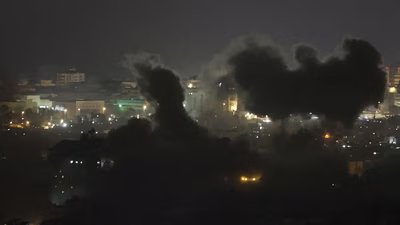
Beirut: Christians in Lebanon are watching their country burn. Again. After Israeli airstrikes pounded Beirut’s southern suburbs last week, displacement orders were issued for entire neighborhoods, and the roads out of southern Lebanon were choked with fleeing families.
Smoke rises after Israeli strikes following an escalation between Hezbollah and Israel amid the U.S.-Israeli conflict with Iran, in Beirut’s southern suburbs, Lebanon, March 12, 2026. REUTERS/Khalil Ashawi (REUTERS)
The trigger was one the population has seen many times. On March 2, after the killing of Iranian Supreme Leader Ali Khamenei in U.S.-Israeli strikes a few days prior, Hezbollah launched missiles and drones toward Israel. Lebanon is again suffering the military escalation of decisions made beyond its borders.
Lebanon is the only Arab country founded on a formal power-sharing system in which Christians serve not merely as a minority to be accommodated but as co-architects of the state. That delicate balance has been under pressure for decades. The pressure on Lebanon has defined the nation since Hezbollah consolidated dominance as Iran’s most successful regional proxy—which began when it joined the Lebanese Parliament in 1992. The terrorist organization now shapes Lebanon’s security and foreign policy through a military force that sits outside state control.
Lebanon’s Christian population was once central to the country’s political and economic life. But sustained waves of emigration—driven by insecurity, economic collapse and political marginalization—have shrunk that role. What was once a confident founding community has become increasingly cautious, reactive and demographically diminished.
Lebanon isn’t alone in this trajectory. Across Iran’s sphere of influence Christian communities have experienced demographic collapse. In Iraq the Christian population fell from about 1.5 million in 2003 to an estimated 250,000 today. In Syria more than half of the Christian population is estimated to have left since 2011, caught between regime violence, Iranian-backed militias, jihadist factions and competing foreign powers.
In Lebanon the erosion has been slower but profound. Hezbollah’s dominance has meant that decisions of war and peace aren’t made by the sovereign state, and everyone has to learn to live with uncertainty. Minorities without militias of their own have had to learn it fastest.
This is why many Lebanese Christians hope for structural change in Iran. Hezbollah’s military capacity, financial networks and ideological legitimacy are inseparable from Tehran, and any significant transformation inside Iran would weaken the organization’s power in Lebanon.
In an extraordinary step, following the latest cross-border attacks, Lebanon’s cabinet reportedly moved on March 2 to outlaw Hezbollah’s military activities—a signal of how urgently the state is trying to reclaim decision-making and avert national catastrophe.
The problem is that any attempt to constrain Hezbollah by decree risks widening sectarian tensions, particularly if it draws the Lebanese military into direct confrontation with armed and heavily embedded Hezbollah. The country can’t afford another round of internal violence layered onto regional war.
Washington needs to respond with firmness. Iran’s regional footprint has too often functioned as a governance model: empower armed partners to override state authority, distort economies and intimidate political life. When that model hardens, pluralistic societies become less governable and less livable.
The U.S. Congress should target the financing networks that keep Hezbollah operational even in its weakened state. And the Trump administration should recognize that ordinary Lebanese—hotel owners, families, small-business owners—are furious that Hezbollah has dragged their country into a war that isn’t theirs.
In churches across Lebanon, prayers for peace increasingly carry another plea: that Lebanon not be used as a battlefield for other nations’ strategies. That armed groups not outrank elected institutions. That families not be forced to choose between staying and surviving.