
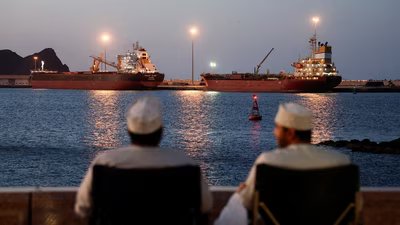
THE STRAIT of Hormuz is tricky for mariners at the best of times—narrow, shallow, congested and often hazy with humidity and dust. In times of conflict, it is a potential death-trap, overlooked by barren mountains and bereft of reliable navigational aids. Tankers carrying oil, refined fuels and liquefied natural gas (LNG) have all but stopped sailing through the passage since the start of Operation Epic Fury, the American and Israeli air war against Iran, brought a shuddering energy shock. Amid reports that Iran is preparing to mine the strait, can America clear the waterway by military force?
Donald Trump, the American president, has repeatedly threatened to escalate the war if Iran blocked the flow of oil. American forces have already sunk much of Iran’s navy, are trying to destroy the weaponry that could threaten shipping and on March 10th declared that the bombing would intensify. Mr Trump did not confirm reporting by CBS News and CNN that Iran was preparing to lay mines, or had started to do so, using small boats. But he warned Iran in a social-media post: “If for any reason mines were placed, and they are not removed forthwith, the Military consequences to Iran will be at a level never seen before.” He also claimed that ten “inactive” mine-laying boats had been destroyed.
The president has also promised to support ship -owners, both by helping to bring down insurance costs and proposing military escorts for tanker convoys. This is an echo of Operation Earnest Will in the 1980s, at the height of the Iran-Iraq war, when America reflagged Kuwaiti tankers and protected them in transit. On March 10th the American energy secretary, Chris Wright, posted and promptly deleted a message on social media claiming that a US warship had escorted a tanker. Meanwhile, European countries and Pakistan are also talking of sending escorts.
More than a quarter of global seaborne oil exports pass through the waterway. Unlike the Suez Canal, which has also been heavily disrupted by conflict, ships transporting fuel from the Gulf cannot avoid the Strait of Hormuz. Laden tankers are thus bunching up on the western side of the strait; empty ones on the east.
In the month leading up to the start of the war on February 28th, an average of 76 tankers sailed through the passage every day, according to data from Votexa, a market-intelligence firm. Since then only a brave handful—five or fewer a day—have run the gauntlet, hoping the profits will justify the risk. China is reported to be trying to negotiate safe passage for its ships, so far to little avail.
The threat from Iran, which has long prepared for such strife, comes in many forms. In the air, it can use ballistic and cruise missiles, as well as drones. On the sea it has fast-attack boats armed with missiles, explosives or rocket-propelled grenades. Under the waves, it can deploy thousands of sea mines and unmanned vehicles, not to mention divers who can place limpet mines on ships at anchor. How much of this has been destroyed is unclear. Several ships have already been attacked, though the circumstances are not always clear.
Read all of our coverage on the war in the Middle East
Mr Trump has urged ship owners to “show some guts”. But American warships also seem wary. The protected convoys have yet to be formed. “The one thing I wouldn’t do right now is do a convoy until the conditions are set,” says Mark Montgomery, a former American rear-admiral now at the Foundation for Defence of Democracies, a hawkish think-tank in Washington, DC. American forces have not yet reduced Iran’s capabilities to the point at which escorts can deal with remaining threats. In any case, he adds, American destroyers used for air defence are mostly busy protecting aircraft-carriers in the region. If convoys materialise, says Mr Montgomery, they will involve constant surveillance, war planes and armed helicopters overhead, and escorts by newly deployed destroyers. It will not be easy, or cheap.
During the Gaza war the Houthis, a militia in Yemen allied to Iran, stopped much of the sea traffic in the Red Sea and Suez Canal by threatening ships in the Bab al-Mandab strait with fairly cheap drones and missiles. American struggled last year to destroy their forces and re-open the strait, and even lost of aircraft that fell off carriers as they dodged Houthi attacks. It ended with a partial ceasefire. Traffic has yet to return to pre-crisis levels, and the Houthis have vowed to resume attacks in solidarity with Iran.
Maritime chokepoints favour the defender. In the past American commanders have said they would be able to re-open the strait within days or weeks, were Iran to attempt to close it. But experts point to the cautionary tale of Britain’s failed campaign in the first world war to force open the Dardenelles, part of the passage between the Black Sea and the Mediterranean. Ottoman forces had laid down complex defences consisting of mines, fortresses and mobile artillery. The allies lost several ships trying to fight their way through from the sea. The Gallipoli landings to seize the passage by land turned into an even bloodier debacle.
Iran, though pummelled from the air, also enjoys layered defences and forbidding terrain in the Strait of Hormuz, notes Jonathan Schroden of the Centre for Naval Analyses, another American think-tank. “You have to peel the layers of the onion,” he says. “If Iran were to mine the straits you would first have to tackle the missiles and the drones and the fast boats before you would go after the mines.” And today, as in 1915, minesweepers are poorly protected and would struggle to operate under fire. America is replacing wooden-hulled minesweepers with littoral-combat ships carrying mine-warfare “packages”, including unmanned drones, though some worry the concept is untested.
In the Dardanelles as in the Strait of Hormuz, notes Caitlin Talmadge, a professor at the Massachusetts Institute of Technology, geography allows the defender to draw enemy vessels close to its shores, where they can more easily be attacked. “Some of the weapons have changed—I am more worried about projectiles than mines—but the concept has not changed,” she says.
America’s technological advantages are blunted in confined waters. Drones and missiles take less time to reach their targets, for instance. Moreover, warships are in some ways more vulnerable to damage than larger tankers. Unlike modern oil tankers, destroyers have single hulls, so are easier to sink; and their superstructure carries expensive equipment, such as air-defence radars. In the 1980s, escort ships typically sailed behind tankers, not in front of them, to avoid being damaged by mines.
A big difference with Operation Earnest Will, says Professor Talmadge, is that in the 1980s Iran was seeking to avoid all-out war with America at sea, despite various clashes, as it struggled to hold back Iraqi forces on land. “The idea that Iran will be restrained because of fear of escalation seems fanciful,” she argues, “It’s already engaged in an existential war for regime survival.”
Alarmed about the economic and financial impact of the oil crisis, Mr Trump has in recent days mixed words of reassurance with his threats. He announced on March 9th that the conflict will stop “very soon”. That soothed markets for a time. But having survived the American-Israeli onslaught, the remnants of the clerical regime seem determined to set the terms for how the war ends. If it has mined the Strait of Hormuz, Mr Trump may find it impossible to declare victory quickly.