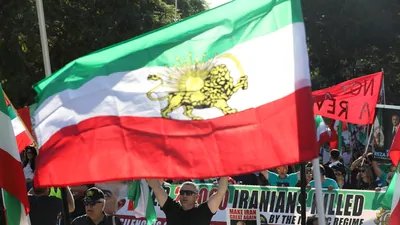
Roozbeh farahanipour was at his Greek taverna in Westwood when he heard reports that Ayatollah Ali Khamenei was dead. At first, Mr Farahanipour was suspicious. After leading a student uprising in 1999, he fled Iran and has spent decades in Los Angeles hoping that the supreme leader would one day get his comeuppance. Then President Donald Trump confirmed the killing on his social-media network. “I grab the bottle of champagne and open it and drink it out,” recalls Mr Farahanipour. A crowd gathered nearby, waving Iranian, Israeli and American flags. “If anybody passed by, came to congratulate me, I poured the champagne for them.”
(File photo). People march in support of nationwide protests in Iran, Los Angeles, California, earlier this year with a banner at the back noting that several Iranians have been killed. REUTERS/Jill Connelly (REUTERS)
Half of all Iranian-Americans live in California. Nearly a third—about 230,000 people—are in the Los Angeles area. Many arrived after the revolution in 1979, particularly Iranian Jews. These first émigrés were often wealthy and highly educated. They settled in Westwood and Beverly Hills and, little by little, built “Tehrangeles”. So when America began bombing Iran last month, Westwood Boulevard became the place where Iranian-Americans voiced their support and hope for the future. A Mediterranean grill boasts a “Make Iran Great Again” sign in its window. A Persian bookstore displays a photo of Reza Pahlavi, the son of the deposed shah and an opposition figure. Beside it hangs a poster that reads: “Regime change in Iran. No more ayatollahs. Islamic Republic must go.”
While many Iranian-Americans celebrate Khamenei’s death and hope for regime change, they are divided over how involved America should be in that process. Like Iran itself, the diaspora is multi-ethnic, multi-religious and, at this point, multi-generational. The contingent most supportive of Mr Trump viewed the 2015 nuclear deal with Iran, negotiated by the Obama administration, as a betrayal. They believe the Trump administration should stay the course until the regime—specifically its most powerful security force, the Islamic Revolutionary Guard Corps—is crippled. “This is not the right time to leave the Iranian people alone,” argues Elham Yaghoubian, an activist and local business leader in Beverly Hills. She wears a pendant in the shape of her native country around her neck.
Her longtime friend, Mr Farahanipour, represents a more sceptical camp. After Khamenei’s death, he says, “The US had a big chance to announce the victory and leave the conflict.” He wants the bombing to cease so Iranians in fallout shelters can take to the streets. The two are united, however, in their distaste for a Venezuela-like outcome, in which Mr Trump backs a more pliable member of the regime to take over. (The president has said Mojtaba Khamenei, the new supreme leader, is an “unacceptable” choice.) “Whoever’s hand is dirty with the blood of the people,” says Ms Yaghoubian, “they have no right to be…in control of the country.”
Enthusiasm for Mr Trump’s campaign may wane if the war drags on. Some of the American-born children of Iranians who left after the revolution are now in their 30s and 40s. Their formative political memories are not of the regime, but of America’s forever wars in Iraq and Afghanistan. Many worry that the Trump administration’s aggression will bring continued conflict rather than liberation. On Westwood Boulevard “Stop war” is spray-painted in bright red letters over photos of protesters killed by the regime in January.
The mood may already be shifting from celebratory to melancholy. On March 8th the denizens of Tehrangeles gathered at the University of California, Los Angeles, for a concert in advance of Nowruz, the Persian new year. The Iranshahr Orchestra’s first piece was a funeral march in honour of the protesters. The composer, Shahab Paranj, offered the crowd a few words: “We feel the sorrow, we share the concern, and we remain hopeful.”