
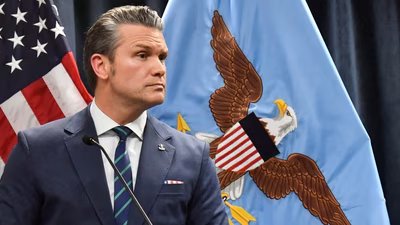
United States Secretary of War Pete Hegseth has stated that Washington is “not concerned” about reports suggesting that Russia is supplying Iran with intelligence regarding troop positions and movements in the region.
In an interview with Major Garrett for CBS’s “60 Minutes” airing this Sunday, Hegseth declined to officially confirm the reports but maintained that the military is fully apprised of the situation. He noted that the US is “tracking everything” and ensuring that such data is factored into current battle strategies.
Hegseth emphasised the strength of the nation’s surveillance capabilities, asserting that “Our commanders are aware of everything.” He further added that, “We have the best intelligence in the world. We’re aware of who’s talking to whom.”
Addressing potential threats to US personnel arising from these reports, Hegseth reassured the public that the administration is prepared to handle any intelligence leaks. “We’re not concerned about that,” he stated, adding that “We mitigate it as we need to.”
Hegseth also highlighted that President Donald Trump is being kept informed of these developments. “The American people can rest assured their commander-in-chief is well aware of who’s talking to who,” he said.
Hegseth warned that any illicit cooperation between foreign powers would meet a firm response from the US. “And anything that shouldn’t be happening, whether it’s in public or back-channelled, is being confronted and confronted strongly,” he remarked.
These remarks follow reports that Russia has been providing Iran with intelligence regarding the positions and movements of American personnel, vessels, and aircraft. According to sources familiar with US intelligence reporting on the matter, CNN reports that this development marks the initial sign of Moscow’s direct involvement in the ongoing conflict.
A significant portion of the shared data reportedly consists of imagery from Moscow’s advanced network of overhead satellites. While the nature of the information is clear, it remains uncertain what compensation Russia is receiving for this support. CNN has reached out to both the Kremlin and the Russian Embassy in Washington for comment on the matter.
Although a report from the Washington Post first highlighted this intelligence sharing, it is not yet confirmed if specific Iranian strikes can be directly attributed to Russian data. However, several Iranian drones have recently targeted areas where US forces were stationed.
CNN previously reported that an Iranian drone strike on a makeshift facility in Kuwait on Sunday resulted in the deaths of six US service members. One source briefed on the matter remarked, “This shows Russia still likes Iran very much.”
Beyond Russian involvement, there are indications that China might be preparing to offer Iran financial aid, equipment parts, and missile components. While Beijing has avoided direct involvement in the war so far, it remains heavily dependent on Iranian oil and has reportedly pressured Tehran to ensure safe passage for ships through the Strait of Hormuz.
One source familiar with the situation told CNN that “China is more cautious in its support. It wants the war to end because it endangers their energy supply.” The CIA has declined to offer a statement, and the Chinese Embassy in Washington has been asked for comment regarding potential assistance to Iran.
Despite these reports of foreign involvement, Hegseth informed reporters on Wednesday that Russia and China are “not really a factor” in the conflict. This comes as the military partnership between Russia and Iran has grown over the last three years, specifically concerning missile and drone technology.
This cooperation includes Iran supplying Shahed drones and ballistic missiles for use in Ukraine, as well as helping establish a drone manufacturing facility within Russia. In exchange, Iran has sought Russian assistance to advance its nuclear programme.
Currently, the US military operation against Iran involves over 50,000 troops, 200 fighter jets, and two aircraft carriers. CENTCOM Commander Adm. Brad Cooper noted this week that the primary military objective is to dismantle Iran’s ballistic missile capabilities.
Hegseth stated that Iran has been utilising these capabilities as a “shield” to further its nuclear ambitions.