
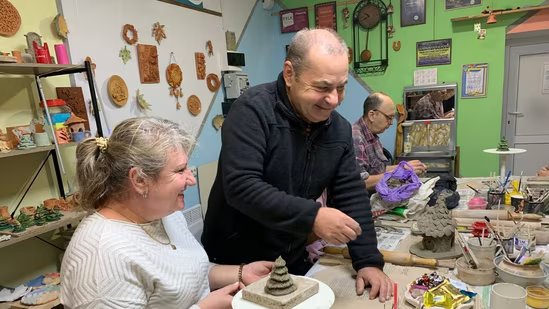
At least three times a week, Oleksandr Ryabov climbs into a bomb shelter in the southern Ukrainian city of Bashtanka and waits for his students to arrive.
They file in and out throughout the day, a diverse group that includes a banker, an engineer, a retired boat captain and children. Many of them are displaced from nearby cities occupied or ravaged by Russian forces.
They’re all there to learn how to sculpt, but the class serves another purpose: to distract from the air-raid sirens, blackouts, drones and repeated shellings that have become part of their daily lives since Russian troops crossed the border three years ago. The two-hour sessions sometimes run long, as the class waits for the all-clear signal.
“In the shelter, you can hear the bombs and planes outside,” said Ryabov. “It’s a coping mechanism that takes their minds off the attacks.”
Ryabov, 61, has been a fixture in Ukraine’s art scene since the early 1990s. He started doing pottery when he was 5, sculpting bread dough in his mother’s kitchen. Before the war he crafted pieces out of his home. He went to work as a pottery master for the Bashtanka House of Culture about a year and a half ago, and has been teaching classes there ever since.
To keep himself and his students safe, the classes are held in the arts-and-crafts center’s basement, which doubles as a bomb shelter during attacks. With funds from a wartime grant, a small room off the main space was outfitted with pottery wheels, work tables and a kiln, and stocked with blocks of clay, paint and other art supplies. The full shelter holds up to 150 people. The studio is just big enough for 15 students at a time.

Tetiana Anatoliivna Kostruzka, a 43-year-old financier who worked in a regional tax office before the war, started taking classes late last year. Since then she’s made vases, pots and napkin holders, among other items. “I really like this, working with clay,” Kostruzka said. “Clay is silent, it’s soft and it’s so calming.”
Viktor Butenko fled Kherson after living for nine months under Russian occupation and settled in Bashtanka in December 2022. The retired river-fleet captain joined the class about a year ago and says he likes making miniature lighthouses because they remind him of his former life on the river.
“I have always loved crafting things with my own hands,” said Butenko, 62, who also makes candleholders that he says come in handy during frequent blackouts.
Olha Viktorivna Cherednychenko initially visited the pottery shelter out of curiosity. The retired ecology teacher said she just wanted to find out for herself what people do in the shelter. “But when I picked up the clay,” she said, “I felt the soul of this clay and I wanted to make something myself.”
She has been sculpting tiny horses to celebrate the coming Year of the Horse. “I cannot say that they are complex,” she said.

Viktoriia Bondarenko remembers working with clay as a child and was immediately drawn to the shelter classes. Despite the location, the studio has a “very warm atmosphere,” said Bondarenko, a retired accountant. She has made little cats, wreaths and ashtrays.
Ongoing electrical outages that keep the kiln from operating, among other issues, makes the work challenging, said Svitlana Silina, a 73-year-old retired forestry engineer. Persistent blackouts have left many pieces unfinished, including candleholders and aromatherapy huts.
A Monday class was recently canceled after a missile attack on neighboring Odesa cut power throughout the city.
“There is a constant threat,” said Inna Homerska, a Bashtanka city council secretary and acting head of community. When air-raid sirens go off, many residents go down to their basements, “but if you’re working downtown you go to one of the central shelters,” she said. Residents can be stuck underground for several hours before the all-clear is sounded.
Homerska said the wartime pottery program reflects the defiant spirit of the city, whose residents in early 2022 took up arms—including hunting rifles and Molotov cocktails—to chase off hundreds of invading Russian troops.
That defiance includes displaying their fragile ceramics in the aboveground House of Culture, along with Ryabov’s own work, which survived a rocket attack last summer that damaged several buildings across the city.


But as the war stretches on, fewer children are showing up. Ryabov said the ever-present danger has led parents to pull them out of the program.
Because the better pieces are presented to visiting dignitaries—or sold in craft fairs to raise money for the Ukraine military—Ryabov is worried about running low. “We need to build up a stockpile of items,” he said.
Polina, a 13-year-old primary school student, continues to attend the shelter classes regularly, making cups, plates and other household pieces. Despite her age, Ryabov said, Polina shows advanced skills with the pottery wheel and has a good feel for the right thickness and balance of clay. Polina said in a few years, she plans to start selling her pieces on Instagram.
“After people create something,” Ryabov said, “they go back home smiling.”
Write to Angus Loten at Angus.Loten@wsj.com