
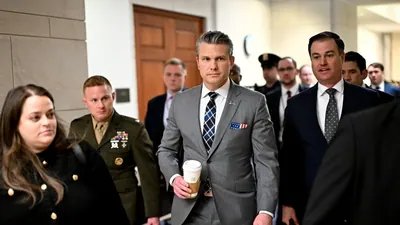
WASHINGTON—President Trump spent an enormous amount of political capital pushing for Senate confirmation of Pete Hegseth, who was pilloried over his personal problems and lack of experience running a major organization.
Now, Trump is leaning on his unconventional, made-for-TV defense secretary to sell his war in Iran to a weary public and an increasingly vocal faction of MAGA skeptics.
Hegseth, a former National Guardsman who served in Iraq and Afghanistan, and who went almost nine months without holding a Pentagon press briefing, has appeared at the lectern three times this week to forcefully defend the president from accusations he is dragging America into exactly the type of foreign conflict he had vowed to avoid.
“To the media outlets and political left screaming ‘endless wars’—stop. This is not Iraq. This is not endless,” Hegseth said Monday at the Pentagon “I was there for both. Our generation knows better, and so does this president.”
In the early months after Trump’s 2024 victory, Hegseth was one of the president’s most controversial cabinet picks. He squeezed through a bruising confirmation fight, batting down concerns about his inexperience and views on women in the military. He shared sensitive operational information in a Signal chat that inadvertently included a reporter. He fired several key members of his inner circle after infighting and leaks to the press. He stumbled on the world stage last year when he got ahead of the president on the issue of Ukraine and the North Atlantic Treaty Organization. And he has faced accusations of war crimes—which he has denied—for the U.S. strikes on alleged drug boats in the Caribbean.
But now, the battles that burnished Hegseth’s MAGA credentials make him an ideal spokesman for the war and help explain why Trump has continued to support the former Fox News host.
“Especially after the wars in Iraq and Afghanistan, Americans are rightly worried about getting into another prolonged conflict without clear objectives,” said Rosemary Kelanic, director of the Middle East of Defense Priorities, a group skeptical of U.S. military intervention abroad. “Relying on Hegseth to brief the press may give Trump more wiggle room to keep U.S. options open and the Iranians guessing as to the U.S.’s next moves.”
To be sure, Hegseth has yet to fully engage the press in a traditional sense. His briefings feature Trump-friendly news outlets who are assigned seats in the front two rows while reporters from large, mainstream outlets are relegated to the back. Those journalists rarely get a question in, while one reporter from a favored site asked him what his prayer was for troops in harm’s way.
At the same time, Hegseth’s frequent press engagements haven’t silenced the critics of the Iran strikes, many from Trump’s normally reliable MAGA base. Right-wing figures Megyn Kelly, Matt Walsh, Tucker Carlson and Erik Prince have criticized the war, as have far-right influencers Nick Fuentes and Alex Jones.
“This is horrifying,” Jones said. “I can’t sign on to covering up Epstein, I can’t sign on to World War Three,” he said in reference to the Jeffrey Epstein investigation.
Fuentes, meanwhile, called the strikes on Iran “an utter and complete betrayal.”
Even Republican senators have made clear that their support for Trump’s Iran strikes have a limit. Rep. Tim Burchett of Tennessee said Tuesday that MAGA voters should be concerned that the operation could become “another forever war.”
“Be concerned. Be vigilant. Hold our feet to the fire. Keep us honest on that issue,” Burchett said, when asked if he had a message for MAGA supporters.
Hegseth’s detractors, meanwhile, say that while he has laid out the military-only goals of the campaign, he hasn’t clearly explained the administration’s ultimate objective beyond destroying missile sites and smashing Iran’s navy.
“I have not yet seen a kind of persuasive explanation from the secretary of what the end goal is, and I think that that’s the primary missing piece of the administration’s public engagement around this issue,” said Suzanne Maloney of the Brookings Institution,a think tank.
Senior defense officials who spoke to The Wall Street Journal said that Hegseth’s role isn’t limited to appearing on TV, and as a veteran of Iraq and Afghanistan, he has made it his mission to be as involved as possible in this new conflict.
“My generation of veterans carried the names of brothers who never came home, brothers butchered by Iranian-backed roadside bombs and well-armed militias,” Hegseth said Monday. “We didn’t start this war, but under President Trump, we are finishing it.”
When he isn’t championing the operation to the public, Hegseth has been privately quarterbacking the U.S. plans to attack Iran and translating Trump’s goals to battlefield commanders, they say. He quickly became the main conduit between Trump and the Defense Department’s civilian and military leaders, the officials said, passing on the president’s thinking to the Joint Chiefs of Staff and civilian staff in the Pentagon, as well as to Adm. Brad Cooper, the head of U.S. Central Command, which is responsible for U.S. military operations in the Middle East.
Hegseth’s work appears to contrast with the common narrative that he focuses only on culture-war issues and exercise videos while other top officials including Secretary of State Marco Rubio, Trump’s special envoys, and even Army Secretary Dan Driscoll take part in the serious matters of high-stakes negotiations.
Senior Pentagon officials said Hegseth has been heavily involved in planning for the operation since shortly after America’s June strikes against Iran’s nuclear missile facilities, when U.S. negotiators came to believe that Iran wasn’t serious about reaching a deal.
While Hegseth has served as a translator of Trump’s political goals, he has avoided trying to micromanage operations. During press briefings, Hegseth has focused on political messaging while Joint Chiefs Chairman Gen. Dan Caine has communicated operational details.
“Hegseth has done a fantastic job empowering Gen. Caine to be the battlefield strategist,” said Sen. Tim Sheehy (R., Mont.), a former Navy SEAL who served in Iraq and Afghanistan and now sits on the Senate Armed Services Committee. “He’s a very hands-on leader who is out there getting amongst the troops, getting amongst the supply chain.”
As the U.S. was building up its military forces in the region, Hegseth participated in regular small-group meetings about the looming operation in the Oval Office with Trump, Rubio, and sometimes Israeli Prime Minister Benjamin Netanyahu, who phoned in, according to the senior Pentagon officials. The defense secretary also spent hours in private conversation with Cooper, they said.
But beyond the standard duties of defense secretary, it is his work in public that Trump is watching most closely.
“America is winning decisively, devastatingly and without mercy,” Hegseth said Wednesday at the Pentagon. “We are only four days into this, and the results have been incredible, historic, really. Only the United States of America could lead this, only us.”
Write to Lara Seligman at lara.seligman@wsj.com and Shelby Holliday at shelby.holliday@wsj.com