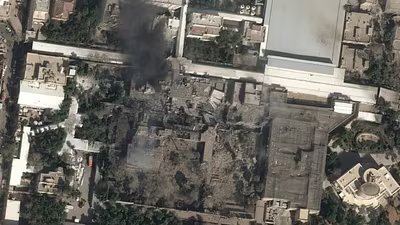
UNTIL HIS compound was obliterated by Israeli missiles at roughly 9:40am on February 28th, Ali Khamenei may have been the most tracked man in the world. The intelligence services of America and Israel had spent years analysing his movements and those of his entourage, as well as of Iranian officials reporting to him. They had known for days of two high-level meetings set to take place in Tehran on Saturday morning. The timing of these meetings explains why Israel and America began their war when they did.
A photo showing Iran Supremo Al Khamenei’s residence (Airbus via NYT)
With American forces massing, Iranian officials had been hoping to persuade their 86-year-old supreme leader to move into an underground bunker. The Israelis and Americans, in turn, were anxious that Iranian spies would learn of the impending strike. Israeli generals spent the evening before the attack at home and then used different cars from their usual ones to travel to their headquarters. America continued negotiating with Iran until 36 hours before the strike, with further talks planned. Before the war in June, the Israel Defence Forces (IDF) had evacuated key bases. They took no such action this time. And then they struck.
Decapitation has long been a core part of war. Other countries have attempted it in recent years. Volodymyr Zelensky has reportedly survived numerous assassination attempts since Russia invaded Ukraine in 2022. It is a strategy that relies on the sort of exquisite intelligence that Israel has shown it can gather. But even when successful, and theatrical, the long-term political consequences are questionable.
In Iran the assassination of Khamenei was the opening salvo of a war that has spread fast. America’s massive military build-up in the region raised the prospect of a protracted war. The decapitation operation may well have appealed to the American president as a quicker way to act. Israeli officers describe “an operational opportunity” to remove leaders, who could be replaced by others more open to making concessions. The model was America’s arrest of Nicolás Maduro in Venezuela, who was replaced by a leader more amenable to American demands.
Neither America nor Israel speaks about the sources of their intelligence (these assets are still being used to surveil the surviving Iranian leaders), though both are eager to take credit for the operation. Mr Trump paid tribute to “our Intelligence and Highly Sophisticated Tracking Systems” in his announcement of Khamenei’s killing and American officials told the New York Times that it was the CIA which had obtained the details of the meeting in Tehran and passed them to the Israelis. An IDF statement credited Israel’s military intelligence branch.
The reality is more complex. The two intelligence services spent months tracking Iran’s leaders and their aides, establishing their patterns of movement. Israel had already penetrated the higher echelons in Tehran, as shown by its assassination of Ismail Haniyeh, the leader of Hamas, in 2024 using an explosive device hidden in a guesthouse belonging to the Islamic Revolutionary Guards Corps, and by air strikes that killed nuclear scientists and IRGC commanders at the start of the war in June 2025.
But mistakes have been made, too. When Israel attacked a meeting of Hamas leaders in a villa in Doha, the Qatari capital, last September, the missiles hit the wrong room, missing the prime targets. This time nothing was left to chance. Khamenei’s compound was struck by 30 missiles and completely destroyed.
Both the build up to this war and Khamenei’s assassination involved a degree of co-operation between the American and Israeli intelligence services that is striking even for such close allies. Usually they are circumspect about sharing some of their unique capabilities. But last year, for the first time, the Americans provided the IDF with direct access to a live-feed from their surveillance satellites, having previously only handed over information on a need-to-know basis. Israel has a handful of its own satellites but their coverage is partial. “It was incredible: for the first time we could see in our own headquarters what the Americans are seeing at the same time,” says one Israeli intelligence officer.
The volume of material available to advanced signal-intelligence collectors is unprecedented. It comes not just from phones carried by targets and those around them, but from other “smart” devices, such as navigation apps and cameras installed in more recent models of cars. Both America’s and Israel’s intelligence communities have invested in artificial-intelligence tools to analyse the torrent of data that flow from these. The Americans’ access to Silicon Valley gives them a boost in this regard.
Technological advances are a mixed blessing. The prevalence of biometric passports and international-identification databases makes it more difficult for spies to take on fake identities when operating in enemy countries. With classic agent-running operations no longer possible, services such as the Mossad, Israel’s spy agency, are having to rethink their work. A breakthrough when tracking down a target is today more likely to come from an analyst sitting at a desk than an agent in the field, or at least from a combination of the two.
New ways of working may make assassination attempts more likely to succeed. In 1992 an Israeli plan to assassinate Saddam Hussein in Iraq failed after five members of a special-forces unit were killed during an exercise rehearsing the operation, highlighting the dangers of using operatives on the ground for assassinations. Such operatives remain crucial but Israel increasingly also uses fighter-jets and armed drones for assassination missions. Manipulated hardware, such as the pagers Israel used in September 2024 to kill dozens of Hizbullah’s operatives and wound many more, is another option.
Assassinations remain highly controversial and their results are uncertain. Israel has often killed the leaders of militant organisations. It eliminated an entire generation of Hamas leaders, including Sheikh Ahmed Yassin, the movement’s founder, but the organisation endured and was still able to attack Israel, culminating in the massacres of October 7th 2023. In 1992 Israeli attack helicopters assassinated Hizbullah’s leader Abbas Musawi, only to see him replaced by the much more capable Hassan Nasrallah, who over the next three decades transformed the movement into a force that dominated Lebanese politics and threatened Israel with its formidable arsenal.
Assassinating the leader of a country raises the risk still further. Khamenei’s death was never likely to yield the swift and decisive result Mr Trump desired, partly because, as pointed out by a former chief of an Israeli intelligence service, neither Israel nor America seem to have “worked out what and who comes after Khamenei”.