
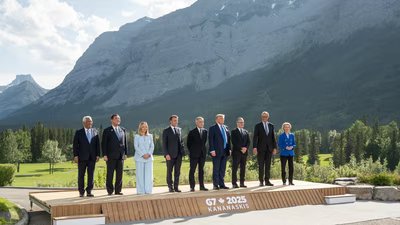
As the conflict between the United States, Israel and Iran enters its sixth day, fellow G7 nations have increased their defences in the Middle East. France, Germany and the United Kingdom have stepped up surveillance and increased their defences in the region, especially after a British base in Cyprus was subject to a drone attack.
The conflict between US-Israel and Iran kick started on February 28, after Tel Aviv and Washington carried out air strikes across Tehran in a joint military operation. These air strikes also resulted in the assassination of Iranian Supreme Leader Ayatollah Ali Khamenei, which prompted Iran to target US and Israeli bases in the Middle East.
Track LIVE updates on US-Iran war here
In the past six days, the entire Gulf region has found itself at the brink of a regional war, with Iranian drone strikes targeting US bases and embassies in the UAE, Qatar, Kuwait, Bahrain, Saudi Arabia, Jordan, Iraq, and Oman. Meanwhile, Israel has also renewed its conflict with militant group Hezbollah, expanding the war to Lebanon.
With the sinking of an Iranian warship near Sri Lanka, tensions between the US and Iran have only escalated, prompting G7 nations such as UK, France, Italy and Germany to up their defences in the Middle East as they brace for possible intervention.
Here’s a look at where G7 nations currently stand –
The UK
Before the strikes between the US and Iran, tensions had already been brewing due to the nuclear talks. During this, the UK government, led by Prime Minister Sir Keir Starmer, blocked the US’ use of the joint military base in Diego Garcia, triggering an angry rant from US President Donald Trump on Truth Social.
Following the start of the conflict, the UK stated it would allow the US to use British Bases for the “defensive purpose” of destroying Iranian missiles. Sir Starmer called on the US and Iran to return to diplomacy and stated that the UK will not be joining this war as it had learnt its lesson from 2003 (US’ invasion of Iraq).
Despite the UK allowing use of its bases, Trump said Starmer’s decision “came a little too late”.
In the past week, London has stated it will increase its defence in the Middle East after a drone attack at RAF Akrotiri in Cyprus. British warship HMS Dragon, which has air defence capabilities, is said to be deployed to Cyprus. The UK is also deploying Wildcat helicopters equipped with Martlet missiles that can take down drones.
France
French President Emmanuel Macron also called for the ongoing escalation to end, urging the US and Iran to return to the negotiating table. However, Macron added that France stood ready to deploy “necessary resources to protect its closest partners, should they request it.”
On Tuesday, Macron announced that France will be taking part in military operations in the Middle East in a “strictly defensive” posture. After this, France’s nuclear-powered aircraft carrier, the Charles de Gaulle, was moved from the Baltic Sea to the Mediterranean.
Additionally, Rafale fighter jets, air defence systems, and airborne radar systems were also deployed to the region.
Also Read | PM Modi speaks to France’s Macron, calls for ‘early restoration of peace’ in West Asia
On Thursday, France authorised US military support aircraft to use a French base. However, combat aircraft have not been allowed.
“Given the context, France has required that the assets involved in no way take part in the operations conducted by the United States in Iran, but strictly in support of the defence of our partners in the region. It has obtained full guarantees to that effect,” read a statement issued by the French military.
Italy
Italian defence minister Guido Crosetto told parliament Thursday that Italy would send “naval assets” to protect EU member Cyprus.
He also said Italy would be sending “air-defence, anti-drone and anti-missile systems” to certain “strategic partners” in the Gulf, confirming a statement from Prime Minister Giorgia Meloni.
Speaking on an RTL radio programme, Meloni sated that Italy had not received any request to use its bases for action against Iran, adding that Italy “is not at war and we do not want to enter a war”.
The Prime Minister added that it will continue to follow the terms established in its bilateral agreements with the US, which date back to 1954, allowing use of bases for logistical and non-combat operations.
“These are technical authorisations when we are clearly talking about logistics and so-called non-kinetic operations – simply put, operations that do not involve bombing,” she told RTL.
Canada
Canadian Prime Minister Mark Carney, while opposing the Khamenei regime in Iran, condemned the US-Israeli strikes, stating that they were “inconsistent with international law.”
“The United States and Israel have acted without engaging the United Nations or consulting with allies, including Canada,” he added further.
Also Read | US torpedoes Iranian ship IRIS Dena in Indian Ocean: What the Geneva Convention says on naval warfare
However, the Labour leader has now added that he would not “rule out” the possibility of Canada participating in the ongoing escalation in the Middle East
“One can never categorically rule out participation,” said Carney, adding that Ottawa will stand by its allies “when it makes sense” and “always defend Canadians.”
Germany
Following a meeting at the White House between Trump and German Chancellor Friedrich Merz, the US president stated that Berlin has been “helping out” the US by allowing its military to access certain bases.
Merz further told reporters that Germany wishes to see a swift end to the war in the Middle East.
While the German chancellor expressed support for the US-Israeli strikes, he ruled out any German military involvement.
Japan
Japan refrained from expressing support for the US-Israeli strikes on Iran, but continues to monitor the situation due to the conflict’s impact on oil and gas supply.
In an official statement, Japanese Prime Minister Sanae Takaichi called on her cabinet to ensure the safety and evacuation of Japanese nationals in Iran, Israel, and neighbouring countries of Bahrain, Qatar, and the United Arab Emirates as the conflict spread in the West Asia region.