
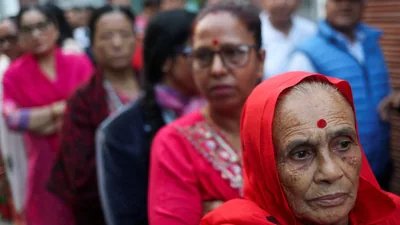
Nepal elections 2026: Nepal is set to go to polls on Thursday, March 5, months after a massive Gen Z-led uprising toppled KP Sharma Oli’s government last year, paving the way for the country to choose its next administration.
Under heavy security, the people of Nepal will cast their votes to elect their next prime minister and government. Three key players vying to hold the top office are rapper-turned-politician Balendra Shah, Gagan Thapa, the young leader of Nepal’s oldest party, the Nepali Congress, and lastly, former prime minister KP Oli. From corruption and job creation to ties with neighbouring India and China, a lot is at stake for Nepal in this election.
Political parties ran their election campaigns from February 16 to March 2. A silent period began after March 2, after which restrictions were imposed on all election campaigns. In just two more days, 18.9 million eligible voters will elect 275 members of Nepal’s House of Representatives.
Nepal’s interim prime minister Sushila Karki on Monday appealed to all citizens to turn out in large numbers for the general elections, stating that the vote would determine the country’s stability and prosperity. She also requested the public “to maintain peace and order” during polls, saying that “peace is Nepal’s identity”.
Nepal election 2026 | 10 key points
1. Date and time of polling: Election for the 275-member HoR of Nepal will be held on Thursday, March 5. Voting will begin from 7 am and conclude at 5 pm. Under the HoR election, 165 of the 275 Parliament members are elected by direct voting and the remaining 110 by the proportionate voting system, news agency PTI reported.
2. Election results date: The Election Commission of Nepal has said that the results under the direct voting system will be announced within 24 hours of the collection of all ballot boxes, while those under the proportional voting system could take one or two days. Nepal’s acting chief election commissioner Ram Prasad Bhandari said the polling body plans to begin vote counting immediately after the ballot boxes are collected.
3. Voters: A total of 18.9 million people of Nepal’s 30 million population are eligible to vote in the March 5 election, and of these, around one million voters — mostly youth — were added to the list after last year’s Gen-Z uprising.
4. Direct voting vs proportional voting: In the direct voting system, the candidate with the maximum number of votes will win. Under the proportionate voting system, seats are allocated to political parties in proportion to their vote share.
5. Key issues at stake: Corruption, job creation, poverty and high rate of youth unemployment are among the key issues in Nepal, Reuters reported, citing analysts. Additionally, the country’s ties with its neighbours — India and China, both of which are also key trade partners — will also be a factor in the March 5 polls. According to the World Bank, India accounts for two-thirds of Nepal’s international trade, while China accounts for 14 per cent. Beijing has also lent over $130 million to Nepal, one of the world’s poorest countries.
6. Key contenders: While nearly 65 political parties are in the fray to hold Nepal’s top office, there are three main contenders: a rapper-turned-politician, a youth leader, and a communist veteran. First is Balendra Shah, popularly known as Balen, who is seen as a front-runner after emerging as a key figure during the election campaign. He was elected mayor of Kathmandu in 2022 and later left the post to become the prime ministerial candidate of the National Independent Party. Another contender is Gagan Thapa, the new young leader of the Nepali Congress, one of the country’s oldest key political parties, a liberal democratic party with close ties to India. Lastly, there is Khadga Prasad Oli, the controversial yet strong communist leader whose government was toppled by the Gen Z protests in 2025. Notably, three-time PM Pushpa Kamal Dahal, who now leads the Nepali Communist Party, is also in the fray.
7. Security arrangements: The Nepal Army earlier said that it was implementing a three-phase integrated security plan, including aerial patrols and neutralising suspicious objects, for the country’s general elections. The three phases are before, during, and after the election. Army spokesperson Rajaram Basnet said the military will conduct security operations at polling stations and counting sites, conduct aerial patrols, and neutralise any suspicious objects during the polls. On the day of voting, all polling booths will have three-tier security. After the election, the integrated team will escort the collection and transportation of the ballot boxes to the counting sites, news agency PTI reported. The integrated teams will comprise personnel from security agencies, election officers and party representatives. Around 3,30,000 security personnel, including 80,000 Nepal Army officials, will be mobilised to ensure the smooth conduct of the elections.
8. What about opinion polls: Nepal’s election commission has urged media organisations in the country not to disclose results of opinion polls before the general elections, as it may hamper a “healthy competitive entertainment”. Nepal’s acting Chief Election Commissioner Ram Prasad Bhandari said, “Media should not disclose the results of such opinion polls ahead of the March 5 election, as it may disillusion voters and spoil a healthy competitive environment by discouraging the candidates.” He also cautioned social media users about the possibility of distorting the neutral environment of the election through technology misuse.
9. Three-day holiday in Nepal: Last week, Nepal declared a three-day holiday — on March 4, 5 and 6 — for the general elections. The country’s cabinet made the decision at the recommendation of the EC, government spokesperson Om Prakash Aryal told reporters.
10. Border curbs, no alcohol: From midnight of March 2 to midnight of March 5, the India-Nepal border will remain closed in view of the general elections. Nepal’s ministry of home affairs issued an official communication last week, stating that all border outposts along the entire stretch of the Banke district bordering India will remain closed for 72 hours, starting 12 am on the intervening night of March 2. Commandant Ganga Singh Udawat of the 42nd Sashastra Seema Bal said instructions had been issued to enforce “restricted movement” at the border from the designated date, news agency PTI reported. He further stated that additional vigilance is already in place at the border, and people are being allowed to cross only after thorough verification and identification checks. Not just border closures, the Nepalese government also prohibited alcohol nationwide seven days before the March 5 elections. The restriction will remain in place till the final results of the election are released.