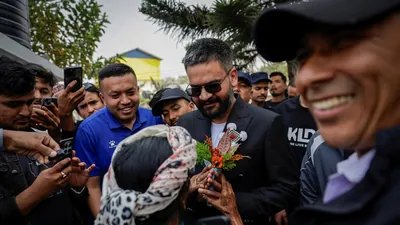
When Nepal goes to the general election on March 5, none of the major party grandees who have been taking turns as prime minister for a good part of the last two decades will be in the reckoning for Singh Durbar.
Balendra Shah, a rapper-turned-politician and the prime ministerial candidate for Rastriya Swatantra Party (RSP), interacts with locals ahead of Nepal’s general election, at a RSP office in Damak in Jhapa district, in Nepal, February 25, 2026. REUTERS/Navesh Chitrakar (REUTERS)
If the size of the campaign and social media coverage are anything to go by, the honour this time should go to the rapper-turned-ex-mayor-turned Rastriya Swatantra Party (RSP) leader Balendra Shah, half their age at 35.
Balen (as he is popularly called) has been projected as prime minister by RSP, the fourth-largest party in the now-dissolved House and the newest of them all, registered only six months before the last general election in 2022. Kathmandu’s popular ex-mayor, not known to deliver long speeches as old-school leaders, has travelled widely and has drawn huge crowds across the country.
Two other leaders in the RSP fold will also be closely followed – party president Ravi Lamichhane, whose rallies are also widely attended, and vice-president Swarnim Wagle, who has been a key figure in putting together candidates from various disciplines, ethnicities, and age groups.
Balen’s is the most followed contest. For good reason. Instead of picking up a comparatively easy Kathmandu constituency, he has filed his nomination from the eastern Tarai in Jhapa-5, where he is pitted against the deposed Prime Minister Oli.
To Balen, the logic to take on the former prime minister is simple: defeat the head of government at his own home turf as a symbolic justice, for it was under Oli that 78 young and innocent Gen Z protesters died in September.
Another interesting race – also in Terai – will be between the newly elected Nepali Congress president Gagan Thapa and the RSP candidate Amreshkumar Singh. Like Balen, Thapa has travelled outside Kathmandu, but the NC chief has not taken on a political heavyweight, though Singh has repeatedly won in Sarlahi, is a local, and is now an incumbent. Nepali Congress leaders argue Thapa is looking to expand the party’s traditional base in Tarai. But most others believe that Thapa had a poor chance of defending his seat in Kathmandu, where Balen has a very strong following.
The Maoist supremo Pushpakamal Dahal ‘Prachanda’ has ‘gone back’ to the Maoist ‘base area’ during his underground years (1996-2006). His constituency of Rukum East, and adjoining district Rolpa, western mountain districts, are where the Maoists launched their anti-regime ‘people’s war’ in early 1996. It will be interesting see if the people in his ‘base’ area, mostly rural, will excuse Prachanda’s ‘absence’ since 2006, or he still has his political roots there. Many have called him a ‘tourist candidate’, as he has been changing his constituency every election.
In many cases, three dominant traditional parties – the Nepali Congress, Communist Party of Nepal-Unified Marxist Leninist (CPN-UML) and CPN (Maoist Centre) – have been on the defensive with the voters.
RSP candidates come from a younger demographic than traditional parties, with many of the young candidates having led the Gen Z protests in September. Of RSP’s 163 candidates, nearly 40 percent are under 40, including 12 under 30 and 53 aged 30–40. In the Ujyalo Nepal Party, 40 of 105 candidates are under 40, 29 are 40–50, 27 are 50–60, and nine are over 60, according to the Kathmandu Post’s election analysis.
Similarly, in the Sharm Sanskriti Party, led by Harka Sampang, 35 of 109 candidates are under 40.
Election results
One thesis that has been held widely is that it will be nearly impossible for a single party to get a majority in the 275-member House of Representatives given Nepal’s two-ballot voting system. In the First Past The Post (FPTP) system, whoever (independent or from a party) wins the most votes takes the constituency; in the second system, Proportional Representation (PR), voter casts their ballot for party of choice (110 seats). Many are watching closely if RSP and other new parties can debunk the conventional wisdom this election.
A significant feature of the election is that it comes right on the heels of Gen Z protests on September 8-9, a youth-led anti-corruption mass movement that led to the ouster of then-Prime Minister Oli, dissolution of the House of Representatives, and announcement of fresh elections under an interim government. When she took office, the newly sworn-in Prime Minister, Sushila Koirala pledged to hold the election in six months. And six months it is.