
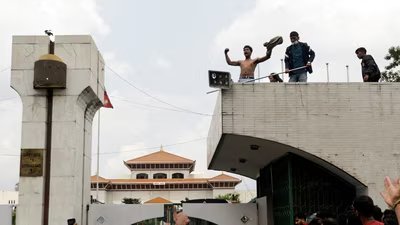
Not many would imagine a big uprising that led to a ruling government to be ousted from power to be led by a generation deemed “unserious” on social media. However, the unfathomable became a reality in Nepal last year, when the Generation Z or GenZ spearheaded a historic protest.
A ban on social media sites became the trigger for one of the biggest protests the country ever witnessed, with 74 deaths and many more wounded as several buildings, including the Parliament, being set on fire.
However, the ban on social media was not the only reason behind the protests. The disparity in the lives of ordinary people and those related to the politicians in the country enraged the GenZ who then marched through the streets of Kathmandu and clashed with the police.
Months after former prime minister KP Sharma Oli’s ouster and former chief justice Sushila Karki becoming the head of a new interim government, nearly 19 million people in Nepal are set to partake in fresh elections, slated to take place on Thursday, March 5.
A lot remains at stake in the Nepal elections, whose outcome on Friday would decide how big of an impact the GenZ uprising actually left on the country’s politics.
Call for ‘new energy’
It has been months since the GenZ-led uprising in Nepal but the influence of youth remains strong ahead of the country’s first elections since then. Young leaders are challenging their senior contenders and promising the revive the country’s economy as locals call for change and “new energy”.
KP Sharma Oli, who was forced to give up power after the mass protests last year, is being challenged in his home turf of Jhapa by former Kathmandu mayor Balendra Shah, a 35-year-old rapper-turned-politician widely known as Balen.
“We have had a difficult few years with old leadership, and we need new energy,” 50-year-old bus driver Pawan Jha told news agency AFP, as he attended Shah’s rally in Jhapa. “The protests were important to bring about change.” Balen represents the Rastriya Swatantra Party (RSP) and remains a symbol of hope for the youth in Nepal.
Unemployment, economic concerns
Economic concerns remain in Nepal despite months of Oli’s government out of power. The World Bank reportedly estimates 82% of Nepal’s workforce is in informal employment, with GDP per capita at $1,447 in 2024.
Most youth are forced to seek work abroad. “The youth should work here and earn their living, rather than go out of the country,” a shopkeeper was quoted as saying, as she called for the country’s unemployment problem to be resolved.
Key parties in fray
Balen’s is not the only party being grabbing attention in Nepal. Two parties, that were also part of the government ousted last year and have faced public dissatisfaction, are also in the fray. They are – the Nepali Congress and the Communist Party of Nepal (Unified Marxist–Leninist).
Besides, the National Independent Party, founded in 2002, has also gained considerable support over the past of few months.
Balen is not the only one wooing the youth vote. Forty-nine-year-old Gagan Thapa of the Nepali Congress also has immense influence among the youth and told AFP he wished to end the “old age” club of revolving veteran leaders.
Sushila Karki’s political future also remains to be seen. She took oath to lead the interim government after the GenZ protests. In her recent message to the public, not only did she ask them to come out in huge in numbers to vote, but also called for “peace and harmony” and “move the country forward on the path of political stability and prosperity”, in a broadcast to the nation on Monday.
All eyes now remain on which party would come out victorious after the elections. However, analysts reportedly predict that no single party is likely to come out with an absolute majority.
(With AFP inputs)