
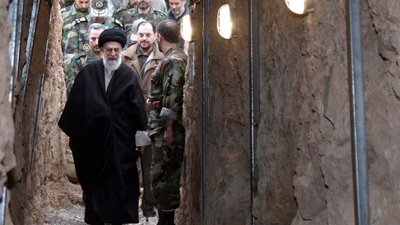
Iran’s Supreme Leader Ayatollah Ali Khamenei was killed in an air strike, part of the joint US-Israel operation on Saturday, which for the world was a surprise offensive but in reality was a sophisticated Israeli intelligence plan in the works reportedly for long – a plot under which all cameras of Tehran were hacked for years.
Angle of one particular camera all hacked in Tehran for years proved especially valuable, according to a Financial Times report, which cited two individuals familiar with the intelligence operation. One of the sources said one camera revealed where the trusted and disciplined bodyguards to senior Iranian officials – including Khamenei – preferred to park their personal vehicles and offered insight into the daily routines within a tightly secured compound.
Inside the plan to kill Khamenei
US President Donald Trump said Saturday that Iran’s supreme leader Ayatollah Ali Khamenei was dead, hours after Israel and the United States launched an attack of unprecedented scale aimed at bringing down the Islamic republic and stopping it from pursuing its nuclear ambitions.
The announcement of Khamenei’s death, which was confirmed by Iran later, parallelly triggered mourning and cheers that could be heard on Tehran’s streets amid plumes of smoke over the Pasteur district where he usually resided.
Advanced algorithms supplemented intelligence files on the personnel guarding top Iranian officials, compiling information such as home addresses, work schedules, commuting routes and – crucially – which officials they were typically tasked with protecting.
The result was what intelligence professionals describe as a “pattern of life”.
The above formed part of a long-running intelligence effort that ultimately set the stage for the assassination of Ayatollah Ali Khamenei – Iran’s paramount leader since 1989.
This real-time stream of surveillance – one among hundreds of intelligence sources – was not the sole method Israel and the US’ Central Intelligence Agency (CIA) used to pinpoint exactly when the 86-year-old Khamenei would be present at his offices that Saturday morning and who would be alongside him.
Nor was it the only tactic.
‘We knew Tehran like we know Jerusalem’
Israel was also able to interfere with individual components of roughly a dozen mobile phone towers near Pasteur Street, causing calls to appear as if lines were busy and preventing Khamenei’s security team from receiving potential warnings, the Financial Times reported.
Long before the strike, “we knew Tehran like we know Jerusalem”, the report quoted as saying a current Israeli intelligence official. “And when you know [a place] as well as you know the street you grew up on, you notice a single thing that’s out of place.”
The extensive intelligence portrait of its primary adversary Iran’s capital Tehran was reportedly built through painstaking data collection. Israel’s signals intelligence unit – Unit 8200 – provided sophisticated signals intelligence capabilities; Mossad cultivated human sources abroad; and military intelligence processed vast quantities of information into daily operational briefs.
Israel also applied a mathematical technique known as social network analysis to sift through billions of data points, identifying unexpected centers of influence and selecting new targets for surveillance or elimination, according to a person familiar with the process. The output of this system was singular: targets.
“In Israeli intelligence culture, targeting intelligence is the most essential tactical issue – it is designed to enable a strategy,” said Itai Shapira, a brigadier general in the Israeli military reserves with 25 years in its intelligence directorate. “If the decision maker decides that someone has to be assassinated, in Israel the culture is: ‘We will provide the targeting intelligence’.”
Over decades, Israel has carried out hundreds of assassinations abroad, targeting militant leaders, nuclear scientists, chemical engineers – and at times killing innocent bystanders. Whether such aggressive use of technological superiority has delivered lasting strategic gains remains hotly debated inside and outside Israel, even in the wake of killing a figure as prominent as Khamenei.
The country’s intelligence advantage was evident during the 12-day war last June, when more than a dozen Iranian nuclear scientists and senior military officials were killed within minutes in an opening barrage.
‘We took their eyes first’
That offensive was a result of a cocktail of a sweeping neutralisation of Iran’s air defenses through cyber operations, short-range drones and precision munitions launched from beyond Iran’s borders, destroying radar systems tied to Russian-built missile platforms.
“We took their eyes first,” said one intelligence official. During both the June conflict and the recent operation, Israeli pilots deployed variants of the Sparrow missile, capable of striking targets as small as a dining table from over 1,000 kilometers away – well outside the reach of Iran’s aerial defenses.
Not every aspect of the latest mission is publicly known, and some details may remain classified to safeguard ongoing sources and methods.
Multiple current and former Israeli intelligence officials interviewed said that eliminating Khamenei was ultimately a political choice, not merely a technological feat.
When US and Israeli intelligence determined that Khamenei would be holding a Saturday morning meeting at his office near Pasteur Street, officials viewed the opportunity to strike him alongside other senior leaders as especially advantageous.
They assessed that once open warfare fully unfolded, tracking such figures would grow far more difficult as Iranian officials retreated to hardened underground bunkers.
Khamenei wasn’t hiding, knew about chances of assassination
Unlike his ally, Hizbollah leader Hassan Nasrallah – who spent years underground before being killed in Beirut in September 2024 after Israeli jets dropped up to 80 bombs on his hideout – Khamenei did not typically live in hiding.
Publicly, Khamenei had contemplated the possibility of assassination, portraying his own death as inconsequential to the Islamic republic’s fate. Some Iran analysts said he even anticipated martyrdom.
Still, during wartime, he did take precautions, according to one interviewee. “It was unusual for him to not be in his bunker – he had two bunkers – and if he had been, Israel wouldn’t have been able to reach him with the bombs that they have,” the person said.
Even during the intense fighting of June 2025, Israel made no known attempt to bomb Khamenei. Instead, it focused on the leadership of the Islamic Revolutionary Guard Corps (IRGC), missile systems and stockpiles, and Iran’s nuclear infrastructure and scientists.
Although Donald Trump had repeatedly threatened action against Iran in recent weeks and assembled an “armada” offshore, diplomatic talks over Iran’s nuclear program were expected to continue.
Oman, serving as mediator, said Tehran was prepared to offer concessions to avert war and described the latest meeting as productive.
In public, Trump complained that negotiations were progressing too slowly. Privately, however, he was “dissatisfied with the Iranian responses”, according to a person familiar with the matter, clearing the path toward conflict.
The strike had reportedly been in planning for months, but officials adjusted the timing after confirming that Khamenei and senior officials would gather at his Tehran compound that Saturday morning.
Double verification mandate to identify Khamenei
Tracking individuals once required labour-intensive confirmation and risked false identifications. In recent years, Israel’s algorithm-driven intelligence infrastructure has largely automated that process.
Yet for a target of Khamenei’s stature, absolute certainty was required. Israeli doctrine mandates that two independent senior officers verify with high confidence both the presence of the target and the identities of those accompanying him, as per the FT report.
According to two people familiar with the matter cited in the report, Israeli intelligence drew on signals intelligence Unit 8200 – including compromised traffic cameras and infiltrated mobile networks – indicating the meeting was proceeding as scheduled.
US intelligence reportedly possessed an even more sold source: a human asset, both individuals said. The CIA declined to comment.
Cyber attack before striking Khamenei, key timing of Operation ‘Epic Fury’
At 3:38 pm Eastern time on Friday, while aboard Air Force One en route to Texas, Trump authorised Operation ‘Epic Fury’ – the name US gave to its strikes on Iran with the help of Israel. For Israel, the action was named Operation ‘Roaring Lion’.
The US military cleared the path for Israeli fighter jets to bomb Khamenei’s compound by launching cyber attacks “disrupting, degrading and blinding Iran’s ability to see, communicate and respond”, the report quopted as saying General Dan Caine, chair of the US joint chiefs of staff.
Caine said the compound was struck in daylight following a “trigger event” carried out by the Israel Defense Forces with U.S. intelligence support.
Israeli aircraft, which had flown for hours to synchronize their arrival, released as many as 30 precision-guided munitions onto Khamenei’s complex, according to a former senior Israeli intelligence official.
The Iranians were meeting for breakfast when they were killed, Trump told Fox News.
The Israeli military said the timing offered a key benefit. “The decision to strike in the morning rather than at night allowed Israel to achieve tactical surprise for the second time, despite heavy Iranian preparedness,” it stated.
The two turning points
Sima Shine, a former Mossad official focused on Iran, described the operation as the culmination of two events separated by more than two decades – The first dated to 2001, when then-Prime Minister Ariel Sharon instructed Mossad chief Meir Dagan to prioritize Iran above other threats.
“‘All the things the Mossad is doing is well and fine,'” Sharon told Dagan, according to Shine. “‘What I need is Iran. That’s your target’.”
“And since then, that is the target,” she said.
Over the years, Israel sabotaged Iran’s nuclear program, assassinated scientists, confronted proxy forces and dismantled Syrian military infrastructure following Bashar al-Assad’s ouster.
Iranian intelligence agencies, however, proved formidable. In 2022, a group linked to Iranian security services released data allegedly taken from a phone belonging to the Mossad chief’s wife. During the 2025 war, Iran reportedly hacked CCTV cameras in Jerusalem for real-time battle damage assessments, purchased images of missile defense systems, and mapped a senior politician’s jogging route through bribery, according to Israeli prosecutors.
The second turning point, Shine said, was the October 7, 2023 Hamas attack, which Israel claims was backed by Iran and which reshaped Israeli thinking about whether foreign leaders should remain off-limits even during wartime.
Assassinating heads of state carries immense operational and political risk. Failed attempts can enhance a leader’s stature, as happened after multiple unsuccessful CIA plots against Fidel Castro. Even successful operations can unleash unpredictable consequences.
But Shine said that Israel’s recent intelligence successes – including the 2024 killing of Hamas leader Ismail Haniyeh in Tehran and a $300 million covert effort to rig thousands of Hizbollah pagers and radios with explosives – created momentum of their own.
“In Hebrew, we say, ‘With the food comes the appetite’,” she said. “In other words, the more you have, the more you want.”