
U.S. attacks on Iran are projected to last four or five weeks but could go longer, President Trump said on Monday as he and other officials offered new rationales for the strikes conducted with Israel since Saturday.
“This was our last best chance to strike,” Trump said, speaking from the White House’s East Room.
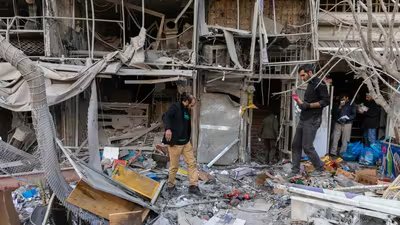
The U.S. said Monday it was adding forces in the region, as Iran hit industrial and military sites across several Middle East countries for a third day. Iran’s attacks sought to turn the standoff with Israel and the U.S. into a broader and more economically damaging conflict.
Trump said Iran had been pursuing a nuclear weapon. He also said the regime was “rapidly and dramatically” building a conventional weapons program, which was intended to shield the nuclear program.
He outlined four goals for the operation, saying the U.S. was working to destroy Iran’s missile capabilities, annihilate its Navy, prevent the country from obtaining a nuclear weapon and stop Iran from arming, funding and directing terrorist groups outside its borders.
The president’s remarks came on the third day of the conflict, during which the number of U.S. casualties rose to six, U.S. Central Command said. Trump has warned that more U.S. soldiers will likely die before the operation ends.
At least 500 Iranian civilians have been killed in U.S. and Israeli strikes, the Iranian Red Crescent said. Iranian state-owned Press TV reported Monday that the wife of Supreme Leader Ayatollah Ali Khamenei, who was killed in strikes on Saturday, died as well, along with other family members.
Meanwhile, Lebanese health authorities said on Monday that 31 people were killed in Israeli retaliatory strikes across the country after the Iran-backed Hezbollah militia attacked Israel from Lebanese territory. Prime Minister Nawaf Salam of Lebanon said Monday that his government had decided to impose a ban on all of Hezbollah’s military activities.
“The hardest hits are yet to come from the U.S. military,” Secretary of State Marco Rubio said on Monday about Iran. “We have objectives. We will do this as long as it takes to achieve those objectives, and we will achieve those objectives. The world will be a safer place when we’re done with this operation.”
Rubio said the U.S. got involved in the Iran strikes because the Trump administration was concerned that Israel’s planned military action would result in an attack on U.S. forces.
The Israeli army said on Monday it had struck dozens of command centers in Tehran that were part of Iran’s Ministry of Intelligence and the Islamic Revolutionary Guard Corps’ internal security forces. The Israeli Air Force targeted IRGC command centers that it said were responsible for directing violence against Iranian civilians and suppressing protests. The Israeli army also said it struck more than 10 headquarters belonging to the Ministry of Intelligence and IRGC’s Quds Force, which directs paramilitary operations abroad.
Israel’s military also said it killed Hussein Makled, the head of Hezbollah’s intelligence headquarters in Beirut.
Strikes damaged Tehran’s provincial emergency-services headquarters and hit medical facilities overnight, Iranian state media reported.
Iran’s ambassador to the United Nations, Amir Saeid Iravani, said on Monday the country doesn’t seek escalation but will continue to defend itself. “Iran does not seek war. It does not seek escalation, Iran will not surrender its sovereignty,” he said at U.N. headquarters.
Ebrahim Jabari, a senior adviser to the IRGC’s commander in chief, on Monday threatened to attack any ship crossing the Strait of Hormuz in a move that could choke about a fifth of global oil supplies and send oil prices soaring.
In Saudi Arabia, five drones were intercepted near the Prince Sultan Air Base southeast of Riyadh, the Saudi defense ministry said. In Kuwait, a small fire broke out at a power plant after a drone was intercepted, a government official said. Qatar’s defense ministry said a missile struck a power company and an energy facility. The Qatar News Agency reported that the attacks forced a halt to production of liquefied natural gas and other products.
In Syria, debris from an intercepted missile struck an industrial power substation outside Damascus, taking it out of service, Syrian state news agency SANA reported.
The Pentagon has enhanced security measures at U.S. military installations.
Three U.S. jet fighters were mistakenly shot down in Kuwait, Centcom said on Monday. The six crew safely ejected from the F-15s and are in stable condition, said Centcom, which oversees U.S. military operations in the Middle East.
Kuwait’s Ministry of Defense said earlier that several U.S. warplanes were downed, with the cause of the incident being investigated.
Speaking at the Pentagon on Monday, Secretary of Defense Pete Hegseth said there were no U.S. forces on the ground in Iran, but didn’t rule out the possibility there could be in the future, while justifying the attacks as a means of defending U.S. citizens. But Senate Majority Leader John Thune (R., S.D.) later said he doesn’t anticipate U.S. ground troops being deployed.
Hegseth said the war won’t go as long or result in nation building as in Afghanistan and Iraq. “This is not Iraq. This is not endless. We set the terms of this war from start to finish. Our ambitions are not utopian. They are realistic, scoped to our interests and the defense of our people and our allies.”
The Trump administration’s messaging over why the U.S. attacked Iran has been inconsistent.
On Sunday, Trump, a Republican, and his allies offered at least two separate objectives. Sen. Lindsey Graham (R., S.C.), a Trump ally, said reducing the nuclear and missile threat from Iran was the intention, not regime change. The White House later reiterated that point.
Elaborating in an interview with the Atlantic, Trump said he was open to discussions with Iran’s current leadership that could end the war if U.S. demands were met.
But hours later, Trump swung back to one of his original goals from the beginning of the air assault on Saturday. In a video, he urged Iranians to “take back your country” from the regime, vowing the U.S. will “be there to help.”
Write to Annie Linskey at annie.linskey@wsj.com, Shelby Holliday at shelby.holliday@wsj.com and Alexander Ward at alex.ward@wsj.com