
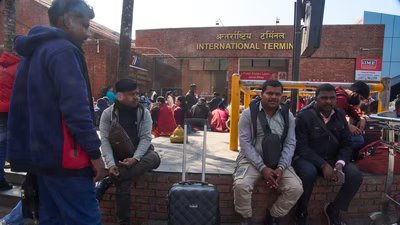
Millions of migrant workers, working in some of Middle East’s crucial sectors, face uncertainty at the moment given the escalation of the conflict in the region after joint US-Israeli strikes led to the death of Iran’s Supreme Leader Ayatollah Ali Khamenei.
Prime Minister Narendra Modi, in a phone conversation with United Arab Emirates President Mohamed bin Zayed, had spoken to him about “taking care” of the Indian diaspora.
A large share of the labour in Gulf countries is supplied by Southeast and South Asian nations, Bloomberg reported. This includes medical practitioners, construction workers and household help.
According to the International Labour Organization, they makes up a workforce of over 24 million. After the start of the conflict, three people – from Pakistan, Nepal and Bangladesh – were reported killed inthe United Arab Emirates.
Apart from this, a Filipino caregiver, identified as Mary Anne Velasquez de Vera, was killed after being struck by a shrapnel while helping her ward reach a bomb shelter in Tel Aviv, Philippine President Ferdinand Marcos Jr. said in a briefing Sunday. Another Filipino migrant worker was injured in Kuwait, Bloomberg reported.
Migrant workers constitute 40% of labour force in West Asia
Migrant workers account for over 40 per cent of the labour force in West Asia, and are crucial to the region’s economy. However, given the present situation, countries are preparing to take measure to repatriate the workforce and bring them back to their nations.
Philippine Migrant Workers Secretary Hans Leo Cacdac said Monday that the country’s government was prepared to order a mandatory repatriation of the nation’s 2.4 million workers in the Middle East if the situation escalates further, according to the Bloomberg report.
Phillipine Interior and Local Government Secretary Jonvic Remulla said this decision would have to be taken carefully, adding that this large-scale relocation can have a “devastating” impact for both the Philippines and the host country. “It’s not as simple as it sounds. The Filipinos run maybe 50% of the health and service capacity of the Emirates,” Bloomberg cited Remulla as saying via text message.
However, many of the migrant workers are in low-income work and often lack adequate protection, which puts the onus of their safety on their nations. Several migrant workers have also been abandoned by their employers in previous conflicts, often without wages and travel documents.