
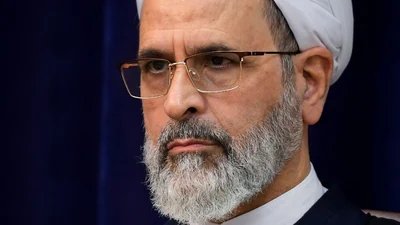
Until this week, Ayatollah Alireza Arafi was a name familiar mainly within the insular world of Iran’s clerical establishment. That changed overnight. On Sunday, Arafi was appointed as the jurist member of Iran’s interim Leadership Council, the body tasked with fulfilling the Supreme Leader’s role until the Assembly of Experts elects a permanent successor.
Follow: Live updates on the conflict
“The Expediency Discernment Council has elected Ayatollah Alireza Arafi as a member of the interim leadership council,” said expediency council spokesman Mohsen Dehnavi in a post on X.
Ayatollah Alireza Arafi now co-governs the Islamic Republic alongside President Masoud Pezeshkian and Chief Justice Gholamhossein Mohseni Ejei. This authority was previously held singularly by Ayatollah Khamenei.
Arafi, thus, is technically one of three members. But, being a cleric in a regime that has been led by only cleric as supreme leaders, he effectively becomes the seniormost.
Born in 1959 in the historic town of Meybod in the central Iranian province of Yazd, Arafi comes from a clerical family, according to his official profile.
In 1969, when he was only 11 years old, he moved to Qom to further his religious studies, which he had begun under his father back in Meybod. His ascent through the ranks of the Islamic Republic was, by most accounts, deliberate and carefully managed from above, according to an analysis by the think tank Middle East Institute.
His name began to rise in prominence after Khamenei became Supreme Leader in 1989, and he was first appointed as Friday prayer leader in his hometown of Meybod in 1992. He was 33 at the time, a young age for such an appointment and a clear sign of Khamenei’s trust in him.
Khamenei’s willingness to appoint Arafi to senior and strategically sensitive positions shows “a great deal of confidence in his bureaucratic abilities”, analyst Alex Vatanka told CNN. Arafi was, still, not known to be a political heavyweight with close ties to the security establishment; but his appointment now means he might have made up for that over the years.
Over the decades, Arafi accumulated a remarkable portfolio of institutional power.
Before his emergency appointment to the Leadership Council, he simultaneously held three of the most influential positions in the country: director of Iran’s nationwide seminary system, member of the Guardian Council, and member of the Assembly of Experts.
He also received Pope Francis in a private audience at the Vatican in May 2022 — a rare gesture of interfaith diplomacy for a senior Iranian cleric.
Polyglot, AI advocate
While deeply embedded in the traditional clerical structure of Qom, Arafi represents a slightly different breed of regime insider. He is considered highly educated, a polyglot fluent in both Arabic and English, and notably technologically adept. He has frequently been speaking on the need for the regime to adapt to artificial intelligence to spread its ideological message globally.
His record is not without controversy. During the 2022 protest wave that followed the death of Mahsa Amini, Arafi drew sharp international condemnation. Speaking publicly to a gathering of clerics in Qom amid the unrest, he warned protesters who targeted Iran’s clergy: “Those who attack the turbans of the clergy should know that the turban will become their shroud,” according to a report by Asharq Al-Awsat.
Canada sanctioned Arafi following those remarks, citing his role in the crackdown on civil unrest.
As Director of Al-Mustafa International University from 2009 to 2018, Arafi oversaw the institution’s mission of exporting the Islamic Republic’s ideology. He claimed that during his eight years leading Al-Mustafa, the institute successfully converted 50 million people to Shia Islam. This number was regarded by independent experts as “unbelievable and unachievable”. Having served as head of Al-Mustafa, he is viewed by the IRGC and political elite as a completely trusted loyalist, as per news agency Reuters.