
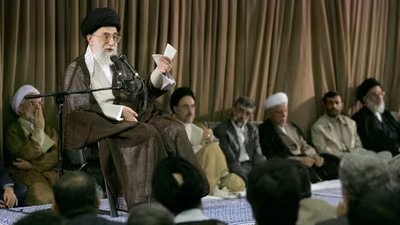
Iran is bracing for a historic transition after the death of Supreme Leader Ayatollah Ali Khamenei, setting off political jockeying both inside and outside the country.
Khamenei, who led Iran since 1989, was the longest-serving head of state in the Middle East. His death marks only the second leadership change since the 1979 Islamic Revolution. The state has announced 40 days mourning and 7 days of public holiday, reported IRNA news agency.
A three-person council will temporarily assume leadership duties following the death of Supreme Leader Ayatollah Ali Khamenei, reported Iran’s news agency IRNA. The country’s president, the head of the judiciary and a jurist from the Guardian Council will collectively oversee the transition period until a new leader is appointed.
How is the Supreme Leader chosen?
Under Iran’s constitution, the Assembly of Experts is responsible for appointing and overseeing the Supreme Leader. The 88-member body, formally known as the Assembly of Experts (Majles-e Khobregân-e Rahbari), comprises Islamic scholars elected by direct public vote for eight-year terms.
Its constitutional duties include appointing, supervising and, if necessary, dismissing the Supreme Leader.
However, the system is tightly controlled. Candidates for the Assembly are vetted by the Guardian Council. Members of the Guardian Council are themselves directly or indirectly chosen by the Supreme Leader, creating a closed loop within the country’s power structure.
After the death of the Islamic Republic’s founder, Ruhollah Khomeini, in 1989, Khamenei rose to the top post after serving as president. Since then, the process of choosing a successor has largely remained an internal matter handled quietly by Iran’s clerical establishment. The coming days will test that system like never before.
Top names in race to replace Khamenei
A recent report by the Council on Foreign Relations, a US-based think tank, listed several figures frequently mentioned as possible successors.
- Hojjat-ol-Eslam Mohsen Qomi – A close adviser to Khamenei, Mohsen Qomi is seen as a trusted insider. Supporters believe his proximity to the late leader could help maintain continuity and stability during a turbulent transition.
- Ayatollah Alireza Arafi – A senior cleric and member of both the Guardian Council and the Assembly of Experts, Arafi also heads Iran’s seminary system. According to the council on foreign relations, his appointment would likely preserve the existing political structure.
- Ayatollah Mohsen Araki – A senior member of the Assembly of Experts, Araki has strong religious credentials and is frequently cited in succession discussions.
- Ayatollah Gholam Hossein Mohseni Ejei – Currently the head of Iran’s judiciary, Mohseni Ejei has held key security and government posts. His administrative experience could carry weight during a period of uncertainty.
- Ayatollah Hashem Hosseini Bushehri – The Friday prayer leader in Qom and a member of the Assembly of Experts, Bushehri is also considered among the potential contenders.
Opposition leaders react
Opposition leader Maryam Rajavi urged citizens to come together during what she described as a period of mounting instability.
“Our homeland continues to endure greater pain and destruction under the rule of religious fascism,” Rajavi said in a statement shared with the New York Post. She also called on Iranians to protect civilians as the country navigates the fallout.
Exiled crown prince Reza Pahlavi also appealed for unity, though he has long advocated a different political path for Iran compared to Rajavi and her allies.
The National Council of Resistance of Iran (NCRI), formed after the 1979 revolution, said it has a ready blueprint for a six-month transitional administration. The group says the plan would organize free elections and “transfer sovereignty to the people.” The NCRI presents itself as a government-in-exile.
Trump announces Khamenei’s death
US President Donald Trump announced Khamenei’s death in a post on Truth Social, describing him as “one of the most evil people in history.”
“He was unable to avoid our Intelligence and Highly Sophisticated Tracking Systems,” Trump wrote, adding that the US was “working closely with Israel.” He claimed “there was not a thing he, or the other leaders that have been killed along with him, could do.” Calling it “the single greatest chance for the Iranian people to take back their Country,” Trump framed the development as a turning point.
The development came after the US and Israel launched massive strikes on Iran on Saturday. Iranian media, quoted by the Associated Press, reported that one of the first explosions was heard near the office of the Supreme Leader.