
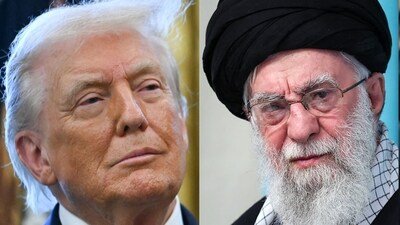
A major attack launched by Israel and the United States killed Iranian Supreme Leader Ayatollah Ali Khamenei, President Donald Trump said Saturday, marking a dramatic escalation in the Middle East region.
Trump described the assassination as giving Iranians their “greatest chance” to “take back” their country, while raising the risk of regional instability and uncertainty over Iran’s future.
“Khamenei, one of the most evil people in History, is dead,” Trump wrote in a social media post. He warned of “heavy and pinpoint bombing” continuing through the week and beyond, as part of a broader assault the US said was aimed at disabling Iran’s nuclear capabilities. Tehran did not immediately confirm the death.
US, Israel attack launch operation ‘Epic Fury’ on Iranian targets: Top 10 developments
- The strikes opened a new chapter in US-Iran hostilities. If confirmed, the killing of the 86-year-old supreme leader would leave a leadership vacuum in a nation where Khamenei held final authority over the clerical establishment and the Revolutionary Guard, the two centers of power in Iran’s theocracy.
- The US-Israel operation followed months of rising tensions and came during the Muslim holy month of Ramadan. Officials said the attacks were meticulously planned, targeting Revolutionary Guard command facilities, missile and drone launch sites, and military airfields.
- About 12 hours after the operation began, the US military reported no American casualties and only minimal damage at its bases, despite “hundreds of Iranian missile and drone attacks.” Israeli officials claimed their strikes had killed the commander of the Revolutionary Guard Corps, the country’s defense minister, and the secretary of the Iranian Security Council.
- Khamenei “was unable to avoid our Intelligence and Highly Sophisticated Tracking Systems and, working closely with Israel, there was not a thing he, or the other leaders that have been killed along with him, could do,” Trump said.
- However, Iranian foreign minister Abbas Araghchi, earlier told NBC News that Khamenei and President Masoud Pezeshkian were alive “as far as I know.”
- Eyewitnesses cited by news agency AFP, described scenes of both shock and celebration in Thran. Some residents were reportedly cheering, blowing whistles, and letting out ululations. Video footage verified by AFP showed Iranians taking to the streets, cheering, playing music, and honking car horns after reports of Khamenei’s death. Celebrations reportedly began even before Trump’s post, in response to earlier reports.
- Ali Larijani, the secretary of Iran’s National Security Council, warned Saturday that Israel and America will “regret their actions.” “The brave soldiers and the great nation of Iran will deliver an unforgettable lesson to the hellish international oppressors,” Larijani posted on X.
- Regional tensions escalated quickly. Saudi Arabia said Iran targeted its capital and eastern regions, which were repelled, while Bahrain reported a missile attack on the U.S. Navy’s 5th Fleet headquarters. Kuwait reported a drone strike near its main international airport, injuring several employees and troops, and Jordan said it “dealt with” 49 drones and ballistic missiles. Explosions were also heard in Qatar. Iranian-backed Houthis in Yemen vowed to resume attacks on Red Sea shipping routes and Israel.
- Meanwhile, flights across the Middle East were cancelled, with countries including Iran, Iraq, Israel, Syria, Kuwait, and the UAE closing their airspace. Airlines such as Air France, Air India, Turkish Airlines, Norwegian, Air Algérie, and Lufthansa announced widespread cancellations.
- Reports of the strikes included civilian casualties. An Iranian diplomat told the United Nations Security Council that hundreds of civilians were killed or wounded. Iran retaliated with missile and drone attacks toward Israel and US military bases in the region, and exchanges of fire continued into the night, keeping the Middle East on edge.
(With inputs from agencies)