
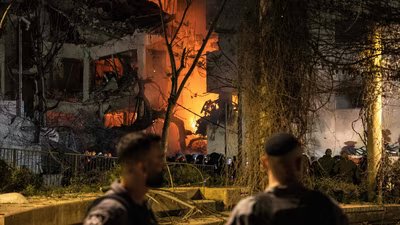
The geopolitical situation escalated quickly on Saturday after Israel and the US launched coordinated attacks on Iran after weeks of face-off and multiple rounds of talks to end the confrontation between Tehran and Washington. Along with Oman, that was mediating the talks, Iran was also showing optimism with the progress of the talks and another round was scheduled for next week in Vienna. Track updates on Iran-US conflict
However, US President Donald Trump wasn’t ‘happy’ with how talks the negotiations with Iran were panning out and on Friday he had indicated an action against Iran by saying that the US has ‘big decisions’ to make. Hours later, explosions reverberated through Tehran and smoke filled the skies, followed by Israel’s confirmation that it had launched ‘pre-emptive strikes’ against Iran. A little while later Trump posted a video confirming US role in the attacks.
Trump called for the Iranian people to “take” their country and promised “overwhelming force”. The conflict soon spread to the wider Middle East region with missile interceptions, explosions, sirens and fires being reported from gulf countries and even Saudi’s capital Riyadh. Follow updates on Khamenei
Experts are apprehensive that the conflict will have global implications.
“The scale of the strikes by the United States and Israel, along with the apparent goal of regime change in Iran, suggest the military conflict could escalate rapidly and unpredictably. There is substantial immediate risk for regional and potentially global escalation, as Iran may now use any available option to respond. China will be the most important global voice to watch, including potential signs on whether this Middle East conflict could damage or even imperil U.S.-China diplomatic engagement and even President Trump’s planned visit,” Rexon Ryu of The Asia Group (TAG) said.
What is happening in Dubai? Follow updates here
Another expert, Aysha Chowdhry, outlined that Trump lacks a clear objective.
“This operation is a strategic departure from prior military actions under President Trump — it looks like a war of undefined duration with no clearly articulated end state, premised on the gamble that military force will generate more favorable regional dynamics or meaningfully weaken the Iranian regime at an acceptable cost. The stated objectives range from eliminating Iran’s ability to threaten the region to preventing a nuclear weapon — the latter likely achievable through diplomacy — while the broader goal remains deliberately vague, leaving open the question of whether this stops at military degradation or aims at true regime change, which would be unlikely without ground forces,” Chowdhry said.
“Escalation has already moved faster than anticipated, with strikes on Iran-aligned militias in Iraq and Iranian retaliation hitting Israel and multiple Gulf states within hours. Years of Iranian détente-building with the Gulf may effectively be over. Proxy forces — the Houthis and Iraqi militias — retain meaningful capacity to harm Americans and project force regionally, while the prospect of regime change driven from the air remains highly uncertain. President Trump’s calls for Iranians to “take” their country echo prior appeals that were forcibly crushed, and absent organized armed opposition or external ground forces, such an outcome risks significant civilian cost with no guaranteed strategic return,” she added.
Daniel Kritenbrink of TAG said that China will position itself as a responsible power, but wait and see before taking major action.
“China will be deeply concerned by today’s strikes on Iran and will almost certainly condemn them, calling for restraint and an end to violence. It will attempt to position itself as a responsible power in support of international order and peaceful resolution of disputes. China likely has four primary concerns: 1) its desire for sustained access to energy resources from the region, including Iran; 2) concerns over the global economic impact of today’s actions; 3) unease over the further use of U.S. military action to effect regime change in a foreign country, which will be unsettling to leaders in Beijing; and 4) a desire to avoid unnecessarily complicating its own relationship with the United States,” Kritenbrink said and added, “These dynamics mean that China will be cautious about responding beyond rhetoric. Despite its many interests in the region, it has historically been reluctant to insert itself directly into the region’s conflicts.”
Kritenbrink also pointed at China’s position in the whole situation in the light of Trump’s upcoming Beijing visit. “Whether the visit proceeds as planned, under altered conditions, or is postponed will depend largely on how events in the Middle East unfold in the days and weeks ahead — and on this, as with much else, Beijing’s default posture will be to wait and see,” Kritenbrink said.
TAG’s George Chen said that China is unlikely to act rashly.
“Attack is one thing. Regime change is another thing. Trump asking Iranian people to take over the government and form a new regime will sound very alarming to China, just few weeks ahead of Trump’s scheduled visit to Beijing. It may be too early to say if the war on Iran will have any impact on Trump’s China trip, but I do doubt that the sentiment for the trip can be as festive as he wants given the SCOTUS ruling on IEEPA and now the attacks on Iran. China has to stand with Russia on the Middle East, and Russia will support Iran for many reasons. This puts China in a dilemma. They may choose to let the state media and some Chinese scholars balk, while Beijing chooses to do nothing serious. Wait-and-see may be Beijing’s best option for now,” Chen said.
Nisha Biswal highlighted the impact of energy, depending on Iran’s ability to threaten the Strait of Hormuz.
“The energy impact hinges on the Strait of Hormuz. With traffic already at a cautionary standstill, markets are pricing risk, not disruption — but that calculus shifts fast if Iran retains the capability to credibly threaten closure. Whether U.S. strikes have sufficiently degraded Iran’s naval, missile, and proxy capacity will determine if this remains a volatility shock or escalates into a sustained supply crisis, compounded by insurance, shipping, and regional spillover risks,” Biswal said.
Nirav Patel said that the conflict highlights that geopolitics are a fiduciary consideration for investors.
“The consequences of the US strike on Iran and subsequent Iranian retaliation toward Gulf highlight a key reality for global investors. Those with exposure to the region have long understood the structural realities of investing in the Gulf — the opportunities remain extremely significant, underpinned by ambitious sovereign wealth strategies, diversification agendas, and long-term growth fundamentals. However, this weekend’s military operations demonstrate a key reality: geopolitics are no longer merely a backdrop to investment decisions in the region, but a direct fiduciary consideration that boards, fund managers, and institutional allocators can no longer treat as secondary,” Patel added.