
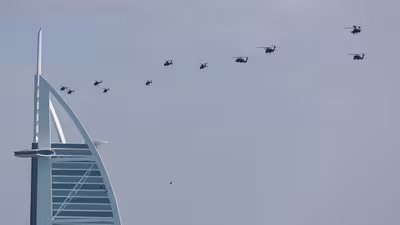
Dubai, one of the world’s busiest aviation hubs ground to a halt on Saturday after Iranian missile strikes rippled across the Gulf, prompting authorities to evacuate the Burj Khalifa and suspend operations at its airports. Explosions were heard across the city as regional airspace closures disrupted global travel routes.
Loud blasts were heard across Dubai on Saturday afternoon and evening after Iran launched retaliatory attacks targeting US-linked military facilities in the region, hours after joint American and Israeli strikes on Tehran. Residents reported loud blasts, shaking windows and missiles streaking across the night sky.
“It was a big explosion, and it made the windows shake,” one witness told AFP.
Track Live Updates on Dubai explosions and US-Iran war here
The Dubai Media Office said emergency response teams attended to an “incident” in the Palm Jumeirah area. Four individuals were injured. Authorities did not immediately confirm whether the incident was directly linked to missile debris.
The evacuation of the 828-metre Burj Khalifa, the world’s tallest building, is also being described as a precautionary measure amid fears of falling debris or further strikes.
What is happening in the UAE?
Iran said it targeted locations in Abu Dhabi and Dubai as part of a broader response to US-Israeli strikes on Tehran.
In Abu Dhabi, the UAE’s Ministry of Defence confirmed that missile debris fell in a residential area, killing a civilian of Asian nationality. The ministry condemned the attack as a “dangerous escalation” that threatens civilian safety and regional stability.
The UAE and US share the Al Dhafra Air Base in Abu Dhabi. Dubai’s Jebel Ali Port regularly hosts US Navy vessels.
A first wave of explosions was reported earlier in the day, followed by additional blasts later in the vening. Smoke was seen in parts of Dubai’s skyline after reported interceptions.
The closures quickly extended to aviation.
Flight operations at Dubai International Airport (DXB) and Al Maktoum International Airport (DWC) were suspended until further notice as airspace across the region shut down.
Airspace restrictions were also imposed by Qatar, Bahrain and Kuwait, disrupting one of the busiest global aviation corridors.
Why the Burj Khalifa was evacuated
The evacuation of the Burj Khalifa was one of the most visible signs of concern in Dubai.
Given its height and prominence, the tower – which houses residences, offices and observation decks – could be vulnerable to falling debris from intercepted missiles. Authorities moved swiftly to clear the building after blasts were heard and air defence activity intensified.
While there were no confirmed direct hits on the structure, officials prioritised crowd safety in one of the world’s most visited landmarks.
Iran-US conflict
The escalation followed joint US-Israeli strikes on Iran earlier in the day. The Pentagon named the operation targeting Tehran “Operation Epic Fury.”
Israel claimed that Mohammad Pakpour, commander of Iran’s Islamic Revolutionary Guard Corps (IRGC), was killed in the strikes.
Iran responded by launching what the Israeli military described as a “barrage of missiles” toward Israel and US-linked targets across the Gulf.
Missiles were reported over Doha, Riyadh and Manama. Bahrain said the US Navy’s Fifth Fleet headquarters was targeted. Qatar said it intercepted incoming missiles and reported no casualties.
Sirens sounded in multiple Gulf capitals. In Bahrain’s Juffair district, residents were evacuated from areas near the Fifth Fleet base.
Across the region, civilians described scenes rarely witnessed in oil-rich Gulf monarchies known for stability.
In Doha, residents fled after a falling missile reportedly struck a residential neighbourhood. In Riyadh, witnesses described “very scary and very loud” explosions. In Dubai, residents watched fireballs streak across the desert sky.
Region on the edge
The Gulf monarchies have historically balanced close security ties with Washington while maintaining cautious diplomatic engagement with Tehran.
Saudi Arabia restored ties with Iran in 2023 after a seven-year rupture. The UAE has also pursued pragmatic engagement in recent years.
Saturday’s missile exchanges shattered the perception of distance from regional conflict.
Missiles streaked across clear skies. Smoke rose near US-linked installations. Airports shut. High-rises trembled.
Authorities across the UAE have urged residents to rely only on official updates and avoid spreading misinformation as the situation evolves.