
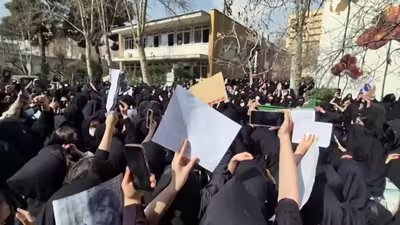
Almost from the moment Iran’s universities opened their gates for the start of a new term last week, it was clear the regime had another problem on its hands. Students came back dressed all in black, shouting slogans against the country’s leader.
Activists are harnessing anger over last month’s brutal crackdown to revive protests aimed at toppling the Islamic Republic. Led by a constellation of disparate groups, the new wave of dissent is ratcheting up domestic pressure on the regime just as it braces for a potential military showdown with the U.S.
The students are bringing a measure of cohesion to what has otherwise been a spontaneous movement fueled by frustration over a crumbling economy. Since last week, crowds have swelled on campuses in major cities as students joined memorials for peers who were killed in the crackdown. The gatherings morphed into heated rallies where students burned the country’s flag and called for the death of Supreme Leader Ali Khamenei. Chaotic scuffles and fistfights erupted on several campuses when antiregime protesters were confronted by mobs of regime loyalists.
As the protests gathered pace, Chief Justice Gholam-Hossein Mohseni-Eje’i warned that “certain slogans and behaviors, such as burning a flag on campus, are absolutely unacceptable.” At least half a dozen universities in cities including Tehran, Isfahan, Shiraz and Urmia announced that courses would be held remotely for the next few weeks. Some said the move coincided with the Muslim holy month of Ramadan, though others cited stability.
Student associations responded by calling for a boycott of online classes and urging students to show up on campus anyway.
“These protests are important, because they show Iranian society is still defiant,” said Arash Azizi, an Iranian-American historian and author of the book “What Iranians Want.” “I don’t think this problem of regime versus people will be resolved unless there’s fundamental change. They know they can’t get out of this so easily.”
Sustaining the protests hinges on a fragile alliance united by little more than outrage. Student activism in Iran has traditionally been split broadly among three camps representing left-leaning progressives, monarchists and regime loyalists. The last of these are often members of the Basij, a paramilitary group backed by the government that has branches in almost every high school and university. This group was instrumental in the violence that put down street protests in January.
What’s emerging now, analysts say, is a coalition of convenience among progressives and monarchists on campus. Mohammad Ali Kadivar, an Iranian associate professor of sociology and international studies at Boston College, says these two camps appear to be tolerating each other as they face a shared opponent. “For now at least, they’re less hostile toward each other,” Kadivar said. “They agree implicitly on what they don’t want, but much less on what comes next.”
The broader opposition movement, much of it in exile, remains bitterly divided. Their rivalry goes back to the betrayals of the 1979 revolution, when democrats and communists helped Iran’s religious clerics overthrow the monarchy. Once in power, the clerics turned on their partners, killing and imprisoning them.
On campuses at least, both sides are focused on a common enemy: Khamenei. Chants of “Death to the dictator” rumble through courtyards. A video shared with The Wall Street Journal by the citizen-journalist network Mamlekate shows demonstrators at Tehran’s Shahid Beheshti University raising their hands above their heads and flinging them from side to side—a taboo gesture mocking Khamenei, whose right arm was paralyzed during an assassination attempt in 1981.
Elsewhere, students plastered school walls with photographs of the dead. At Sharif University of Technology, they hung toy rats from trees—a reference to Khamenei hiding from his enemies in underground bunkers—according to video footage verified by Storyful, which is owned by the Journal’s parent company News Corp.
What has surprised some analysts is the degree to which students have rallied behind Reza Pahlavi, the exiled son of Iran’s late and final shah. Pahlavi has positioned himself as a potential leader if the regime falls, and in early January he urged Iranians to join the protests that began late last year over the country’s free-falling currency. Many protesters said that was why they participated.
On Jan. 8, the regime shut off the internet and moved to crush the snowballing movement. Human Rights Activists in Iran, a U.S.-based nonprofit, says it has confirmed the deaths of some 7,000 people during the crackdown, and the arrests of more than 50,000 others.
Students on several campuses have embraced symbols of the monarchy, such as the country’s former flag, which has a “Lion and Sun” emblem on it associated with the dynasty. They frequently chant slogans like, “Long live the shah!”
The editor of a student media outlet based in Tehran said he supports having Pahlavi lead a transitional unity government until elections can be held, and hopes to get past the factional differences that have divided the opposition.
The editor, whose name the Journal withheld out of concern for his safety, said he founded a new coalition called the Union of Lion and Sun Universities to streamline student activism and that more than 30 student groups joined in its first few days.
United Students Media, a left-leaning collective of student activists across Iran, told the Journal that it doesn’t support Pahlavi, whom it views as undemocratic. Its goal, it said, “is to overthrow the Islamic Republic.”
Iran’s universities have long been incubators for political change. Radical students at the University of Tehran played a crucial role in the 1979 revolution. Since then, Iran’s Shiite clerical leaders have tried to control schools by purging staff and replacing them with loyalists while harshly punishing dissent on campus.
Iran’s students often have taken risks that other segments of society couldn’t. In 2009, they defied threats from the regime to lead opposition rallies. In 2022, authorities violently suppressed the “Woman, Life, Freedom” street protests sparked by the death of Mahsa Amini, a young woman killed in police custody after being detained for improperly wearing her hijab. Students headed for the relative safety of campuses to keep momentum alive.
“The question is will they be able to build political alliances, can they organize and mobilize the masses,” said Azizi, the historian. “What catches on is completely unpredictable, there’s almost a mysterious alchemy to it. What’s clear is this: The regime hasn’t pacified them.”
Write to Feliz Solomon at feliz.solomon@wsj.com