
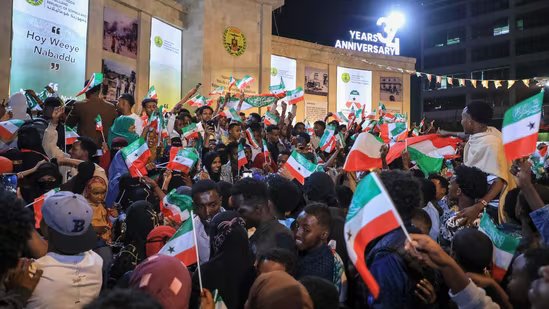
Israel on Friday became the first country to formally recognise Somaliland as an independent and sovereign state, a decision that has drawn sharp international backlash and renewed focus on a little-known, disputed region in the Horn of Africa.
Announcing the decision, Israeli Prime Minister Benjamin Netanyahu said Israel would pursue immediate cooperation with Somaliland across sectors such as agriculture, health, technology and the economy.
In a statement, he congratulated Somaliland President Abdirahman Mohamed Abdullahi, praised his leadership and extended an invitation to visit Israel.
Netanyahu said the recognition was “in the spirit of the Abraham Accords”, the US-brokered normalisation agreements that reshaped Israel’s relations with several Arab states.
The accords, signed in 2020 during the first term of former US President Donald Trump, led to Israel establishing formal diplomatic ties with the United Arab Emirates and Bahrain, with other countries joining later.
Also Read | What is ‘Somaliland’, the ‘independent state’ officially recognised by Israel?
Where is Somaliland?
The region has been vying for the recognition since 1991 when it unilaterally seceded from Somalia.
The territory is located in the Horn of Africa, in the northwestern part of Somalia, sharing coastline with the Gulf of Aden and bordering Djibouti.
Why the tensions?
Although it functions as a de facto sovereign entity with its own government, currency and military, it lacks international recognition and is still considered part of Somalia by the United Nations.
The lack of recognition has restricted access to foreign loans, aid and investment, leaving the region economically underdeveloped.
While Somalia has endured decades of civil war and instability, the breakaway region has remained largely peaceful by comparison.
Tensions escalated last year after landlocked Ethiopia reached a deal with Somaliland to lease a stretch of coastline for a port and a military base, a move that drew strong objections from Somalia.
Also Read | Netanyahu for, Trump against: Why are nations divided over recognizing Somaliland
Why the backlash?
Foreign ministers from more than 20 countries, along with the Organization of Islamic Cooperation, have strongly rejected Israel’s recognition of the “Somaliland” region of Somalia in a joint statement, warning that the move could destabilise the Horn of Africa and the Red Sea region.
In a joint statement, the ministers said Israel’s decision, announced on December 26, amounted to a “full and blatant disregard for international law” and could have “serious repercussions” for regional and international peace and security.
They condemned the recognition as a “grave violation” of the principles of international law and the UN Charter, which upholds state sovereignty and territorial integrity. The ministers also warned that recognising breakaway regions of sovereign states sets a “dangerous precedent” that threatens global stability.
Reaffirming support for Somalia, the signatories said they fully back the country’s sovereignty and “unequivocally reject any measures” that undermine its unity or territorial integrity.
The ministers also rejected any attempt to link Israel’s move to efforts to forcibly displace Palestinians, stressing that such actions are “unequivocally rejected in any form, as a matter of principle”.
The Palestinian Authority and Turkey, a close ally of Somalia, also rejected Israel’s decision.
Egypt said its top diplomat had held talks with counterparts in Turkey, Somalia and Djibouti, with all sides condemning the move and reiterating “full support for the unity, sovereignty and territorial integrity of Somalia”.
When asked by the New York Post whether the United States would also recognise Somaliland, Trump said “no”, adding: “Does anyone know what Somaliland is, really?”