“Ghost Elephants” is what filmmaker Werner Herzog calls the subjects of his latest documentary, acknowledging in his title that the animals may not exist. Longtime fans of Mr. Herzog will nod sagely: Men whose level of commitment to a dangerous obsession straddles the line between admirable and demented have formed the core of Mr. Herzog’s work for more than half a century. As is usually the case in the German director’s films, it’s the vigor of perpetual seeking that matters, not the resolution (if any).
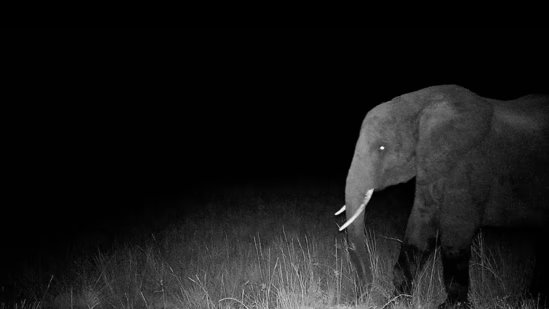
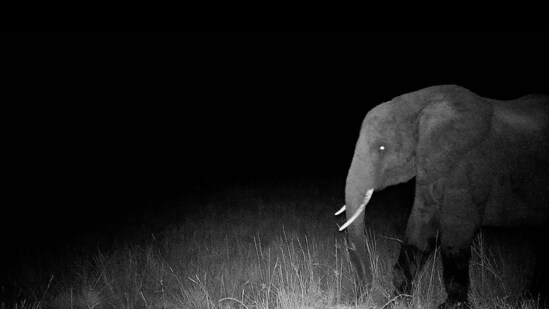
An elephant captured by a motion-controlled camera.
As exhibited in many documentaries (he has made more than 30) as well as a number of fiction films, Mr. Herzog’s career is a story of rambling joyously around the planet, with a child’s sense of wonder, a poet’s affinity for the mystical, and a scientist’s attention to forensic detail. The hero of this feature (in theaters ahead of a March 8 release on Hulu and Disney+) is a South African explorer named Steve Boyes, whom we meet as he visits the Smithsonian National Museum of Natural History to gaze in awe upon a taxidermy mount of the largest land mammal hunters have ever killed.
“Henry,” as the bull elephant was nicknamed, was shot by a team who took him down with 16 high-caliber bullets in 1955 and stands just over 13 feet tall. He’s heavier than the largest T. Rex ever unearthed, so huge that his magnificent tusks and skull had to be stored separately, in a back room. Mr. Boyes wonders if any current descendants of Henry—any similarly gargantuan beasts—are still roaming the planet, then sets out to find them, if they exist.
Mr. Herzog, who with his intensely dramatic yet dryly matter-of-fact vocal stylings lends the feature his typically scintillating narration, follows him on a journey to Namibia and Angola in search of the ghost elephants. Mr. Boyes intends to extract DNA samples from them via darts designed to break the skin, then fall away. Many obstacles await, some of them deadly.
The photography is occasionally dazzling—a standout sequence is a series of time-lapse images providing views of the movements of the stars over Africa—but Mr. Herzog is primarily a storyteller, albeit a digressive one. As in many of his previous, highly engaging documentaries (2005’s “The White Diamond,” 2008’s “Encounters at the End of the World,” 2011’s “Cave of Forgotten Dreams”), the film revels in tangents, asides and speculation. Mr. Herzog is interested in everything, and makes everything interesting, exulting in all of the world’s settings, the stranger the better. He takes his time absorbing every seemingly inconsequential detail as he becomes attached to the personalities of eccentrics on their self-assigned quests to accomplish unlikely goals.
We meet three master trackers who, the narrator says, “read tracks in the sand as we would read a newspaper”; have a dizzying encounter with a slug that has buried itself deep beneath the soil, and which is so acutely poisonous that men who get scratched describe making deep cuts in their own arms to bleed out the toxin and save their lives; and pause to pay homage to the king of the Nkangala people, Regedor Kaketche, whose realm appears to be a modest one. His throne room is made of cinder blocks and has a dirt floor. The king solemnly advises the adventurers on how, according to lore, elephants became revered participants in the history of his people.
In the forests of Angola, Mr. Boyes’s group heads into a little-explored section that’s approximately the size of England yet has no formal roads or bridges. Traversing this land means, for instance, wading across a river that is said to be a home of crocodiles. The adventurers reckon that they’re probably safe because it’s off-season for the toothy beasts.
In keeping with my longstanding policy of avoiding actions that might put me between the jaws of a crocodile, the expedition is not exactly the kind that might entice me to find my wading boots. But that’s why we have movies. The lean, athletic Mr. Herzog, 83 years old, seems as spry and eager as ever, and his global enthusiasm remains a force of nature in itself. “Ghost Elephants” takes its place as yet another of the director’s essential forays into the wild and unknown.