
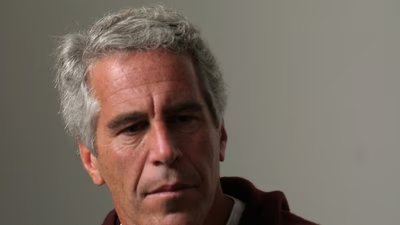
NEW YORK—Jeffrey Epstein never earned a college degree—let alone one from a fancy Ivy League university.
Yet some of Epstein’s deepest ties were with America’s most distinguished academics, cultivated over years through financial support, shared interests and hospitality at his glittering properties.
Those relationships are now imploding careers at elite universities as millions of Epstein-related documents released by the Justice Department show how the late sex offender stretched his tentacles deep into academia.
Just this week, Richard Axel, a Nobel laureate Columbia professor, and Lawrence Summers, the decorated economist and former Harvard president, stepped down from positions at their institutions because of their Epstein ties.
Axel said Tuesday that he would resign as co-director of Columbia’s Mind Brain Behavior Institute, calling his association with Epstein “a serious error in judgment.” Summers, meanwhile, said Wednesday that he would end his tenure as a Harvard professor at the end of the academic year. In November, he took leave from teaching duties, apologized and said he was “deeply ashamed” after the release of a batch of emails in which he asked Epstein for advice on “getting horizontal” with a woman he was pursuing.
Last week, Bard College retained a law firm to review President Leon Botstein’s ties to Epstein after the latest emails released by the Justice Department showed what appeared to be a warm personal relationship—even years after Epstein pleaded guilty in 2008 to charges of solicitation of prostitution and procurement of minors to engage in prostitution.
In a statement earlier this month, Botstein said Epstein wasn’t a friend and that his dealings with him were “only for the sole purpose of soliciting donations for the College.”
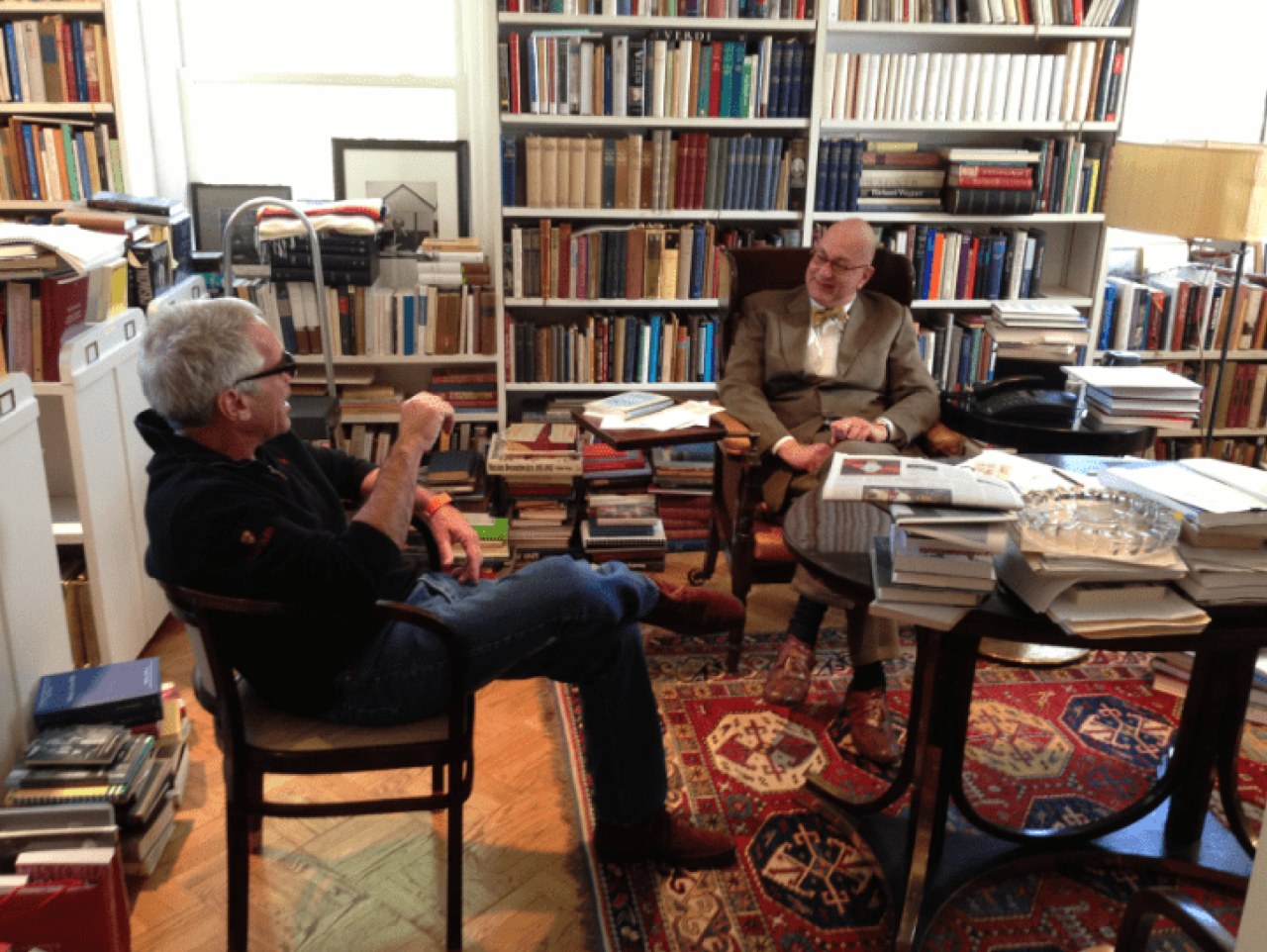
Epstein’s associates in the world of academia ranged from household names such as MIT linguist Noam Chomsky and theoretical physicist Stephen Hawking to lesser-known but influential stars in fields such as computer science and artificial intelligence.
Unlike the Wall Street titans and private-equity investors Epstein courted, professors and researchers couldn’t grant him access to vast fortunes. But they helped to burnish the myth of intellectual genius that was also essential to his rise.
In a 2007 New York magazine profile, for example, Axel vouched for Epstein’s unique smarts, saying: “He has the ability to make connections that other minds can’t make. He is extremely smart and probing. He can very quickly acquire information to think about a problem and also to identify biological problems without having all the data that a scientist would have.”
Epstein, himself, played up the part by frequently donning a Harvard sweatshirt, spending time on campuses and haunting TED conferences devoted to discussions of futuristic sciences and technology. He also hosted a gathering for physicists in the Virgin Islands in 2006. One of the Justice Department documents was a “list of scientists” with 30 names and what appeared to be blacked-out contact information.
Academics were useful props as Epstein embarked on a campaign to rehabilitate his image as a science-oriented philanthropist after his 2008 criminal conviction. Some remained steadfast defenders.
In a reminder of the banter that flowed freely among some powerful men in the pre-MeToo era, messages between Epstein and his academic associates that made it into the documents shared by the Justice Department were often sprinkled with objectifying remarks about women, particularly undergraduate students.
In December 2010, for example, American virologist Nathan Wolfe invited Epstein to a dinner with an investor and “a couple of hottie interns from WEF,” he wrote. The two remained in touch as late as 2018. “Hey Jeffrey,” Wolfe wrote. “It’s been forever. I’m in NYC this week. You around? Let’s catch up.”
A Stanford spokeswoman said Wolfe’s visiting appointment at the university ended early last week, when it was scheduled to do so. Wolfe didn’t immediately reply to a request for comment.
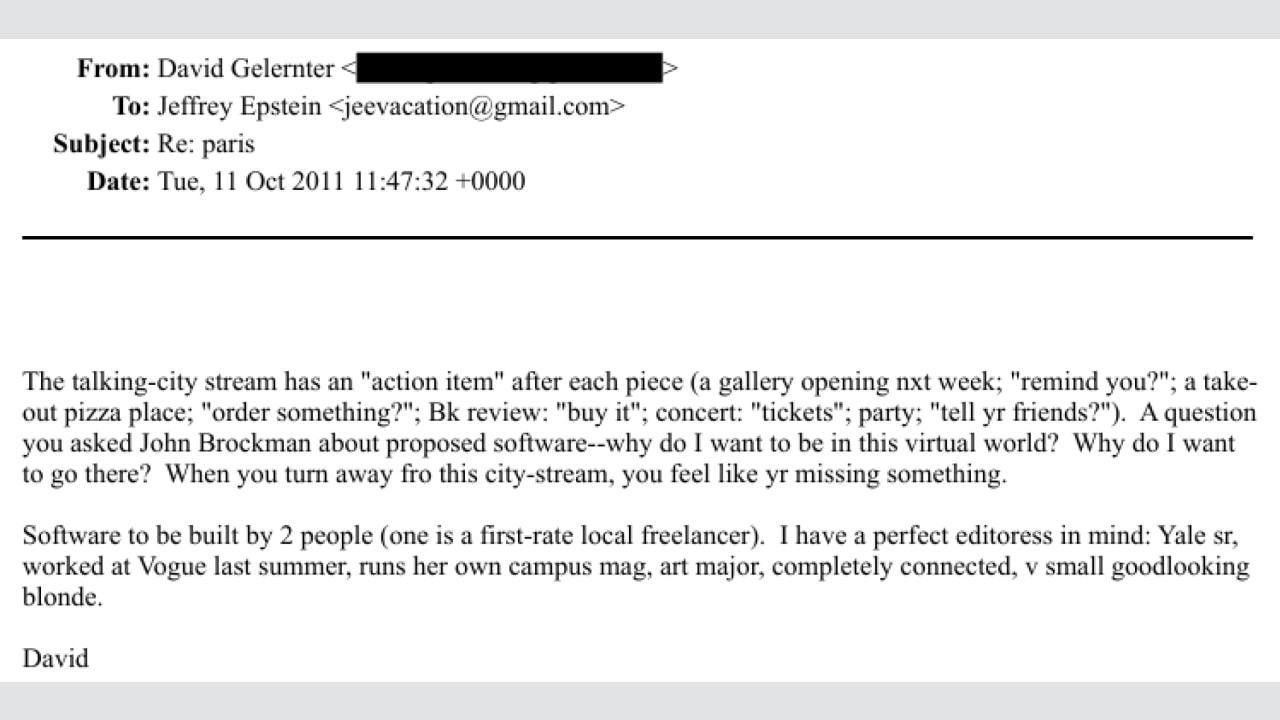
In a 2011 email to Epstein, Yale computer-science Prof. David Gelernter described an undergraduate as a “v small goodlooking blonde.” Gelernter didn’t respond to a request for comment.
For Epstein, money was the primary means to infiltrate cash-hungry academic institutions, which can employ hundreds of people in their development offices. Fundraisers often beat the bushes—and alumni networks—cultivating relationships with potential patrons.
In a May 2020 report, Harvard revealed that Epstein had contributed $9.1 million to the university in the decade before his conviction. The bulk of that—some $6.5 million—was a 2003 pledge, during Summers’s presidency, to establish the school’s Program for Evolutionary Dynamics under Prof. Martin Nowak. On Wednesday, Nowak, a mathematics professor, was placed on paid administrative leave in connection to a university investigation into his ties with Epstein, a Harvard spokesman said. Nowak didn’t respond to a request for comment.
That multimillion-dollar gift appears to be the exception. More typically, Epstein’s gifts to individual scientists totaled in the tens-of-thousands of dollars, making them a relative bargain among his investments.
That is consistent with the feast-or-famine environment of higher education. While a handful of star researchers on the cutting edge of science attract federal grants in the tens-of-millions of dollars, faculty in the social sciences and humanities often struggle to generate six figures.
Robert Trivers is one example. In 2007, the Swedish Royal Academy of Science awarded Trivers, then a professor of anthropology at Rutgers University, the Crafoord Prize, a prestigious science award that is often mentioned alongside the Nobel. His research ranged from honor killings to the evolutionary dimension of human altruism and the logic of deceit and self-deception.
In a March 2019 email included in the Justice Department documents, Trivers—who by then had left Rutgers—listed the tens of thousands of dollars Epstein had lavished on him over the years.
“When you once said, perhaps in Palm Beach, that there would never be a time when you would not support me, i joked to friends this was better than social security,” Trivers wrote, praising Epstein’s “personal integrity.”
In a separate email to Epstein that month, Trivers said that he had faced backlash for public remarks in which he had defended Epstein’s conduct as not “so heinous” because adolescent girls now matured far earlier than their counterparts did decades ago. A message to Trivers prompted an automatic email response stating that he is now in poor health and asking for privacy.
Sometimes, one Epstein academic contact opened the door to another. That appeared to be the case with Nouriel Roubini, the American economist and New York University professor best known for predicting the 2008-09 financial crisis.
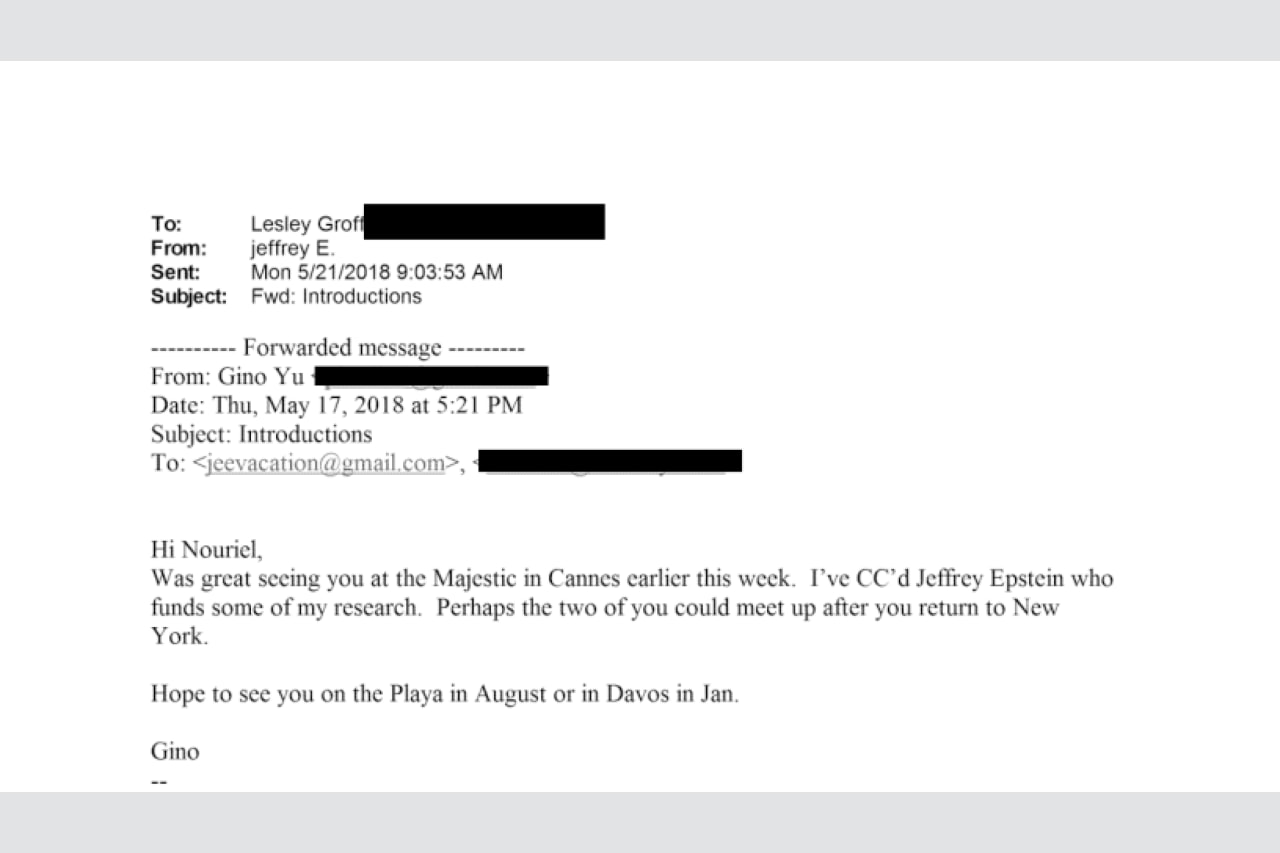
Roubini was introduced to Epstein by another, lesser-known academic, Gino Yu. “Was great seeing you at the Majestic in Cannes earlier this week,” Yu wrote to Roubini in 2018, according to the released emails. “I’ve CC’d Jeffrey Epstein who funds some of my research. Perhaps the two of you could meet up after you return to New York.”
Yu signed off: “Hope to see you on the Playa in August or Davos in Jan.”
Later that year, emails and calendar entries showed Epstein’s assistant coordinating with Roubini to arrange a meeting.
Roubini told The Wall Street Journal on Wednesday that he met Epstein only once in his office for a half-hour, and never interacted with him again. “He wasn’t really interested in my views but rather name dropping,” Roubini said. He added that he had learned about Epstein’s 2008 conviction in 2011. Yu didn’t immediately respond to a request for comment.
There was something else that academics offered Epstein beyond a veneer of respectability: access. Or, at least the appearance that he could help the children of his wealthy contacts win admission to Ivy League schools.
In a series of 2016 emails included in the Justice Department documents, Epstein appeared to arrange for Axel to help smooth the path to Columbia for Alice de Rothschild, a scion of the banking family.
In September, Epstein wrote to Axel: “im in paris, im bringing the rothschild girl 18 to new york, trying to convince her to go to columbia, psychology, or cognitice science. who should i call.”
Axel replied: “send me CV or better her application. I will look over and get to the right people.”
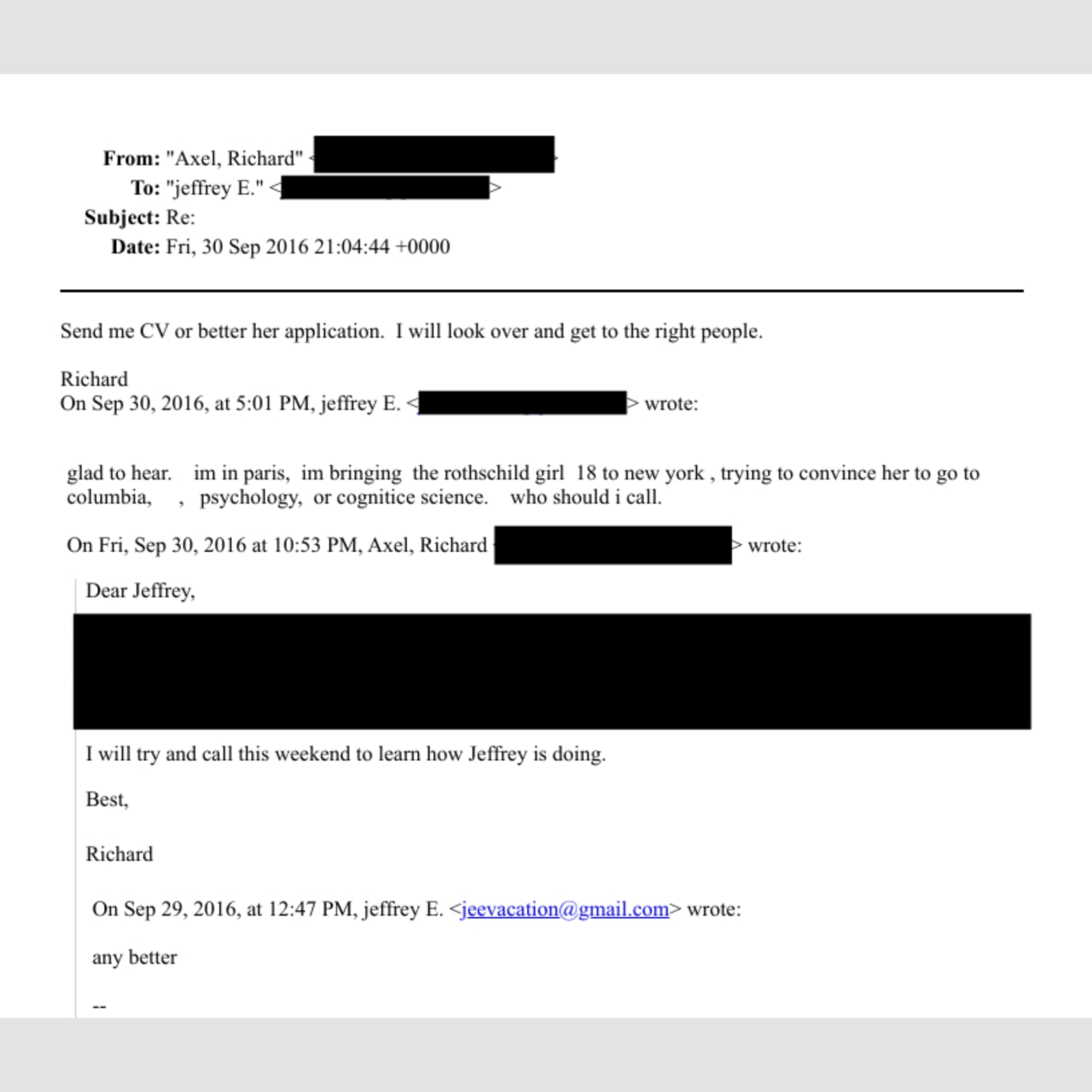
In October, Epstein wrote Axel again: “the baroness and daughter would like to see columbia on thurs. . she is the wealthiest woman in europe.”
A Columbia spokesperson said Axel has “often been asked to speak with prospective students interested in applying to Columbia” but “has no role in or power over admissions processes.”
In February 2017, Axel broke the bad news to Epstein: Alice de Rothschild had been denied admission.
She would go on to study biology at NYU from 2017 to 2022. A family spokesperson said: “Alice de Rothschild’s university admissions in the United States, as well as her rejections, are entirely due to her grades. Alice cannot be held responsible for Jeffrey Epstein’s unilateral actions.”
Write to Joshua Chaffin at joshua.chaffin@wsj.com, Neil Mehta at neil.mehta@wsj.com and Douglas Belkin at Doug.Belkin@wsj.com