There is something telling about the Kohrra franchise and its inextricable link to NRIs. Twice in a row now, the show has had NRI murder victims. Perhaps it is this NRI identity that forces an overstretched police department to stitch an investigation out of fraying threads, even as their own lives unravel. To make this contrast more explicit this season, we are introduced to the son of an enslaved labourer hopelessly looking for his lost father across police stations. Eventually, the justice system fails him in a profound way that is both expected and inevitable.
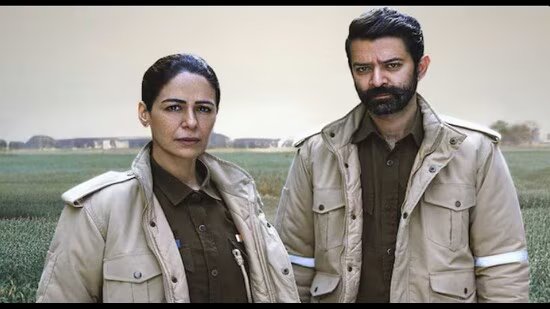
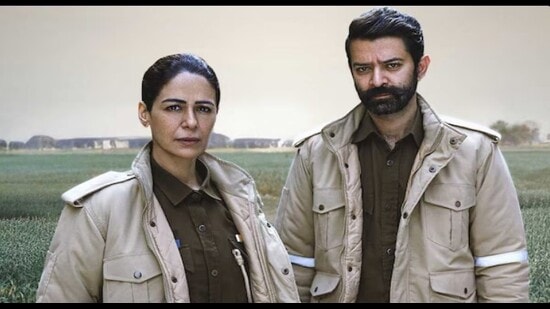
Mona Singh and Barun Sobti in Kohrra Season 2 (Still from Kohrra Season 2)
The second season of Kohrra paints a portrait of Punjab so viscerally ugly that you just cannot afford to look away. The state’s cultural vibrance is traded for abandoned fields; the sunlit cityscape for grey hinterlands. The visual grammar echoes the first instalment, even as directors Sudip Sharma and Faisal Rahman descend deeper into the shadows, examining the corrosive familial tensions that form the spine of the six episodes.
A harrowing reality now in north India, property disputes — which often snowball into legal battles — are explored in all their brutal ramifications. A slow-burn devastation is triggered when Preet (Pooja Bhamrrah) moves into her brother’s house after separating from her NRI husband. A wounded yet spirited woman, Preet not only stakes a claim to her father’s property but exposes her brother’s philandering ways. Chaos ensues. Legal notices are sent. Potential heirs are assaulted. The family structure — whatever little of it remained — collapses. I wondered if these acts of usurping each other’s share — disguised as attempts to secure one’s future — were manifestations of calculated self-interest masquerading as self-preservation.
Mona Singh plays Dhanwant Kaur — an aggrieved mother, a once-disgraced police inspector, and a woman fighting with all her might to hold her life together as it steadily unravels. Her husband is an alcoholic swimming in deep despair, afflicted by the guilt of having unwittingly caused his son’s death. Dhanwant’s arc is truly tragic. There is little that the inspector can do to unlive the life that has unfolded. Her existence is less about moving forward than about learning to live with what cannot be undone. She is haunted by her son’s presence, overcome with grief at losing him.
Barun Sobti returns as Amarpal Garundi. He is a stand-in for police brutality, but much of his violence that was earlier critiqued is now played for laughs. Garundi is embroiled in a complicated case of accidental parentage that drives a wedge between him and his wife, Silky. The dynamic between Dhanwant and Garundi is affectionate rather than adversarial. At one point, Dhanwant calls Preet “tedhi janani” (a difficult woman). The description begs for the viewer to concur that Preet must have done something right to have ruffled so many feathers.
Punjab’s reel-obsessed youth take up considerable narrative space this season. We are introduced to a crop of music video stars, DJs with Russian monikers and blue-haired artists — all of whom moonlight as scammers. These flashy, aesthetically appealing GenZ-adjacents are not entirely different from the show’s grittier character archetypes. They are capable of being just as calculating — some even siphoning off lakhs from victims. It’s just that they conceal their shrewdness under aesthetics so well, it goes undetected. Adding to this vain obsession with aesthetics is Silky’s nail bar, which quickly emerges as a placeholder of Garundi’s affection. With Silky gone, Garundi fights against time to set up the studio in her absence, waiting hopelessly for her return.
Further complicating its portrait of Punjab’s self-destructive cultural patterns, the show confronts the state’s long history of bonded labour — an ongoing crisis that seldom finds space in mainstream conversation. Bonded labourers from Bihar and Jharkhand, often belonging to Dalit communities, work tirelessly in appalling conditions in Punjab. In a gut-wrenching scene, we see a psychologically troubled labourer revisit the house in which he was enslaved. Having secured his freedom, he returns to the barn and fastens the irons around his own ankles, as though compelled to rehearse the trauma that has long governed his body. The image refuses to leave you, persisting long after the final frame dissolves. In its wake, the arc gives voice to generations of bonded labourers long held captive by Punjab’s elite. Writers Sudip Sharma, Gunjit Chopra, and Diggi Sisodia don’t fight shy of exposing the multigenerational impact of this evil practice.
Of all the evocative sequences and montages in the season, the most striking is when we see Lohri celebrations unfold. The festive grief cuts through these visuals. For Dhanwant, the deepest wound is her son’s absence. She sits in her car parked at the intersection where her son breathed his last, replaying the visuals in her head in despair. For Garundi and Silky, it is the ache of accidental parentage spoiling their relationship. For Sam (played by Rannvijay Singha), it is the devastation of losing his wife to a crime he did not anticipate. And for the aggrieved son searching for his father, Lohri is less a festival than a huddle around a wavering bonfire — an evening spent among men who, like him, sleep on pavements with no home to return to.
Kohrra Season 2 opens with visuals of prabhat feri. As the morning procession fades into the dawn, the fog leaves behind not just a murder mystery but a reckoning. What remains is a Punjab caught between inheritance and implosion, unable to outrun the ghosts it has raised. It is a portrait so unflinching it refuses to loosen its grip on memory.
Deepansh Duggal writes on art and culture. Twitter: @Deepansh75.