
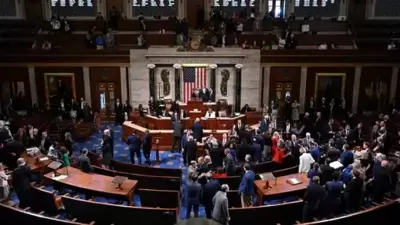
US President Donald Trump will address the joint session of Congress at the United States Capitol on Tuesday. The address comes amid political debate over immigration enforcement and federal spending, according to The Hill.
When Trump delivers his address, the seating inside the House chamber will follow a long-established protocol structure of the US government
Vice president and speaker sit behind the president
As the president delivers his remarks from the rostrum, JD Vance and Mike Johnson are expected to sit directly behind him. Their placement is symbolic of the presence of both the executive and legislative branches during the address.
Cabinet, justices and military leaders in front rows
The first rows facing the dais are reserved for Cabinet secretaries, justices of the Supreme Court of the United States, the Joint Chiefs of Staff, members of the diplomatic corps and other dignitaries.
Former lawmakers and senior officials are also typically seated in this section.
Also Read: Trump’s State of the Union address: Which guests and speakers are attending? All we know
Lawmakers seated on a first-come basis
Most seats on the House floor are not assigned. According to the Congressional Research Service, senators and House members choose seats on a first-come, first-served basis.
Lawmakers often sit with colleagues from across the aisle as a gesture of unity.
Each House member may invite one guest, who sits in the gallery above the chamber.
Presidential guests sit with the First Lady
The president usually invites about two dozen guests whose stories highlight key policy themes. They are seated in the First Lady’s box on the chamber’s left side, where they are visible to lawmakers and television viewers.
Also Read: Fact-checking Trump’s 8 wars claim at the Board of Peace speech; ‘9th one is coming’
The designated survivor stays away
One Cabinet member is kept away from the event as the “designated survivor,” remaining at a secure location to ensure continuity of government in case of an emergency.
Several Democrats are boycotting the speech and organizing alternative rallies near the Capitol to protest his policies, especially on immigration. According to the New York Times, last year, many democrats felt that they mishandled their response to President Trump’s joint address to Congress. Representative Al Green of Texas was removed from the chamber and later censured after interrupting the speech while waving his cane.