
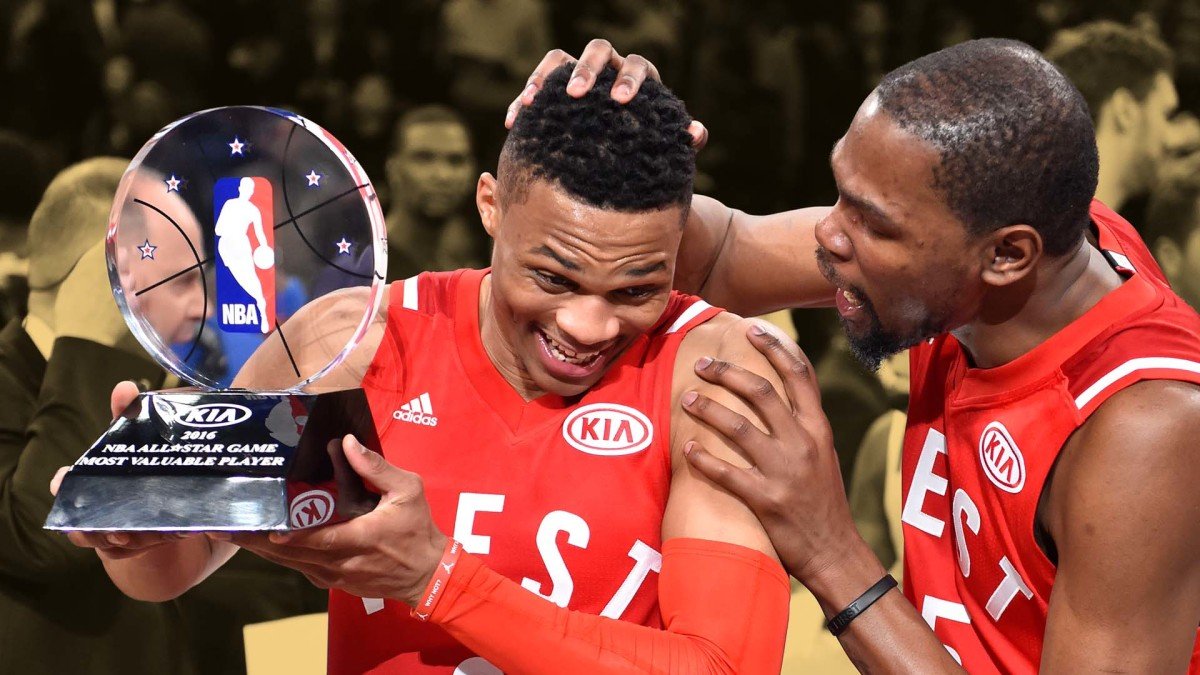
Nowadays, the era of Kevin Durant and Russell Westbrook in the Oklahoma City Thunder is viewed through the lens of failure. How else can you describe a situation in which the two of them, alongside James Harden, went on to build Hall of Fame careers, yet never brought the Larry O’Brien trophy to OKC?
Still, few could have predicted that more than 15 years later, the trio would collectively own two Finals MVPs, three MVP awards, nine scoring titles, five assist titles, an all-time triple-doubles record and very likely finish their careers as top 10 scorers in league history.
Advertisement
At the time, however, they were young. The franchise had just reloaded from Seattle to OKC, and they were still growing into the superstars they would later become. Patience was required and many believe the tension stemmed from the perception that Westbrook saw himself as the team’s true leader.
“Man, I led my team in shots ever since I’ve been in the league. But playing with Russell Westbrook, a lot of people said I should put him in his place,” KD said on “First Take”. “He’s a player that you can’t put in his place. He’s a big personality. I was just gonna support him no matter what. My whole thing was to let these guys grow and be creative in their own space. You know, that’s what teammates do.”
KD was always the main guy in OKC
KD has a point. During his stint in OKC, he looked like the best player in the world, right behind LeBron James and as good as Westbrook was, he was not on that level.
Advertisement
In 526 games with the Thunder, Durant averaged 28.1 points, 7.4 rebounds, 3.7 assists, 1.2 steals and 1.0 blocks per game, shooting 48.9 percent from the field, 38.7 percent from deep and 88.3 percent from the free-throw line. He attempted 19.2 shots per game, including 4.9 3-pointers and 8.4 free throws per contest. His usage rate during that span was 30.4 percent.
Westbrook averaged 20.7 points, 7.5 assists, 5.4 rebounds and 1.7 steals, shooting 43.7 percent from the field, 30.4 percent from three and 81.5 percent from the line. He attempted 16.7 shots per game, 2.7 of them from beyond the arc and got to the free-throw line 6.5 times per game. His usage rate was slightly higher than Durant’s at 30.9 percent, which makes sense given that he was the team’s primary ball handler.
However, reports suggested that the 6-foot-11 forward ultimately left OKC because of frustration with Westbrook’s ball-dominant style.
Advertisement
“Durant wanted an offense that kept the ball moving and provided him easier scoring chances,” the report said. “The Thunder fired coach Scott Brooks, brought in Billy Donovan and still the offense stalled out at key moments, often with Westbrook dribbling into oblivion.”
“Ultimately, he got frustrated and felt that they had plateaued,” a source close to Durant told Bleacher Report. “[Donovan] came in and he still had the same issues that he had with Russ under Scotty. The offense didn’t change much. He still had to take a ton of contested shots every game and that’s when he had the ball at all.”
KD eventually went to GSW to play in the system that suited him perfectly
There were brilliant moments as teammates, including several deep playoff runs. The peak came in 2012, when they reached the NBA Finals but lost 4-1 to the Miami Heat and their “Big 3”.
Advertisement
They played perhaps their best basketball in 2016, when they held a 3-1 lead in the Western Conference finals against the 73-9 Golden State Warriors. OKC looked ready to capture its first title since relocating, but they blew the lead and that collapse effectively marked the end of Durant’s era in OKC.
A partnership many still believe could have worked had they stayed together remains one of the league’s greatest “what ifs”. In the end, Durant got what he wanted. He joined GSW, a team whose ball movement and system suited him perfectly and won two championships, while Westbrook continues to chase his first title.
This story was originally published by Basketball Network on Feb 23, 2026, where it first appeared in the Old School section. Add Basketball Network as a Preferred Source by clicking here.