
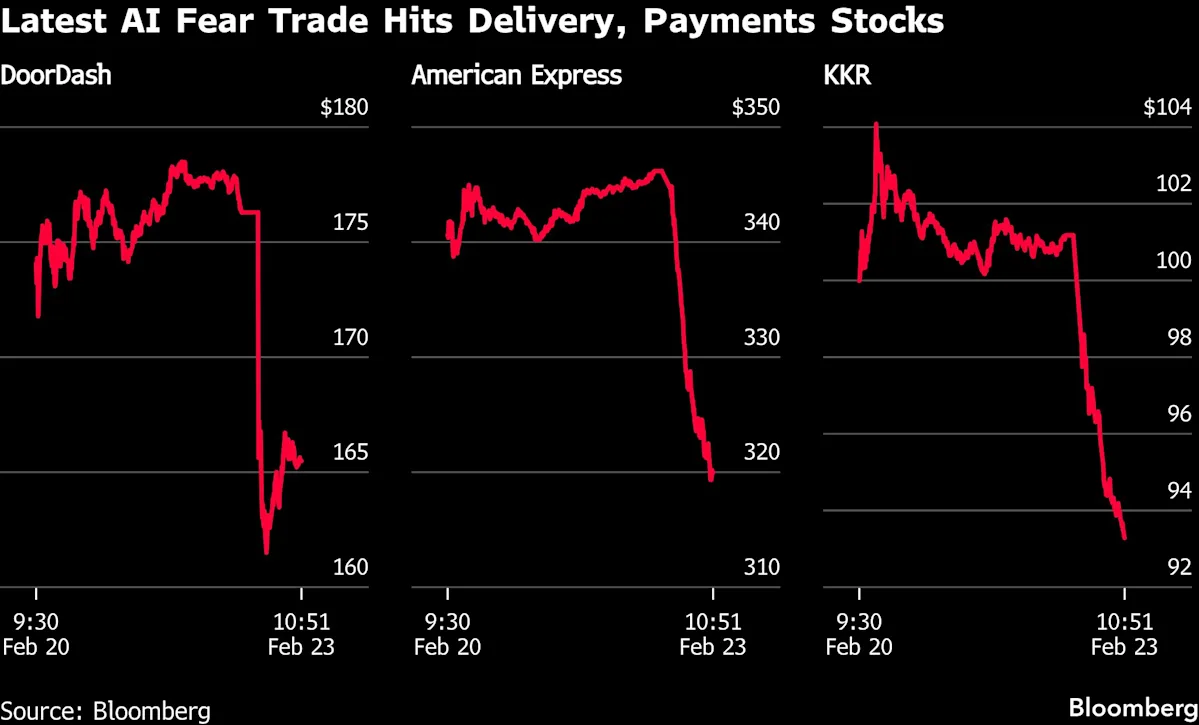
(Bloomberg) — The artificial intelligence “scare trade” erupted again on Monday as growing concerns about the disruptive power of AI dragged down shares of delivery, payments and software companies, and sent International Business Machines Corp. to its worst plunge in 25 years.
It began after a bearish report was published over the weekend by a little known firm called Citrini Research.
Most Read from Bloomberg
The report, released on social media Sunday, outlined the potential risks to various segments of the global economy, using hypothetical scenarios set in the future, specifically calling out food delivery services and credit card companies as ones facing trouble.
Then AI startup Anthropic said in a blog post Monday that Claude Code tool can help with modernizing COBOL, a dated programming language that’s mainly run on IBM computers.
And finally came a warning from Nassim Taleb: investors should brace for escalating volatility and even bankruptcies in the software sector as the AI rally enters a fragile phase.
IBM shares closed down 13%, the biggest one-day drop since 2000. DoorDash Inc., American Express Co., KKR & Co Inc. and Blackstone Inc. all slumped by at least 6%. Shares of other companies name-checked in the article, including Uber Technologies Inc., Mastercard Inc., Visa Inc., Capital One Financial Corp. and Apollo Global Management Inc. all fell by 4% or more.
“The sole intent of this piece is modeling a scenario that’s been relatively underexplored,” a preface to the article, which was published Sunday, said. “Hopefully, reading this leaves you more prepared for potential left tail risks as AI makes the economy increasingly weird.”

Citrini Research, founded by James van Geelen, presented a scenario set in June 2028 where AI’s disruption has caused mass unemployment for white collar workers, declining consumer spending, software-backed loan defaults and economic contraction. Still, the report notes clearly — “What follows is a scenario, not a prediction.”
Among the various outcomes discussed in this “thought exercise,” Citrini laid out a situation where the dominance of delivery apps like DoorDash and Uber Eats are displaced by “vibe-coded” alternatives.
“We definitely believe agentic commerce will be transformative to the industry,” DoorDash co-founder Andy Fang said in an X post in response to Citrini. “The ground is shifting underneath our feet, and the industry is going to need to adapt to it.”