DONALD TRUMP does not get it. On February 21st Steve Witkoff, his envoy to the Middle East and elsewhere, told Fox News that the president cannot understand why Iran has not “capitulated” to America’s demands over its nuclear programme, given the vastness of the American military presence now looming over the Islamic Republic. The latest addition to that force streaked over Israel’s Mediterranean coast on February 19th at 31,000 feet, clearly visible in the afternoon sun. The E-3 AWACS were en route to a Saudi Arabian air-force base where American troops are stationed. Their mission would be to co-ordinate multiple sorties in complex air operations over Iran, if war happens. America has built up a huge military presence in the Middle East—the biggest overseas in over two decades, with more than one-third of all available American naval vessels now in the region. Its presence means Mr Trump has a range of options if he decides to attack Iran.
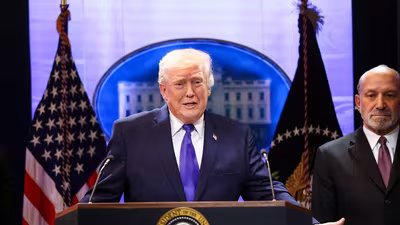
US President Donald Trump. (REUTERS)
He has ordered strikes on Iran before. In June he sent seven B-2 stealth bombers, which flew 18 hours from Missouri, to drop bunker-busting bombs on Iran’s nuclear facilities. But if he does order another assault, the range of targets would almost certainly be far more expansive—and the consequences uncertain.
A second aircraft-carrier is due to arrive in the region within days. With that, America will have assembled a force of around 200 fighter-jets along with a supporting fleet of AWAC command-and-control aircraft, aerial tankers and electronic-warfare and rescue aircraft. It also has warships capable of launching hundreds of Tomahawk cruise missiles. America has also beefed up its missile-defence forces in the region, with batteries of THAAD and Patriot missile interceptors flown in, and squadrons of F-15E fighters, with guided rockets, capable of shooting down Iranian drones. “The abundance of assets America now has in the theatre clearly reflects the intention this won’t be just a one-off sortie, but a sustained air campaign, with repeating missions and presence in Iranian airspace,” suggests Eden Attias, a former Israeli air-force general.
Talks between American and Iranian negotiators are expected to continue in Geneva on February 26th. The president has repeatedly expressed his desire for a diplomatic solution to the stand-off with Iran. But, as Mr Witkoff explained, despite the pressure of America’s military threat, it is proving “hard” to get the Iranians to say “‘We profess that we don’t want a weapon, so here’s what we’re prepared to do.’” Maintaining the current level of military readiness is prohibitively expensive and at some point risks leaving other regions exposed.
If Mr Trump loses patience and decides to attack, his generals will be considering a range of options. They could hope to bomb Ayatollah Ali Khamenei, Iran’s supreme leader, and those close to him. Mr Trump might be hoping for a similar outcome to that seen in Venezuela whereby another figure in the Iranian leadership, more amenable to deal-making and America more generally, would take charge. Many in the region believe discreet negotiations towards such an outcome are already under way. But given the anger within Iran following the massacre of protesters last month, installing another member of the existing regime may be viewed by Iranians as betrayal on the part of America after Mr Trump promised to come to the aid of protesters.
America could also target the Islamic Revolutionary Guards Corps (IRGC), the regime’s military arm, which was involved in the bloody suppression of the protests. That could involve hitting local IRGC headquarters or aiming to kill its leadership, which so far has shown no signs of breaking with the regime. It could also try to destroy other military targets, including the regular army. America may decide to attack Iran’s ballistic-missile bases that threaten America’s own bases in the regions, as well as its allies. It might also focus some attention once again on Iran’s remaining nuclear sites. A military operation could hit all five sorts of targets. Even a limited strike against the IRGC could be paired with a huge effort to pre-empt and limit Iran’s capability to launch retaliatory attacks.
Iran, inevitably, is considering its more limited options, too. Its air force is small and consists mainly of creaky American jets purchased over half a century ago, when the shah ruled. In lieu of an air force that can pose any real threat, Iran has built up a formidable force of ballistic and cruise missiles and long-range drones. It managed to fire missile salvoes at Israel throughout the 12-day war last June, despite Israel’s air force gaining air superiority over Iran and carrying out hundreds of strikes unimpeded.
Iran’s choice of targets will be determined as well by the regime’s understanding of the events. Iran could fire once again at Israel, though this would mean drawing another of Iran’s foes into the new war. It could also aim at American bases throughout the region, notably the Gulf states, as it did in Qatar last summer. “In the previous rounds, it was clear that they [strikes] would be short and limited, and that all the sides were looking for an off-ramp,” says a senior Israeli officer. “Iran’s leaders may work on the same assumption this time—that any strike is a prelude to more negotiations. But the size of forces deployed by the Americans and the talk of regime change could lead them to believe they have nothing to lose by firing everything they have in all directions.” That could include urging its proxies, Hizbullah in Lebanon and the Houthis in Yemen, to unleash their missiles, supplied by Iran.
All this leaves Mr Trump a dilemma. It is unclear what he hopes to achieve with his vast arsenal. Talk of punishing the regime for the slaughter of its citizens has quietened. He has mentioned regime change. But he has also emphasised his desire for a nuclear deal. Air strikes may fail to achieve any of these things. Limited ones will do little to coerce Iran into making sufficient concessions on its nuclear programme to allow Mr Trump to claim a win. A sustained, large-scale attack, designed to bring about regime change, risks dragging America into yet another protracted war in the Middle East, the consequences of which would be highly uncertain. Mr Trump almost certainly does not want that kind of involvement. He may still be hoping that he can ratchet up the pressure sufficiently, perhaps with some kind of more limited strikes, so that Iran’s leaders, already weakened, capitulate. But it is far from clear that such bombing raids alone can bring about political change on the ground.