
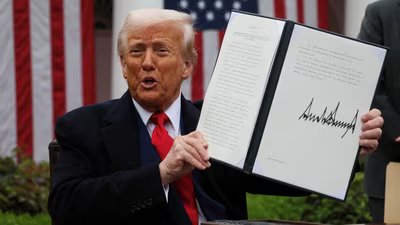
The Supreme Court on Friday struck down President Donald Trump’s global tariffs. The justice, in a 6-3 ruling authored by conservative Chief Justice John Roberts, focused on tariffs imposed under an emergency power, including the sweeping “reciprocal” tariffs announced by the Trump administration of almost every country.
What the Supreme Court said
The US Supreme Court ruled that the Trump administration’s interpretation that the International Emergency Economic Powers Act (IEEPA) law grants the US President power to impose tariffs would intrude on Congress’s authority and violate a legal principle called the “major questions” doctrine.
Follow for live updates on Trump traiffs
US Chief Justice John Roberts cited a prior Supreme Court ruling in the order and wrote that “the president must point to clear congressional authorisation to justify his extraordinary assertion of the power to impose tariffs,” adding: “He cannot.”
The “major questions” doctrine, supported by the conservative justices, holds that any major executive action with significant economic or political impact must have clear congressional approval. The court relied on this principle to block several key executive measures introduced by former Democratic President Joe Biden.
Also read: Why has US Supreme Court struck down Trump’s global trade tariffs? A four-point explainer
“Our task today is to decide only whether the power to “regulate … importation,” as granted to the president in IEEPA, embraces the power to impose tariffs. It does not,” Roberts wrote in the ruling.
Roberts wrote that if Congress had intended IEEPA to bestow on the president “the distinct and extraordinary power to impose tariffs, it would have done so expressly, as it consistently has in other tariff statutes.”
Along with Roberts, the majority were conservative Justices Neil Gorsuch and Amy Coney Barrett, both appointed by Trump during his first term, along with the three liberal justices.
Also read: US Supreme Court strikes down Donald Trump’s tariffs
What the dissenting judge said?
Meanwhile, the three dissenting justices were conservatives Clarence Thomas, Samuel Alito and Brett Kavanaugh.
Kavanaugh, who was also appointed by Trump during his first term as president, in a written dissent said that IEEPA’s text, as well as history and prior Supreme Court rulings, supported the Trump administration’s position.
“Like quotas and embargoes, tariffs are a traditional and common tool to regulate importation,” wrote Kavanaugh, whose dissenting opinion was joined by Thomas and Alito.
“The tariffs at issue here may or may not be wise policy,” Kavanaugh added. “But as a matter of text, history, and precedent, they are clearly lawful. I respectfully dissent.”