
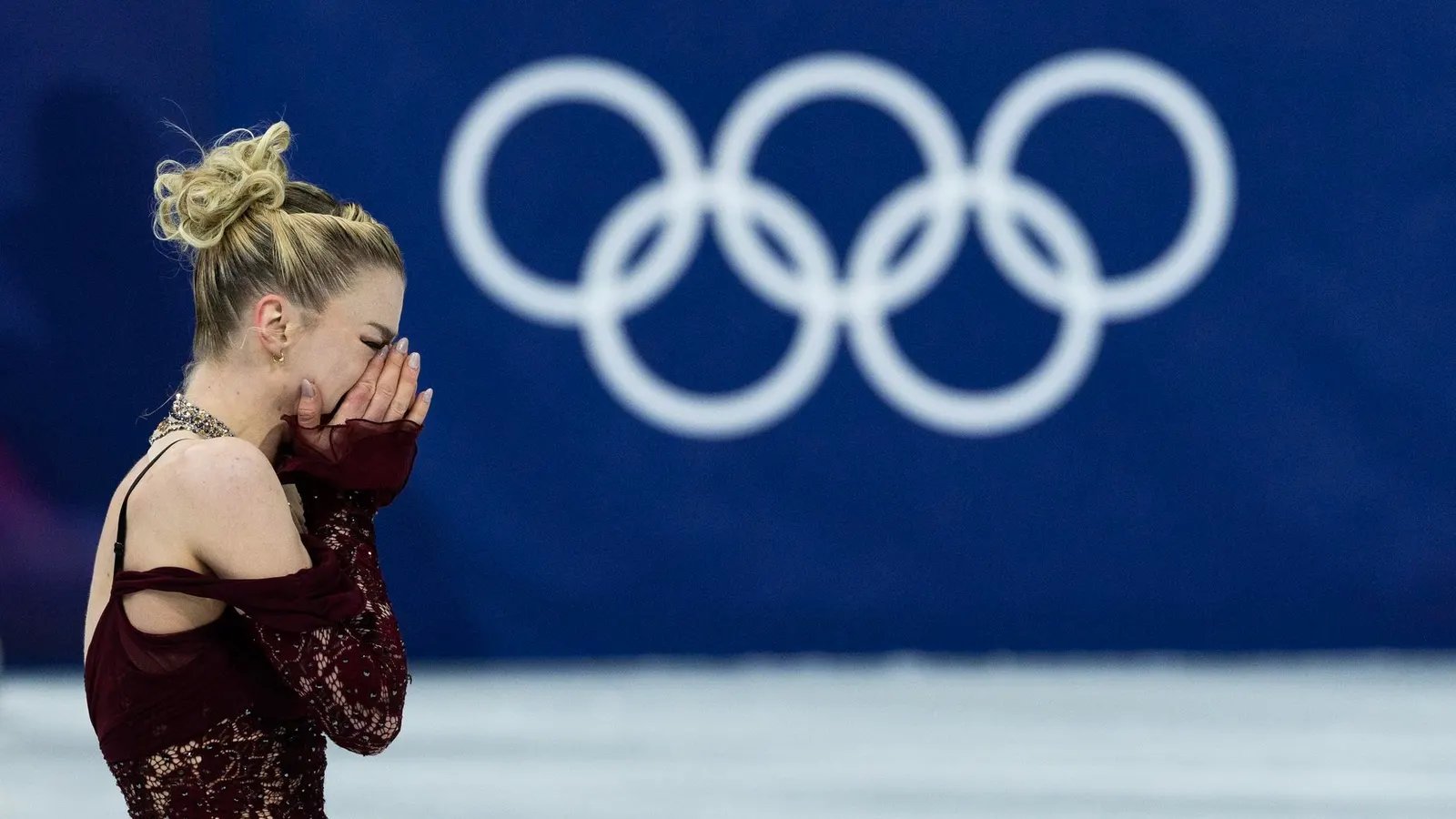

MILAN, ITALY – FEBRUARY 17: Amber Glenn of the United States reacts after competing in the Women’s Single Skating – Short Program on day eleven of the Milano Cortina 2026 Winter Olympic games at Milano Ice Skating Arena on February 17, 2026 in Milan, Italy.(Photo by Steve Christo – Corbis/Corbis via Getty Images)
Corbis via Getty Images
U.S. Olympic figure skater Amber Glenn was a favorite for gold in the ladies’ singles competition in Milan Cortina, until she wasn’t. Though Glenn looked sharp as she opened her highly difficult short program, she committed a small but fateful error in her final jump of the night.
To a casual fan, Glenn had done nothing wrong. She completed the third and final jump in her skate, landing cleanly without a fall. But for those with an understanding of the sport’s requirements, Glenn’s mistake was devastating. It would likely cost her an Olympic medal.
Here’s what happened.
After hitting the highest-graded triple Axel of her career and a solid triple-triple jump combination, Glenn just needed one more jump to complete the most difficult elements in her short program skate. She was so close, she could almost taste it.
All that was left: a triple loop jump. Compared to her opening triple Axel and combination jumps, a standalone triple loop should have been a breeze for Glenn. However, life on the ice is unpredictable.
Glenn appeared to mistime her takeoff, balking and “popping” the jump, and only completing two revolutions. She had executed a double loop, not a triple.
Not the end of the world, right? Wrong.
The “Zero-Point” Rule
In women’s figure skating, a short program requires the following elements:
- Double or triple Axel
- Triple jump (standalone)
- Jump combination consisting of two triple jumps, or a triple and a double jump
- Flying spin
- Spin combination with only one change of foot
- Step sequence fully utilizing the ice surface
- Layback/sideways leaning spin or sit, or camel spin without change of foot
Per item No. 2, the ISU Special Regulations and Technical Rules (Rule 611) require a triple jump; if a skater performs a double, the element is officially designated as “not according to requirements.” By “popping” her required triple jump, Glenn had failed to meet the mandatory technical checklist for her short program.
Thus, instead of receiving a base value for the lesser double loop, Glenn received a zero for her “Invalid Element.”
Even if the double jump was performed beautifully, the Technical Controller will flag the skill as “No Value” (NV). On the official score protocol, the jump is marked with an asterisk (*)—the mathematical kiss of death in figure skating. Just like that, Glenn lost over seven points: a devastating blow.
Had the 26-year-old executed the jump as planned, she would have likely been in gold medal contention.
Glenn was not the only athlete in Milan Cortina whose dreams were dashed due to this rule. Canadian national champion Madeline Schizas doubled the same triple loop as Glenn, receiving no value for her jump.
MILAN, ITALY – FEBRUARY 17: Madeline Schizas of Team Canada competes during the Women’s Single Skating – Short Program on day eleven of the Milano Cortina 2026 Winter Olympic games at Milano Ice Skating Arena on February 17, 2026 in Milan, Italy. (Photo by Sarah Stier/Getty Images)
Getty Images
While Glenn qualified for Thursday’s free skate, Schizas’ mistake prematurely ended her Olympic journey in the short program. She missed the qualification mark by a razor-thin margin: .15.
“I received zero points for one element, which is really unfortunate,” Schizas said after the competition. “And today, that was the difference between qualifying and not qualifying. So obviously that’s very tough. But I guess that’s part of life.”
The rule has been in effect for over 50 years, and the zero-point system became more visible and mathematically devastating in 2004 with the implementation of the International Judging System.
When the IJS was introduced, officials stated that the goal was to “increase the difficulty and athletic standards of the sport” by creating a “test of consistency” in which partial credit is intentionally withheld to force elite athletes to take technical risks.
Though the “zero-point rule” is considered “devastating” by many experts and fans, skating purists maintain that it confirms the Short Program’s duality as a “technical checklist.”
A Chance At Redemption
Amber Glenn and the top 24 women’s figure skaters will return to the ice on Thursday for the women’s free skate. Though Glenn is unlikely to contend for the podium after Tuesday’s error, anything is possible in figure skating.
Glenn enters the event in 13th, and American teammates Alysa Liu and Isabeau Levito sit in third and seventh, respectively. Japan’s Ami Nakai holds a slim lead over three-time world champion Kaori Sakamoto in second.