
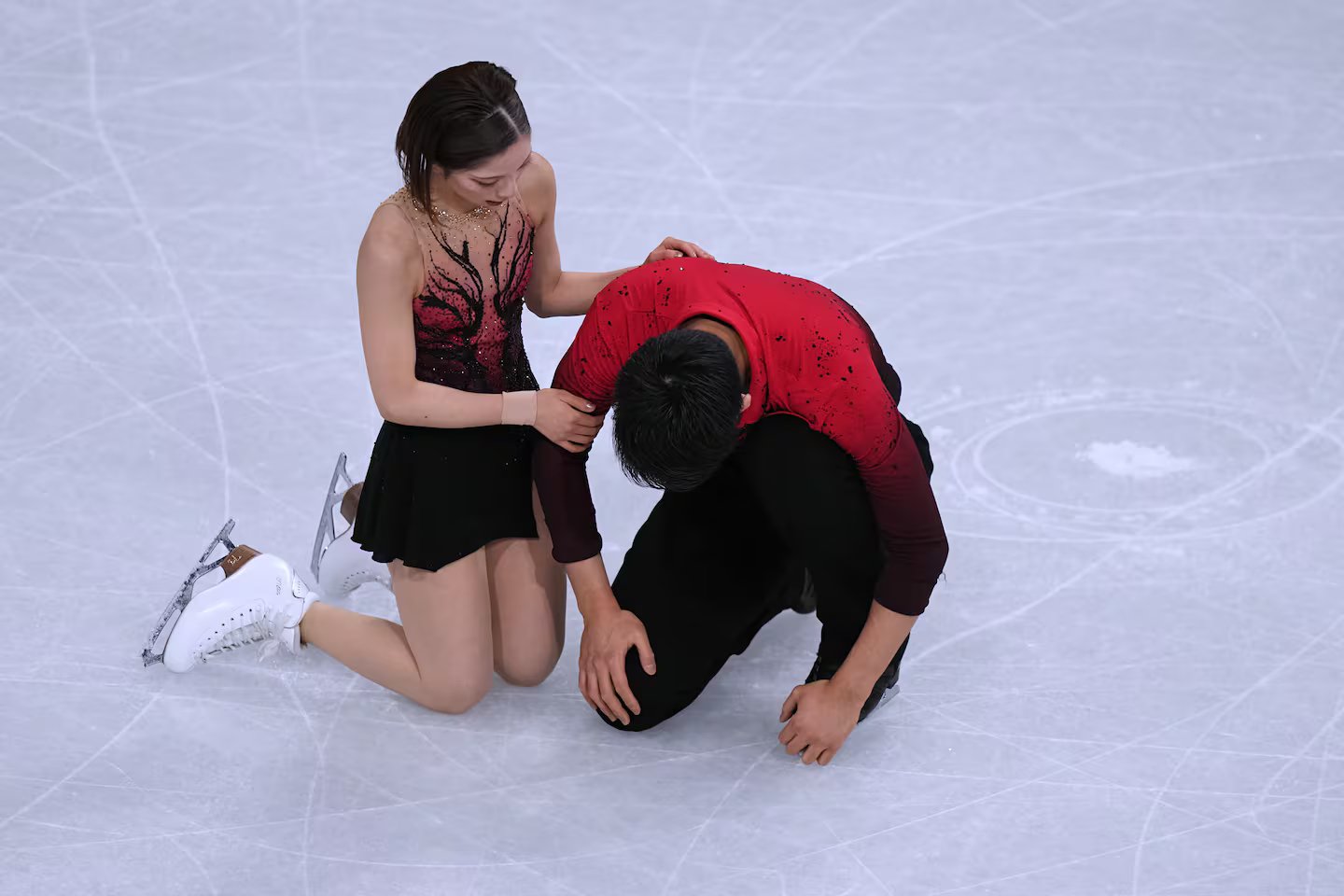
And now Japan’s Riku Miura and Ryuichi Kihara, who have two global championships on their résumé, are buried in fifth place after Sunday’s short program, well behind German leaders Minerva Fabienne Hase and Nikita Volodin after one botched lift ruined their routine.

The Rising Sun had been on the ascent at these Games with the Japanese collecting two silver medals and a bronze in the men’s and team events.
The pairs presented an excellent chance for gold for a country that for decades was an afterthought in this discipline of precarious lifts and throws.
Until Miura and Kihara finished seventh in Beijing four years ago the Japanese never had placed among the top dozen in the event at the Olympics, and as often as not didn’t bother to enter.
The Russians owned pairs skating at the Games from 1964 through 2006, winning 12 straight titles and taking gold and silver seven times. With the Germans, Canadians, and Americans all bringing medal contenders, what was the point in Japan bothering?
The Chinese ended Russia’s hegemony in Vancouver in 2010, going 1-2 with Shen Xue-Zhao Hongbo and Pang Qing-Tong Jian.

The Motherland made one final stand on home ice in Sochi four years later but the Germans won in 2018 and the Chinese prevailed on their home ice in Beijing in 2022.
The Japanese breakthrough came at the subsequent World Championships that year where the top five pairs from the Games either were banned (three Russians) or stayed home (two Chinese).
Miura and Kiharu finished second to US rivals Alexa Knierim and Brandon Frazier, then won the crown in 2023 and again last year.
They didn’t prevail by much on Causeway Street, just 0.7 points ahead of the Germans. But the Japanese won both the short and long programs in the Olympic team event and seemed positioned not only to claim their country’s first gold in the event but also its first medal.
Miura and Kiharu started off well enough, executing their triple twist and triple toe jumps. Then, on what was supposed to be a Level 4 lasso lift, Miura awkwardly slipped off Kiharu’s shoulders and down his back and had an awkward landing.
So not only were they just credited with a Level 2 lift, the Japanese were hung with a minus-2.30 for grade-of-execution and also were dinged on their component marks.
That left them nearly 7 points behind the Germans going into Monday’s free skate. Under the former ordinal scoring system, which was based on placements, Miura and Kiharu would already be out of contention for gold and probably for the podium.
“It’s not over,” coach Bruno Marcotte assured a disconsolate Kiharu when he came off the ice. But the Japanese are closer to 12th place than to first.
That’s what one bad mistake in the short program can do since there are only seven required elements. Seven points is a considerable hole to climb out of.
The Germans, who won the 2018 title with Aljona Savchenko and Bruno Massot, have a long history of pairs success.
They won the first gold in 1908 when skating was part of the Summer Olympics and have been frequent medalists since.
“It was just the first part,” Hase observed. “So tomorrow we have to do the same again.”
But after what Hase went through in Beijing, being anywhere near the podium is a thrill. After former partner Nolan Seegert tested positive for COVID, they had to withdraw from the team event. After Hase had to train by herself for 10 days, they finished 16th in the individual competition after a catastrophic free skate.
The Japanese aren’t in a hopeless position, but rallying for the gold will be a longshot. They caught a break in the men’s event after both Yuma Kagiyama and Shun Sato submitted flawed free skates. But, after Malinin’s shattered long program, both of them made the podium.
The fourth reigning world champion, Alysa Liu, skates Tuesday. Not since 2002 (Sarah Hughes) have the Americans won the women’s gold medal and Liu will be up against Kaori Sakamoto, Japan’s three-time former global champion whom Liu dethroned in Boston.
In this slip-sliding sport last year is so last year. Especially when you’re dealing with the rare air atop Olympus.
“It’s nerve-racking for everyone,” Kagiyama said.
John Powers can be reached at john.powers@globe.com.