
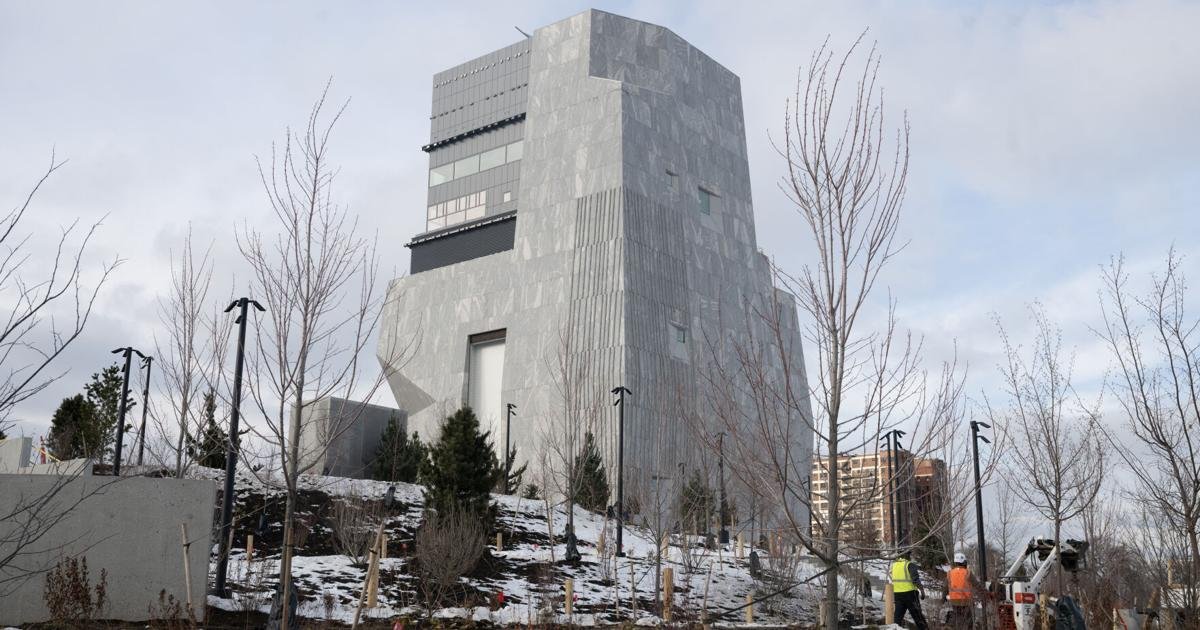
With just six months until its anticipated June 2026 opening, the Obama Presidential Center is nearing completion, its 225-foot granite-clad tower already casting a long shadow over Jackson Park.
On a recent guided tour led by foundation officials, the Herald got an early look at the sprawling campus, which its leaders say is designed to function as both a national monument and a neighborhood hub. The polarizing project has long been the subject of debate on the South Side, but as construction winds down, the focus is increasingly on the center’s role on the South Lakefront once its doors open.
The center’s design, officials told the Herald as the tour group strode toward the base of the towering museum building, is said to reflect input from former President Barack Obama, who is a self-described “armchair architect.” His editorial hand is visible throughout, from the cutout on the museum’s southwest corner to his insistence on increasing the building’s height beyond the architects Tod Williams and Billie Tsien’s original conception. The exterior is clad in New Hampshire granite known as “Tapestry,” a stone that shifts in hue depending on the city’s mercurial weather. Its veins become more pronounced during golden hour and take on an “effervescent” quality in the rain, foundation staff said on the tour.

The north face of the Obama Presidential Center’s museum tower in Jackson Park, Dec. 11, 2025.
Inside the museum, Julie Mehretu’s 83-foot painted glass installation on the north face awaits visitors riding escalators through the museum’s eight floors. The Ethiopian-American artist, known for her abstract paintings, drawings and prints done “in response to social and political change,” created the glass work to be experienced from inside looking out. It’s a fitting metaphor, perhaps, for a center whose relationship with the surrounding neighborhoods it overlooks remains somewhat strained.
“A really key theme throughout the campus was that we really wanted to make sure that it was accessible and inclusive to everyone,” a foundation official told the Herald on the tour.
The privately funded center is projected to cost roughly $850 million and sits on the city-owned parkland under a 99-year lease for which the Obama Foundation paid $10. As of 2023, the foundation has raised $1.5 billion and set the goal of raising an additional $100 million. To date, tech billionaires and major Democratic donors Steve Ballmer, Marc Benioff, Bill Gates and Reid Hoffman have all given the foundation at least $25 million.
The unfinished John Lewis Plaza leads to the museum’s main entrance. Amazon founder Jeff Bezos, who donated $100 million to the foundation, selected Lewis’ name from a list of civil rights, historical and local figures. The naming system, foundation officials said, was designed to encourage additional giving by allowing donors to honor others rather than themselves.
City and foundation officials have estimated that the center will draw between 700,000 and 1 million visitors a year and generate a long-term economic impact of more than $3 billion.
The museum itself is meant to take visitors on a journey “from me to we,” as foundation staff told the Herald while ascending by elevator to its upper floors. Four floors requiring paid admission chronicle not only Obama’s two terms in office but also protest movements that emerged during his presidency, among them the Black Lives Matter and Dreamer movements.
Obama, described by staff as the country’s “first digital president” with 96% of his presidential records digitized, chose not to house his physical archives on site, a decision that drew some controversy. Instead, the center’s museum focuses on memorabilia and commissioned artworks, including pieces by Richard Hunt, Nick Cave and Idris Khan, each invited to work in unfamiliar mediums. Among the installations awaiting placement is Nekisha Durrett’s “Hem of Heaven,” depicting abolitionist Harriet Tubman’s shawl.
Four additional floors, including the Sky Room observation deck that offers panoramic views of the South Side all the way to Northwest Indiana, will be free to the public.

The view looking north from the Obama Presidential Library’s Sky Room observation deck, Dec. 11, 2025.
Beyond the museum, the campus sprawls across 19.3 acres with facilities intended to function as community spaces. One of these is The Forum, described on the center’s website as a “commons designed to bring people together.”
The Forum’s main atrium is named for Hadiya Pendleton, the teenage King College Prep student who was shot and killed in 2012, shortly after performing at Obama’s second inauguration. That atrium leads to the 299-seat Elie Wiesel Auditorium, built to exactly that number of seats to satisfy the fire code, with modulated wood paneling to optimize acoustics. Foundation officials said the auditorium is smaller than originally planned in response to community input calling for a more intimate venue.
Beneath ground level are recording studios for podcasting and music production, multipurpose rooms and offices, and a 400-vehicle parking garage with 20 EV charging stations. Glass cutouts for trees and artworks allow natural light to flow into the center’s underground spaces.
The Forum also houses a mid-priced restaurant by Chef Cliff Rome of Peach’s Restaurant and Bon Appétit, serving what the foundation describes as “comfort American food.”
Nearby, a Chicago Public Library branch will feature a reading room stocked with books written and selected by Barack and Michelle Obama, as well as multiple copies of titles from the former president’s annual reading lists.
Home Court, a 60,000-square-foot multipurpose building with a facade designed to resemble basketball nets, contains a regulation NBA-size court that doubles as an event space. A joint mural by Sam Kirk and Dorian Sylvain adorns the back wall, while Obama’s 2008 campaign slogans “Hope” and “Yes We Can” ring the court.

Construction crews install flooring inside The Forum, a commons building on the Obama Presidential Center campus, Dec. 11, 2025.
A long road to opening
Originally slated to open in 2021, the center’s construction was significantly delayed by lawsuits seeking to block construction in Jackson Park, arguing that it would change the park’s historic design and lead to tree loss. Construction began in 2021 after the legal challenges were mostly resolved.
Hundreds of trees were ultimately felled during construction, and the Women’s Garden was dismantled to make way for the center. A new Women’s Garden planned at the base of the museum building is still under construction.
The legal battles also unfolded alongside broader concerns about housing stability in surrounding neighborhoods. Early on, the project prompted fierce debate over whether it would accelerate displacement as property values around the park rose. Community groups pressed the foundation to enter into a formal community benefits agreement, but those efforts were unsuccessful. Organizers then turned to the city, where local alders — with grassroots support — pushed for protections aimed at local tenants and homeowners.
Those efforts resulted in two City Council ordinances: the Woodlawn Housing Preservation Ordinance, passed in 2021, and Jackson Park Housing Pilot, approved earlier this year.
The landscape design, at least on parkland, attempts to soften the center’s footprint somewhat on Frederick Law Olmsted’s historic park. Some of the hundreds of trees felled during construction have been repurposed as downed logs throughout the wetlands area and children’s playground, which features structures inspired by nature, including oversized tulips, dragonflies and bird nests. The campus will be powered entirely by renewable energy, with solar panels installed on the Garden Pavilion and Home Court roofs. A water-conservation system will also capture 98% of rainfall onsite, saving more than 1 million gallons of potable water annually, according to the foundation.
The Eleanor Roosevelt Fruit and Vegetable Garden, named for the first lady who championed Victory Gardens during her husband’s WWII presidency and honoring Michelle Obama’s White House Kitchen Garden, includes raised beds at varying heights for accessibility, with a nearby teaching kitchen. Michelle Obama also insisted on a sledding hill, a rarity in Chicago’s flat landscape, from which visitors can catch glimpses of Lake Michigan.
The campus grounds can be traversed by 3.1 miles of winding paths. The foundation, however, does not plan to provide funding to the Chicago Department of Transportation to help restore and reopen the Darrow Bridge, a bridge that used to connect the east and west sides of the park just to the south of the Griffin Museum of Science and Industry. Closed by the city since 2013, the bridge would allow pedestrians to walk from the campus’s grounds directly to Lake Michigan.
Foundation officials declined to specify an exact opening date in June, citing concerns about potential minor construction delays. When pressed about opening day programming — whether that be music, dancing, food — they offered only that they “would imagine all of those elements.”