
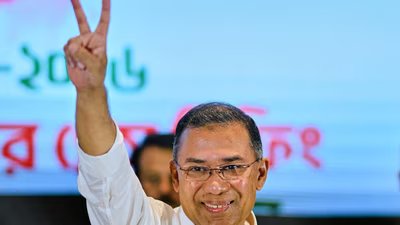
Bangladesh Nationalist Party chairman Tarique Rahman on Tuesday took oath as the Prime Minister of Bangladesh, after being elected as the leader of the BNP parliamentary party.
The BNP bagged 209 out of 297 seats in the Bangladesh Parliament, while the right-wing Jamaat-e-Islami, once their ally and now their primary rival, won 68 seats in the February 12 elections. Deposed PM Sheikh Hasina’s Awami League was banned from contesting the polls.
Apart from Rahman, 25 ministers and 24 state ministers also took oath. The BNP cabinet has 50 members, with 25 ministers 24 state ministers, and three technocrats, Prothom Alo reported. Among the 25 ministers, 17 are new faces, with all state ministers also holding the position for the first time. PM Rahman is also a cabinet member for the first time.
Lok Sabha Speaker Om Birla represented India at Rahman’s swearing-in ceremony. Birla reached Dhaka earlier today, and was accompanied by foreign secretary Vikram Misri and other officials, PTI news agency reported.
Upon his arrival, Birla was received by Bangladesh foreign ministry secretary Nazrul Islam. The Lok Sabha speaker said this was an “important moment” which would strengthen people‑to‑people ties and shared democratic values between India and Bangladesh.
An invitation had been extended to Prime Minister Narendra Modi, who was among the first leaders to congratulate Rahman on the victory. However, PM Modi had talks scheduled with French President Emmanuel Macron in Mumbai on Tuesday.
Bangladesh’s interim government ‘s leader Muhammad Yunus resigned Monday. The interim government had been running the country after the ouster of Sheikh Hasina in July, 2024.
“Today, the interim government is stepping down. But let the practice of democracy, freedom of speech, and fundamental rights that has begun not be halted,” Yunus said in his farewell address to the nation before handing over to an elected government.
Security ramped up at Bangladesh’s Jatiya Sangsad Bhaban
Bangladesh’s home ministry directed police personnel, as well as others concerned, to ensure maximum security at the Jatiya Sangsad Bhaban, where Rahman took oath, the country’s state-owned news agency reported.
The law enforcement agencies were asked to take all necessary measures to guarantee the safety of the Prime Minister and the cabinet ministers during the ceremony, Bangladesh Sangbad Sangstha reported.
A comprehensive plan to ensure security at the venue and surrounding areas was finalised, BSS reported citing sources from police headquarters. Special security arrangements were centered on South Plaza, with the Special Security Force (SSF) to ensure tight security during the PM’s movement.
The security convoy included police personnel, Presidential Guard Regiment (PGR), SSF, jammer systems, SSF security screening teams, along with ambulance and medical support, according to BSS.
BNP, Jamaat disagree on ‘Constitution Reform Council’
The BNP and Jamaat-e-Islami faced disagreements on the ‘Constitution Reform Council’, formed to implement the July charter which was voted upon by the people of the country alongside the parliamentary elections.
The July charter demands the Constitution to be massively rewritten. The 84-point complex proposal was laid out in the referendum in a cognised but nearly esoteric form for voting.
While the Jamaat-e-Islami’s newly elected MPs took oath as Members of Parliament and also took a second oath as members of the “Constitution Reform Council”, the BNP refused to do so, PTI reported.
The election commission reported that over 60 per cent of voters cast a “yes” vote in the referendum. “We have not been elected as members of the Constitution Reform Council; no provision of the council is yet to be incorporated in the Constitution,” PTI cited BNP MP Salahuddin Ahmed as saying.