Nicaragua is sometimes called the “tropical North Korea”. Even by the standards of Latin American autocracies, it feels tense in Managua, the capital. Any political talk is hushed for fear that informers may be hovering. Television stations spout propaganda, religion or bland entertainment. Church sermons are hollow. Rubbish lines the road, the smell of its incineration hanging in the air. “This is a ship sinking more every year because there is no change—just [the regime’s] twisted ideas,” says a resident. In 2025 the United Nations estimated that nearly a fifth of Nicaragua’s population was hungry. The regime expelled UN representatives in response.
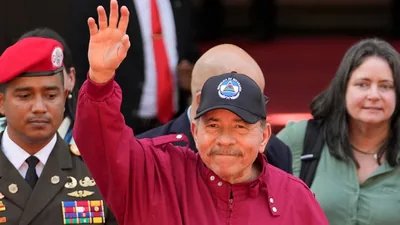
Nicaragua’s President Daniel Ortega waves after attending the swearing-in ceremony of Venezuela’s President Nicolas Maduro for a third term at the National Assembly in Caracas, Friday on January 10, 2025.
Daniel Ortega (pictured) became president in 2007 after winning an election. The former Marxist-Leninist guerrilla had ruled from 1979 to 1990, after overthrowing the dynasty that had run Nicaragua for four decades. He soon turned to repression. In 2018 the government used lethal force to put down widespread anti-government protests, killing at least 355 people. By 2021 he had locked up seven main opposition candidates and secured re-election through a sham vote. In 2024 he overhauled the constitution, elevating his wife, Rosario Murillo (also pictured), to “co-president”. That paved the way for Ms Murillo, who is 74 and had previously been his vice-president, to succeed her husband, who is 80. The new constitution reduced the courts and legislature to mere “organs of the state”. The pair increased their control of the army and the police. Their sons took important posts in government.
Cultural life has been squashed unless it celebrates Rubén Darío, a long-dead poet, or Ms Murillo herself, who has published multiple volumes of poetry. Take Granada, once a cultural hub, which used to host an annual poetry festival. It was cancelled after 2018, when police fired on protesters at the festival. The regime has also smothered civil society, shutting more than 5,500 NGOs. Almost 300 journalists have fled the country since 2018. University independence has been eliminated. In a devout country, even the Catholic church has come under attack. Since 2022 more than 200 clergy have been jailed or forced to leave Nicaragua, including 18 nuns from Mother Teresa’s charity.
Some 800,000 Nicaraguans have left since 2019, says Manuel Orozco of the Inter-American Dialogue, a think-tank in Washington, more than 10% of the 7m population. In 2023 the government began stripping critics of citizenship and confiscating their property. Some emigrants discover they cannot return or renew their passports. “Their entire life is systematically dismantled,” notes a UN report. Even out of the country, Nicaraguans are not safe. In June Roberto Samcam, a retired army major and outspoken critic, was shot dead at his home in San José, Costa Rica’s capital. NGOs have linked his killing to the Ortega regime. “They came to our door; the repression has no borders,” says Claudia Vargas, his widow. At least six others have suffered a similar fate since 2018.
The regime has shifted away from the Cuban model of an authoritarian system cloaked in revolutionary rhetoric to a still authoritarian one focused on the welfare of the Ortega-Murillo clan. Its sole objective is for the family to stay in power, says Eliseo Núñez, a former opposition legislator. There is little effort to inspire. Limp posters that bear an unflattering photograph of the pair along with the slogan “Avanzando la revolución” are the only visible propaganda.
The clan now dominates the economy, too. Allies control ports, energy and telecommunications. Growth has recently been solid, 3-4% a year since 2022, but it rests on narrow foundations. Remittances, mostly from the United States, account for 30% of GDP, among the highest shares in the world. Exports, another big source of income, are also dependent on the United States.
The regime has drawn closer to China in an effort to reduce this dependence. Shopping centres built by Chinese firms are popping up. After the United States put sanctions on the state mining company, Eniminas, the government rewrote concession rules. Chinese firms displaced Western ones and now hold concessions covering about 8% of the country’s land. That has boosted gold exports, generating dollars and helping to evade sanctions.
Ms Murillo has taken control of the ruling duo. Repression has increased. In 2025 the regime turned on fellow Sandinistas, the Marxist-Leninist-inspired guerrillas with whom Mr Ortega overthrew the previous dictatorship. Among them was Bayardo Arce, a former Sandinista commander and longtime economic adviser, who was placed under house arrest before being convicted of money-laundering and fraud. “If you’d told me a year ago they would do this, I would never have believed it,” says Oscar René Vargas, a Sandinista intellectual who once saved Mr Ortega’s life.
Low pressure zone
Despite increasing repression and cosying up to China, even as the United States takes a closer interest in the left-wing autocracies in its region, the consequences for the Ortega-Murillo regime have been limited. That may be because Nicaragua lacks both oil and strategic value. Yet Donald Trump’s rhetoric about American control of the western hemisphere has increased uncertainty. Marco Rubio, his secretary of state, has repeatedly denounced the Nicaraguan regime alongside those in Venezuela and Cuba.
The United States has the power to depose Mr Ortega, as it did Nicolás Maduro, Venezuela’s dictator, in January. By leaving Mr Maduro’s deputy in charge, says Mr Vargas, Mr Trump showed Nicaraguan regime insiders that “there is political life for them” after the first family is forced out. Ricardo Zúñiga, who oversaw Central America policy under Joe Biden, says this chimes with his aim at the time, to make clear that the United States would work with anyone but Ms Murillo.
The United States has increased diplomatic pressure. On January 30th the State Department called Ms Murillo’s position “illegitimate”. Yet it has stopped short of harsher measures, such as curbing American oil exports to the regime, or severing banking ties. In January it declined to expel Nicaragua from the Central American Free-Trade Agreement, though it will gradually impose tariffs on Nicaraguan exports not covered by the agreement, reaching rates of 15% by 2028.
The regime has long proved adept at conceding just enough to ease pressure, says Mr Zúñiga. On February 8th it ended visa-free entry for Cubans, which had facilitated migration northward towards the United States. That followed the limited release of some political prisoners in January—even as others were detained.
Mr Nuñez argues that succession also poses a risk to the regime. Ms Murillo lacks her husband’s revolutionary credentials. She is widely disliked and seen as divisive within the regime, in part because she is an eccentric (her belief in mysticism is well documented) and has a vengeful streak. Many were appalled when she sided with her husband when her daughter from a previous marriage accused him of raping her. Mr Ortega denies the accusation.
Yet Ms Murillo has amassed great power. Nicaraguans at home are too frightened to resist. The opposition is fractured. “Nicaraguans have already paid too dearly,” says Ms Vargas, the widow. Mr Ortega and Ms Murillo seem indifferent to their hollowing out of the state. For now, so does Mr Trump.