
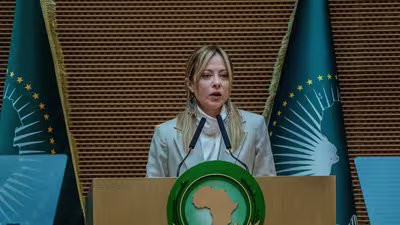
ROME—The U.S. under President Trump has lost trust across Europe, but Italian Prime Minister Giorgia Meloni is sticking with America.
Meloni is doing all she can to keep the troubled trans-Atlantic relationship alive. She has resisted European proposals to retaliate against Trump’s trade threats and called for the U.S. and Europe to deepen their ties. This weekend, she broke with most of the continent by pledging to join Trump’s Board of Peace—albeit only as an observer.
She knows she is going against the prevailing mood in Europe. Trump’s threats in January to seize the Danish territory of Greenland capped a year in which the White House accused Europe’s democracies of betraying Western civilization, pushed them to include far-right parties in government, hit their economies with tariffs and pressured Ukraine to accept a Russia-friendly peace plan.
The Italian leader argues Europe has no choice but to persevere with the U.S. alliance. What is the alternative, she asked reporters in January with a flash of irritation. “Should we leave NATO? Should we close American bases? Should we break off trade relations? Should we storm McDonald’s?”
Italian officials admit that it isn’t easy to try to be a bridge over a widening Atlantic Ocean, and that it hasn’t borne much fruit yet.
Italian business is hurting from Trump’s tariffs on Europe. Late last year, Rome had to frantically lobby the White House not to slap 107% tariffs on Italian pasta—a national symbol—a move that would have humiliated Meloni after her efforts at friendship.
Trump prompted fury in Italy and Europe last month when he dismissed North Atlantic Treaty Organization allies’ military contributions in Afghanistan, where 53 Italian soldiers were killed and hundreds wounded. Meloni said she was astonished by his words, adding, “Friendship requires respect.”
“We’re in a delicate phase in Europe-U.S. relations,” Meloni said on Saturday.
“She is playing a risky game in terms of public perception,” said Lorenzo Pregliasco, founder of YouTrend, an opinion-polling and political communications firm in Turin. “Italians see Trump as a threat. If they see him doing damage to the Italian economy or to European security and stability, they could blame Meloni.”
Behind Meloni’s attachment to the alliance lies a calculation that Italy can’t afford the cost of a divorce. The country’s barely growing economy needs the U.S. export market and is sensitive to trade wars. Its strained government coffers can accommodate higher defense spending within NATO but would struggle if Europe had to replace U.S. military protections.
Some European capitals believe Meloni’s ideological affinity with Trump is also a driving factor. The 49-year-old Italian leads the right-wing Brothers of Italy party, whose hard-line views on immigration, law and order, and the peril of “woke” ideas overlap with MAGA’s.
A White House that has repeatedly belittled Europe and its leaders treats Meloni as an exception and a kindred spirit. She is “one of the real leaders of the world,” Trump declares on the cover of Meloni’s book “Giorgia’s Vision,” based on interviews she gave to an Italian journalist. Vice President JD Vance wrote the foreword of the English edition, due out in April—a favor it is hard to imagine him doing for French President Emmanuel Macron.
But ideological affinity has its limits. Surveys show Trump is deeply unpopular in Italy, as in most of Europe, and is a divisive figure even for Meloni’s right-wing voters. She takes pains to say that she doesn’t always agree with Trump and that, when she disagrees, she says so to his face.
Many observers in Rome believe that Meloni has lost any illusion about a return to a smooth relationship with the U.S., and that her engagement with Trump has become pragmatic rather than conviction-driven.
“My impression is that Meloni is trying to keep a channel open, but she has given up on building an axis with Trump. She has understood that he is entirely unreliable,” said Carlo Calenda, a centrist Italian senator.
Still, when German Chancellor Friedrich Merz told the Munich Security Conference last Friday that Europe doesn’t agree with MAGA’s culture war, and that the Atlantic alliance must be based on cold interests rather than on values that are no longer shared, Meloni upbraided him.
“These are political considerations,” she told reporters during a trip to Africa on Saturday, suggesting that diplomacy is a separate field. “We must work instead on greater integration between Europe and the United States.”
There is little appetite for that in Europe or the White House, especially after the Greenland clash, which tested Meloni’s outreach effort to the limit.
She was on a tour of East Asia when Denmark, France and other European allies deployed troops to Greenland, officially for a NATO exercise but also to raise the costs for the U.S. if Trump used force to take the North Atlantic island. Trump threatened tariffs against European countries involved.
Meloni called Trump from Seoul and told him it was all a misunderstanding.
“I think the message that arrived from Europe wasn’t clear,” she told reporters that day, describing the phone call. “The risk is that the initiatives of some European countries could be interpreted in an anti-American way. However, that wasn’t the intention,” she said. The U.S. was right to worry about Russian and Chinese interference in the Arctic, and European allies just wanted to help, she said.
Leaders in Northern Europe believe Trump backed down on Greenland because of their firm stance against Trump’s threats, coupled with selloffs in financial markets. Some of them fear Trump will revive his threats over Greenland eventually.
Meloni, however, believes her efforts to de-escalate the row were vital.
She faces another delicate balancing act this week. On Thursday, Trump is due to host the first meeting of the Board of Peace, an invitation-only international organization under his personal leadership, created as part of his Gaza peace plan, but which he has said might replace the United Nations.
Few democratic nations have signed up so far. Meloni politely declined to become a full member, citing legal problems under Italy’s constitution. But on Saturday, she said the U.S. had invited Italy to join as an observer, an idea she endorsed.
She hasn’t decided yet whether to join the gathering at the Donald J. Trump Institute of Peace in Washington, D.C., herself, or send someone more junior. She said she is waiting to see which other European leaders might go.
Write to Marcus Walker at Marcus.Walker@wsj.com