
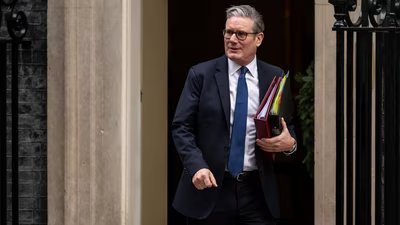
It is haunting season in Westminster. As ever when the mood is mutinous, its denizens are on the lookout for a posse of phantom ministers, sometimes known as the men in grey suits. Rumour holds that in the coming months they may glide into Number 10 and tell Sir Keir Starmer that his time is up. If the past is a guide, though, this ghostly group will not materialise.
History offers lessons for Labour MPs still hoping to oust Sir Keir. They apply across parties and time, from the deferential era of yore to today, when British political leaders have the shelf-life of smartphone models. A big takeaway for plotters concerns those men (or women) in grey suits. It is no use waiting for some spectral figure to do the dirty work discreetly. You have to grip the axe, openly and together.
The first lesson for mutineers is: pick the right moment. The wake of a chastening by-election—like that in Gorton and Denton on February 26th—could be propitious; more so a humbling for the ruling party in local or regional elections, such as those on May 7th. But plotters must have an eye on the wider chronology. Deposing a leader in the middle of a parliament invites pressure to hold a general election, which a party in the doldrums may lose. Wait much longer, and it can seem too late to change the public’s mind.
This “goldilocks problem”, as Philip Cowley of Queen Mary University of London, terms it, applies to the state of the nation too. It makes no sense to ditch a leader if everything is tickety-boo. But assailing one in an emergency may look self-indulgent (unless, like Liz Truss, she obviously caused it). “No time for a novice,” proclaimed Gordon Brown, the embattled Labour prime minister during the financial crisis of 2007-09—a gibe partly directed at pretenders on his own side. Today the jittery bond market discourages upheaval.
Time their ambush wisely, and insurgents enjoy natural advantages. For starters, prime ministers are distracted by the need to keep running the country: facing a leadership challenge in 1990, Margaret Thatcher flew off to a summit that marked the end of the cold war. Next, as both she and (in 2022) Boris Johnson learned, leaders can be too cocooned or aloof to grasp their peril. “They’re hard-headed enough to know that their colleagues would all kill them if they could,” says Sir Vernon Bogdanor of King’s College London. “But they tend to think they’re invulnerable, and that’s what gets them in the end.”
As in other walks of life, only more so, every enmity a leader has aroused, each intended or inadvertent slight, comes back to bite them in a showdown. All the MPs sacked from government jobs, demoted or overlooked can avenge themselves. The older the government, the more has-beens and no-hopers it collects. Conservative MPs who loathed Mr Johnson’s loucheness and lies got the chance to punish them in 2022. Thatcher’s imperiousness had irked lots of ministers. Conversely, like Mr Brown—but unlike Sir Keir—she could count on a praetorian guard of acolytes.
Helpfully for regicides, the fight isn’t fair. Even if they scrape a majority, prime ministers can be mortally wounded by a leadership contest or confidence vote. As Sir Anthony Seldon, a historian, puts it, “You can be dead in the water even if, technically, you win.” Thatcher beat her challenger, Michael Heseltine, in the Tories’ first ballot in 1990, but not conclusively. Neville Chamberlain won the parliamentary vote in 1940 that led to his removal, but too many MPs deserted him. (“I have friends in the House!” Chamberlain rashly proclaimed, raising the stakes of that pivotal debate: when their strength is in doubt, shrewd leaders avoid testing it.)
The trigger for a crisis tends to be a high-level resignation, like that of Geoffrey Howe, Thatcher’s chancellor, in 1990, or Rishi Sunak, who quit the same post in 2022. The nerviest day in Mr Brown’s plot-strewn tenure, says someone who used to work in Downing Street, was when James Purnell, the welfare secretary, resigned in 2009 and told Mr Brown to go too.
The whip hand
Crucially, though, one walkout is unlikely to be enough. Like Anas Sarwar, the Scottish Labour leader who suggested Sir Keir pack it in, Mr Purnell went over the top, only to find no one behind him. Then as now, others sympathised but declined to strike; the men in grey suits proved elusive. By contrast, a stampede of resignations did for Mr Johnson. Thatcher gave up after a mass of senior ministers told her she was finished. “I had lost the cabinet’s support,” she later wrote. “It was the end.”
Meanwhile, cornered leaders have advantages of their own. As another veteran says, the prime minister retains “control of the board”; ie, the Number 10 machine, the bully pulpit and the lure of patronage, which lets him dangle fancy titles like “deputy prime minister”. When Mr Purnell walked, the first thought in Downing Street was “Where is David Miliband? Get him on the line!” (The then-foreign secretary was perceived as Mr Brown’s likeliest challenger.) As Sir Keir’s team did on February 9th, Brownites hit the phones to shore up support. In extremis, minders can be dispatched to keep tags on waverers.
Urgency can also help besieged leaders. Cabinet colleagues may have only minutes to choose between swearing allegiance and rebelling. Would-be assassins must instantly weigh the chance of success against the costs of failing. “He who wields the knife,” lamented Lord Heseltine after he lost out in 1990, “never wears the crown.” That is not quite right—both Mr Johnson and Mr Sunak were handy with a dagger—but swinging and missing is a bad look. Loyalty can pay off better in the long term, or even the short one. Winston Churchill defended Chamberlain’s government in 1940, but in doing so, observed an mp, showed “by his brilliance that he really has nothing to do with this confused and timid gang”. He took over two days later.
A leader’s main weapon is uncertainty. Say Sir Keir is dislodged by his rivals; none can know who will succeed him. They or an ally may triumph, but so might a foe. Crucially, notes Sir Vernon, both Labour and the Tories now choose leaders in a two-stage process: MPs narrow the field but party members crown the winner. The resulting unpredictability heightens the jeopardy and cuts the incentive to act. And in an anti-political age, the public may be no fonder of a new overlord than of the old.
“No one can be sure what happens next,” counsels Graham Brady, who, when he was chairman of the 1922 committee of Tory MPs, helped persuade a string of prime ministers that the game was up. “You may be heading for an iceberg,” Lord Brady says, but generally “it’s hard to see how throwing the captain overboard will lead to a better outcome.” A party commits regicide, says this political angel of death, when it “can’t imagine any other way”.
History’s final lesson is that, in this scenario—when dread of defeat, or of Nigel Farage, outweighs fear of the unknown; when a party decides it still has a chance but its leader doesn’t—the end for prime ministers can come in a rush. Howe resigned on November 1st 1990; Thatcher announced her own resignation three weeks later. Two days after Mr Sunak jumped, Mr Johnson bowed out, too.
“One minute you’re up there giving a speech,” says Mr Cowley, “and later that day you’re up against the wall.” The coup de grâce for Sir Keir—if or when it comes—may be as swift and brutal as other kinds of revolutionary violence. In place of a tumbrel and farewell from the scaffold, the condemned prime minister says their final words in Downing Street, then rides up the Mall to bid adieu to the monarch. The rest is memoirs and regrets.