“Twenty-eight, twenty-nine, thirty!” Al Carns, a junior defence minister and a colonel in the Royal Marines, polished off the pull-ups with ease. The fireman he had challenged on camera was defeated. Military men hold a mysterious allure within British politics. People mention Mr Carns as a future Labour leader, even though he entered Parliament only in 2024. In the land of the nerd, the jock is king. In his crop of junior ministers, Mr Carns is a warrior among wonks. How many pull-ups can Josh Simons, a Cabinet Office minister, do? Has Torsten Bell, the pensions minister, ever killed a man?
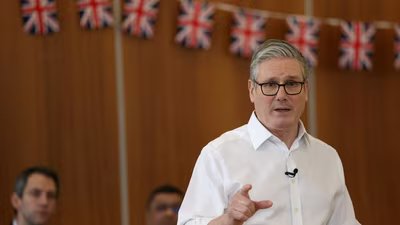
File photo of Britain’s Prime Minister Keir Starmer. (AP)
Desperate people do desperate things. And there are few more desperate than the typical Labour mp, who faces electoral misery. Sir Keir Starmer is, already, the most unpopular leader in British polling history, embroiled in scandal over the appointment of Peter Mandelson and steering Labour to electoral catastrophe over both the short term and the long. Absurd scenarios are being proposed. Why not install a man with 18 months’ experience in Parliament, such as Mr Carns, as prime minister? Normally, there is a “Break Glass In Case Of Emergency” figure, ready to step into Downing Street. Not this time. There is no Gordon Brown, who spent a decade as chancellor glowering at the back of Sir Tony Blair’s head. Every alternative to Sir Keir ranges from the implausible to the insane, yet one will eventually become inevitable.
Andy Burnham, the mayor of Greater Manchester, would make sense. Among the pretenders, he alone polls above Sir Keir. Unfortunately for Mr Burnham, he is not an mp. And he can become an mp only with the say-so of Sir Keir, whose political clout now extends to a grip over Labour’s internal structures and little further; Mr Burnham tried once, and Sir Keir said no. Should he become an mp, Sir Keir would swiftly stop being prime minister. While Sir Keir wants to prolong his stay in Downing Street, he will prolong Mr Burnham’s shift in Manchester.
Labour mps want rid of the prime minister and yet abhor anyone engaged in the icky business of doing it. This paradox haunts Wes Streeting, comfortably the most ambitious cabinet minister. Ambition is no crime; ministerial ineptitude is. As health secretary, Mr Streeting is guilty of the collective sin of this government: a failure to prepare for power. A sweeping change to the National Health Service—abolishing the quango that ran the service—came not as an immediate big bang but a belated whimper, Mr Streeting having tiptoed for the first year.
Angela Rayner, Sir Keir’s former deputy prime minister, is the favourite. This is striking enough given that HM Revenue and Customs has a live investigation into her (at best) disorganised tax affairs, for which she left the government. Before her fall, Ms Rayner’s rise was remarkable. She left school with no qualifications and crawled from society’s scrapheap to the brink of Downing Street via her wits. Ms Rayner has life experience. Possibly too much. “Angela Rayner is not a suitable person to lead the country because she is not sufficiently educated,” said one caller, on a radio phone-in. “She doesn’t have the vocabularityability,” exposing the caller’s own lack of vocabularityability. British voters love the idea of a working-class politician until they meet one.
Politics rather than prejudice stands in the way of others. In a government that has been rather left-wing, Shabana Mahmood, the home secretary, is an exception. She has overseen a dramatic tightening of Britain’s immigration policy. For Labour mps who wince at the idea of doing anything nasty, she would be a strange choice. Sir Keir and Morgan McSweeney, the prime minister’s former chief of staff, tried to push Labour’s mps to the right on immigration. Some, such as Ms Mahmood, moved happily. The rest pushed back and pushed Mr McSweeney out of a job.
Ed Miliband, the leftie energy secretary, has proved the most competent minister in the cabinet, diligently setting a path for the next two decades of energy policy, for good and ill. Other challengers to Sir Keir struggle for name recognition; Mr Miliband suffers from it. Voters have rejected Mr Miliband once already, when he led Labour to defeat in 2015. Perhaps it is all for the best that Mr Miliband professes not to want the job.
After all, why would he? Labour already has a new leader: Sir Keir. Sir Keir was always a weak prime minister, in so far that his own views mattered little. “There is no such thing as Starmerism,” he said, often and accurately. Sir Keir did what he needed to in order to be elected, such as talking tough on immigration; now he will say what he needs to, to have a chance of staying in power. A lurch to the left is inevitable. Mr Miliband and his ilk are in power, but not in office. Why bother making it official?
Sir Keir is dead. Long live Sir Keir!
Britain is in the midst of a constitutional experiment. The prime minister does not command a majority; the majority commands him. Labour’s backbenchers—that mix of former trade-union officials, lobbyists and people who attend seminars on The Third Sector best labelled the “soft left”—now run the country. To govern is to choose and Labour mps have to pick who will be the face of this new government.
Herein lies the problem. Labour’s mps have proved incapable of taking any tricky decision voluntarily. They faint at modest reforms to welfare and wince at spending restraint. When it comes to the prime minister, external circumstances will, eventually, force a choice. Perhaps a mortifying by-election defeat to the Green Party in a Manchester suburb later this month will jolt them, or a May massacre in Scotland, Wales and London. Maybe the remorseless prospect of defeat in 2029 will foist action upon them. Until then, they can grumble, brief and watch videos of Mr Carns doing pull-ups while wondering what could be.