
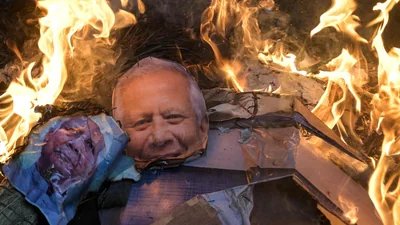
As Bangladesh heads to elections on Thursday, February 12, New Delhi is watching closely. India has made it clear it is ready to engage with an elected government in Dhaka. But the road to that reset has been rocky. After Sheikh Hasina’s escape to India in 2024, ties between the two neighbours have taken a sharp downturn, and the killing of radical youth leader Sharif Osman Hadi in December proved to be a flashpoint.
Hadi, a prominent face of the July uprising and a vocal critic of India, was shot on December 12, 2025, in Dhaka’s Paltan area. He was airlifted to Singapore General Hospital on December 15 but succumbed to his injuries three days later. What followed after was a wave of violence across the country, with attacks reported on the offices of media outlets such as The Daily Star and Prothom Alo in Dhaka, the Indian diplomatic mission in Chattogram, and, in several instances, members of the Hindu minority community.
Violence against minorities
In the days after Hadi’s killing, there were reports of attacks on minorities, particularly Hindus. One incident that drew widespread attention was the brutal lynching of Hindu garment factory worker Dipu Chandra Das in Mymensingh following blasphemy allegations. He was reportedly tied to a tree and set on fire.
New Delhi reacted strongly to the developments. In December last year, India described the “unremitting hostilities” against minorities in Bangladesh as a matter of “grave concern” and demanded punishment for those involved in the lynching of Dipu Chandra Das.
Earlier in January, India again pressed Bangladesh to “swiftly and firmly” deal with attacks on minorities and termed it “troubling” that attempts were being made to attribute the incidents to extraneous reasons.
“We continue to witness a disturbing pattern of recurring attacks on minorities as well as their homes and businesses by extremists,” external affairs ministry spokesperson Randhir Jaiswal said.
Such communal incidents need to be dealt with “swiftly and firmly”, he added. “We have observed a troubling tendency to attribute such incidents to personal rivalries, political differences, or extraneous reasons,” Jaiswal said, warning that “such disregard only emboldens the perpetrators and deepens the sense of fear and insecurity among minorities.”
Anti-India sentiments
The deterioration in ties cannot be seen in isolation from Bangladesh’s domestic political upheaval. Relations became strained after the interim government headed by Muhammad Yunus assumed charge following the collapse of the Sheikh Hasina government.
Hasina, long seen as India’s trusted ally, has been living in India since being ousted. Dhaka has sought her return, but New Delhi has not agreed so far – a factor that has added to anti-India sentiment within sections of Bangladesh’s political spectrum.
In the aftermath of Hadi’s killing, some young leaders reportedly made provocative anti-India statements. Anti-India sentiment is not new in Bangladesh, but it has sharpened in recent months.
In December, Bangladeshi security forces had to stop protesters from marching toward the Indian High Commission in Dhaka. In the same month, a mob pelted stones at the Indian Assistant High Commission building in Chittagong, prompting outrage in Delhi. According to local news channel Dhaka Tribune, police detained 12 people in connection with the incident, but they were later released without charge.
There were counter-protests in India as well. Political parties including the Congress and the BJP, along with parties in West Bengal, protested against the persecution of minorities in Bangladesh.
Representation gap for Hindu minority
Minority representation in Bangladesh’s political system also remains limited. Only four percent of candidates standing for election, this time, come from minority backgrounds in the country of 170 million, according to official data cited by AFP. This leaves minorities underrepresented in parliament and politically vulnerable.
Hindus have often been targeted for their perceived loyalty to the now-banned Awami League of Sheikh Hasina. The collapse of her government and the subsequent anti-Hasina uprising triggered a fresh wave of communal tensions.
The interim government led by Muhammad Yunus has downplayed the violence, attributing many incidents to criminal motives rather than communal targeting. However, India has publicly rejected such explanations when they appear to dilute the gravity of the attacks.
Strategic stakes for Delhi
Policy makers in India are acutely aware of the changing dynamics in Bangladesh. An Indian parliamentary panel, led by Congress’ Shashi Tharoor, recently said developments there pose “the greatest strategic challenge” to Delhi since Bangladesh’s independence war in 1971.
According to the panel, the political instability in Bangladesh has spilled over into wider social unrest, with protests erupting across the country even as economic pressures deepen public frustration. The committee further said the external affairs ministy informed lawmakers that India continues to engage with Bangladesh’s interim government while supporting the aspirations of its people.
For India, Bangladesh is not just a neighbour, it is central to its Act East policy, regional connectivity plans and security calculus in the Bay of Bengal. Instability, rising anti-India rhetoric, and attacks on minorities complicate that equation.
As Bangladesh votes on February 12, New Delhi has indicated it will work with an elected government. That could open the door for a diplomatic reboot.