
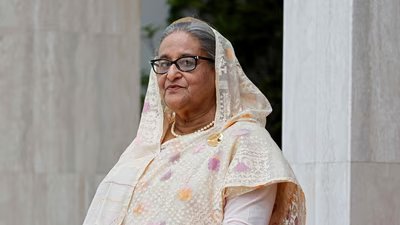
With Bangladesh heading to polls on Thursday, the country’s former prime minister Sheikh Hasina remains in self-imposed exile in India. Hasina was ousted after student-led protests in July 2024, following which she flew to New Delhi, where she is residing at a secret safe house under full security.
An interim government led by Nobel Peace laureate Muhammad Yunus has been governing Bangladesh since Hasina’s ouster.
While her party, Awami League, has been banned from contesting the February 12 general elections, the timeline for the 78-year-old leader’s return remains unclear, particularly after she was handed the death penalty by a Bangladesh court in November. The court found the former prime minister guilty of “crimes against humanity” in relation to the “July Uprising” protests.
Also Read | Sheikh Hasina ouster to key polls: A look at 2 years of turmoil for Bangladesh
However, despite her exile, Hasina has continued to maintain a discreet public presence, addressing the public through online audio messages and making her opinions known through social media. There have also been rare glimpses of her taking a quiet stroll in Lodhi Garden, a preview of her life in Delhi after the ouster.
Hasina’s first public address
In her first public address, released days before the Bangladesh elections, Hasina attacked the country’s Chief Adviser Muhammad Yunus and her rival, Bangladesh Nationalist Party. She further lamented the “lawlessness” and “persecution of minorities” in Bangladesh.
Her audio recording was played at an event titled “Save democracy in Bangladesh” at the Foreign Correspondents Club, wherein she urged citizens to rise up against the interim administration, alleging it was incapable of delivering free and fair elections. She demanded an “ironclad guarantee” to protect religious minorities, women, and vulnerable communities, while urging the United Nations to conduct a “new and truly impartial investigation” into the events since the fall of her government, according to an earlier HT report.
She alleged that Bangladesh had become a “vast prison, an execution ground, a valley of death”, while adding that the homeland won under her father Sheikh Mujibur Rahman was being “ravaged by the monstrous onslaught of extremist communal forces and foreign perpetrators”.
While terming Yunus a “murderous fascist” and “corrupt”, she accused him of engineering a conspiracy to oust her along with who she described as “his anti-state militant accomplices.”
Hasina also slammed the BNP in an audio message posted to the Awami League Facebook page. She said the party had “boycotted” the 2024 election, alleging that they had no evidence of any irregularity in the polls.
Living freely in Delhi: Hasina’s life after ouster
In October last year, Hasina interacted with the media for the first time after her ouster. In an email interaction with Reuters news agency, Hasina said she lives freely in Delhi but remains cautious owing to her family’s violent history.
The former PM’s father and three brothers were killed in a 1975 military coup when she and her sister were abroad.
According to an earlier HT report, right after landing in India, Hasina was shifted from Hindon to a secure bungalow in central Delhi somewhere near India Gate and Khan Market, intelligence officials with knowledge of developments said. They added that multiple layers of security protected the former PM.
A Reuters reporter had last year allegedly seen a rare glimpse of Hasina taking a quiet stroll through Delhi’s historic Lodhi Gardens, accompanied by two individuals who appeared to be her personal security detail. She reportedly acknowledged passersby who recognised her with a nod.
However, despite her quiet life in Delhi, Hasina had said she would want to eventually return to her country. “I would of course love to go home, so long as the government there was legitimate, the constitution was being upheld, and law and order genuinely prevailed,” she said in October last year.
Also Read | Decoding the revival of Jamaat-e-Islami: The who, what & why ahead of 2026 Bangladesh polls
Death penalty and extradition requests
Hasina was sentenced to death in absentia on November 17 by a special tribunal for “crimes against humanity” over her government’s brutal crackdown on student-led protests last year. Following this, Bangladesh’s foreign office had in November last year sent an “official letter” to India seeking the extradition of the former PM.
Responding to Bangladesh’s extradition request, Hasina turned down the demand and said she would not return to be subjected to what she termed as “political assassination.” In an interview with ANI news agency, she said the requests came from “an increasingly desperate and adrift Yunus administration”, and said she would return only when there is a “legitimate government” and “independent judiciary.”
Hasina further challenged Yunus “to take his charges to The Hague”, saying she was confident an independent court would acquit her of all charges.
After the sentencing, the country’s interim Foreign Adviser had said last year that Dhaka expected a response from New Delhi, adding that the “situation is different now.”
The formal extradition request for Hasina was conveyed through the Bangladesh High Commission in New Delhi following the special tribunal’s verdict under the existing extradition treaty between the two countries, Hossain said. Bangladesh had also sent a note verbale in December, 2024 to India seeking Hasina’s extradition, to which New Delhi acknowledged receipt without further comment.