
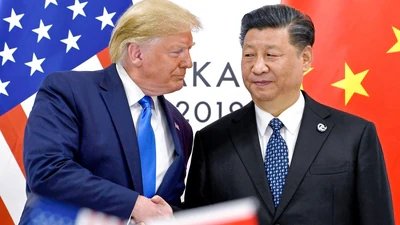
LONDON—In a world increasingly shaped by two unpredictable great powers—the U.S. and China—the world’s middle powers are boosting cooperation in areas from trade to security in a bid to ensure they don’t become roadkill in the new world order.
Canada’s Prime Minister Mark Carney has emerged as one of the biggest proponents of cooperation among a range of countries including Canada, most of Europe, Japan, South Korea, Australia, India, Brazil, Turkey and others.
“Middle powers must act together because if we’re not at the table, we’re on the menu,” the Canadian leader told the World Economic Forum recently in Davos.
The emerging world order leaves many countries feeling unmoored. On the one hand, the U.S. is retreating from its longstanding role as the leader of the international rules-based order, and it is more openly using its economic and military power to coerce other nations into doing its bidding. China, meanwhile, has pitched itself as the new grown-up in the room, but countries don’t trust it because they see it as an autocracy willing to bend global trading rules in its favor.
“The rest of the world is seeing these two unsavory alternatives, and bouncing around between these two poles,” says Eswar Prasad, an economist at Cornell University.
Middle powers are increasingly trying to protect themselves in two ways: hedging against their dependence on the superpowers by boosting self-reliance, and seeking alliances with other middle powers on specific issues, like supply chains, trade routes or security cooperation, said Stormy-Annika Mildner, executive director of the Aspen Institute Germany.
Large parts of the world outside the U.S. and China are still signing trade deals. Many are ramping up military spending. And others, like France, are trying to create homegrown alternatives to U.S. dominance in tech software.
But none of this will be easy, or fast. Middle powers are a diverse group, so “it comes down to finding the right coalitions for the right topics,” Mildner added.
And given such countries often have competing interests and values, they could cause more global disruption instead of helping anchor security and peace.
Western countries spent 70 years building trade and security links with the U.S. Untangling that isn’t quick or cost-free. For now, many have no choice but to try to avoid a damaging trade war or showdown over security.
“For all our frustration and anger, we shouldn’t hastily write off the trans-Atlantic partnership,” German Chancellor Friedrich Merz said in Davos. His country has reasons for caution about pulling away quickly from the U.S.: It sits close to Russia, lacks nuclear weapons of its own and has a stagnant economy that relies heavily on exports.
There are few easy options in areas like trade. The U.S. has long been an engine of global demand, but it is now closing itself off, limiting options for other nations to sell their exports. China isn’t an alternative because it is focused on selling to other countries, rather than buying from them.
Under Carney, Canada has steered away from the U.S. in trade policy with China, accelerated approval of delayed oil, gas and mining projects to develop more economic autonomy, and expanded export terminals to reduce reliance on U.S. sales.
The European Union has pressed ahead with free-trade deals with India and South America’s Mercosur countries, and is pushing to complete a deal with Australia. “We are making a deliberate choice: openness over protectionism, cooperation over fragmentation, and rules-based trade over unpredictability,” EU Trade Commissioner Maroš Šefčovič said.
Merz recently visited India. He is touring Saudi Arabia, Qatar and the United Arab Emirates this week, and will be in China at the end of the month. The trip will follow recent visits to China by French President Emmanuel Macron and the U.K. Prime Minister Keir Starmer. But all are wary of swapping out one form of dependence for another—possibly worse—version.
Many middle powers, especially Germany, are increasing military spending. The European Commission, the EU’s executive body, created a financing program last year to help fund member countries’ military spending. Canada joined that program in December.
European countries are also deepening defense and security ties with like-minded countries in East Asia, including Japan, South Korea, Singapore, Australia and New Zealand—all of which share fears of Russia and China.
The U.K., Italy and Japan, for instance, are developing a sixth-generation jet fighter by 2035. South Korea has emerged as a major arms supplier to some European countries. Poland is buying tanks from South Korea, artillery from the Baltics and long-range missiles from Norway. And the U.K. and Australia are working together with the U.S. to build nuclear-powered submarines, something South Korea is doing as well.
“There is a growing octopus of ties between Europe and Asia which reflects the rise of China but also hedges against the U.S. to some degree,” says Neil Melvin, director of international security studies at the Royal United Services Institute think tank in London.
There are limits to Europe’s ability to defend itself. The continent can produce its own artillery, tanks, subs and ships, but is heavily dependent on the U.S. in key areas such as fighter aircraft and military satellites, as well as nuclear protection.
“If anyone thinks here, again, that the European Union—or Europe as a whole—can defend itself without the U.S., keep on dreaming. You can’t. We can’t,” North Atlantic Treaty Organization Secretary-General Mark Rutte told the European Parliament recently.
Melvin says the world is likely entering a period where countries cluster in smaller groups of trust. But he warns that middle powers will struggle to find common ground, especially if they have different values. He wonders whether countries like Saudi Arabia could really be partners for European democracies or Canada.
Unless middle powers can look beyond their short-term interests, they could become a further destabilizing force, Prasad says. After Russia’s full-scale invasion of Ukraine in 2022, India refused to join in international sanctions against Russian oil sales, and has provided the Kremlin with a major financial lifeline for its war.
Many middle powers, such as Turkey and Israel, may also fight for regional influence and disrupt stability. Israel’s decision to become the first country to recognize Somaliland, a self-governing territory within Somalia, has sparked tensions with Turkey and Egypt, who oppose the move.
There is also a risk of nuclear proliferation. France’s decision by Charles de Gaulle to opt out of NATO’s command structure and create its own nuclear deterrence is looking prescient. Last week, Merz confirmed publicly for the first time that Berlin was discussing a potential extension of the French and British nuclear umbrella to Germany. Sweden has said it wants to join those talks. But costs could be prohibitive for a continent with stagnant economic growth.
The European Union itself is a good example of the promise and limits of cooperation—it links 27 countries, giving it collective clout to negotiate trade deals and set common standards. But its bureaucracy bogs down decision-making on everything from boosting economic growth to collective defense.
Given U.S. security guarantees, the EU never had to grapple much with defense, said Melvin. Now, a new world order will test the EU’s ability to create quick consensus. “Without U.S. power, it’s very unclear that there’s a thing called Europe rather than a lot of different countries with different interests,” he said.
Write to David Luhnow at david.luhnow@wsj.com, Kim Mackrael at kim.mackrael@wsj.com and Bertrand Benoit at bertrand.benoit@wsj.com