
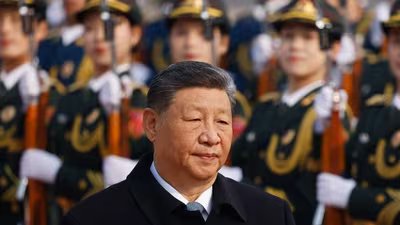
In purging his top generals, Chinese leader Xi Jinping put the command of the armed forces in the hands of one man—himself. Now, his vision alone will decide the course of Beijing’s looming confrontation with Taiwan.
The arrest of Gen. Zhang Youxia, a close ally and childhood friend the Chinese leader called “big brother,” removes any internal authoritative voices who could slow Xi’s hand in any move against Taiwan, the democratic, self-governing island that Beijing claims as part of its territory.
The timing is critical. The Chinese military is racing toward a 2027 deadline Xi has set for “modernization,” often interpreted as readiness for a Taiwan contingency.
A near-term invasion of Taiwan, though, is now less likely, said foreign-policy and military analysts, now that Xi has purged five of the six senior generals that he had handpicked to lead the military just three years ago. Xi is pivoting to a campaign designed to break Taipei’s resolve without firing a shot, these analysts said.
Beijing will increasingly lean on tactics that fall just below the threshold of open conflict, the analysts said. This includes relentless exercises intended to simulate a maritime and air blockade of Taiwan, displaying the blunt force behind Beijing’s psychological offensive.
“Xi’s approach at the moment is a broader coercive campaign that integrates military posturing with economic and cyber pressure,” said Laura Rosenberger, the senior national-security official and the top American diplomat in Taiwan under former President Joe Biden.
Beijing is also opening new fronts through “legal warfare,” using domestic Chinese law to target Taiwanese officials and raising the risk for Taiwanese people to travel to the mainland, as activities once considered routine political expression can now be reclassified as criminal offenses.
China is engaging in cyberattacks aimed at paralyzing Taiwan’s energy and healthcare infrastructure, Taiwanese officials say. Meanwhile, Beijing’s intimidation of countries like Japan aims to leave Taiwan diplomatically stranded.
The message: China’s military leadership may be in flux, but Xi’s focus on Taiwan remains unrelenting, and his ability to strangle Taiwan’s supply lines and exhaust its economic resilience remains unyielding.
Xi’s motives for removing Zhang—announced on Jan. 24—remain a mystery.
Chinese military leaders were told in a closed-door briefing that Zhang leaked nuclear secrets to the U.S. and accepted bribes—serious enough charges to justify ending such a senior official’s career, though the Communist Party doesn’t always tell even its own leadership ranks the full or true story behind Xi’s moves. At a press briefing Thursday, a Chinese Defense Ministry spokesman warned against unfounded speculation and referred back to the original announcement of the probe into Zhang’s alleged violations of party discipline and state law.
Another emerging theory is that Zhang and Xi disagreed over when the Chinese military should be ready for combat with Taiwan. Xi wanted the military to “achieve joint operational capability for a Taiwan invasion by 2027, whereas Zhang clearly placed this goal closer to 2035,” said a Jan. 26 analysis of official records by analyst K. Tristan Tang at the Jamestown Foundation, a Washington, D.C.,-based think tank.
Following Zhang’s arrest, Tang noted, an editorial in the army’s flagship newspaper accused Zhang of having “seriously trampled” on the military’s chairman responsibility system—the principle that codifies the absolute command of Xi, the chairman, over the military. This choice of words, Tang said, suggests that Zhang’s approach represented “a political challenge that subverted Xi’s authority.”
A credible military option remains the backbone of Xi’s approach, Rosenberger said, because “that provides the essential leverage Xi needs to exhaust Taipei’s resolve.”
The Trump administration maintains that it doesn’t support any unilateral change to the status quo in the Taiwan Strait and will keep a military posture to maintain it.
Other analysts say any potential policy rift between Zhang and Xi might have been over how to man, train and equip the military.
“For a U.S. deterrence strategy to be effective, we need Xi Jinping to be surrounded by competent generals who will give him objective advice,” wrote Drew Thompson, a former Pentagon strategist now with the Singapore-based S. Rajaratnam School of International Studies, in a recent analysis.
By gutting the military’s top decision-making body, Thompson noted, Xi will have a harder time with command and control, creating the operational risk of a leader trying to command a million-man army through a “one-man committee.”
“Without Zhang Youxia,” Thompson said, “the risk of miscalculation goes up.”
The removal of Zhang highlights a higher level of confidence about the prospect of “reunification” than Xi has shown at any point since he rose to power in 2012, according to people who consult with Chinese officials. This confidence is bolstered by his absolute control over the military.
It also stems from a fundamental reassessment of Washington’s resolve. Beijing views Trump as having little appetite for a costly military intervention in the Taiwan Strait.
Even the Trump administration’s recent $11.1 billion arms sale to Taiwan, the largest in history, has been interpreted in Beijing as “promoting the defense industry” rather than a security commitment, said Yun Sun, director of the China program at the Washington, D.C.,-based Stimson Center.
“Beijing is convinced it may never see a U.S. president more indifferent to the Taiwan Strait than Trump,” Sun said.
Xi sees his upcoming meetings with Trump this year as a tactical opening to further erode Taipei’s confidence. By potentially offering trade concessions, such as multibillion-dollar orders for Boeing aircraft, Xi aims to secure the kind of transactional statements from Trump that could sow doubts in Taipei about the U.S. commitment to its defense.
However, administration officials say the White House is focused on blunting Beijing’s aggression through a “denial defense” anchored in the First Island Chain—the string of islands stretching from Japan through Taiwan to the Philippines that acts as a natural barrier to Chinese naval expansion.
In addition, while the recently inked U.S.-Taiwan “Silicon Pact” seeks to reshore advanced semiconductor manufacturing, officials say it simultaneously reinforces Taiwan’s security. By hardwiring the island’s industrial ecosystem into the American economy, they say, the pact effectively converts Taiwan’s high-end silicon output into an indispensable U.S. national security asset.
Overall, by raising the cost of military action for China, U.S. officials say Washington aims to prevent a Chinese military attack—and domination of the region—without engaging in needless confrontation.
Write to Lingling Wei at Lingling.Wei@wsj.com