
EUROPE SEEMS to be caught in a pincer. On one side, Donald Trump is ramping up America’s effort to gain sovereignty over Greenland, a Danish territory. “Nobody is going to fight the US militarily over the future of Greenland,” boasted Stephen Miller, the White House’s deputy chief of staff, on January 5th. On the other side is Vladimir Putin. “Russia is testing us in the grey zone with tactics that are just below the threshold of war,” noted Blaise Metreweli, the head of MI6, on December 15th. She pointed to cyber-attacks, drone sightings, arson and “aggressive activity in our seas, above and below the waves”.

There have been fresh hints of that activity in recent weeks. In six days there have been six instances of damage or disruption to undersea cables in the Baltic Sea. The latest episode occurred on January 2nd, when a 65km-long cable to Lithuania was severed in Latvian territorial waters off Liepaja on the country’s west coast (see map). Latvian police boarded a suspect vessel—one of four that crossed the cable’s route on the day—and studied its anchor and logs, but found nothing incriminating. Repairs are likely to take one to two weeks.
A few days earlier, on December 31st, Finnish authorities seized a cargo ship suspected of damaging two communication cables between Finland and Estonia. The Fitburg, which was en route from Russia to Israel, was boarded after a helicopter saw its anchor being dragged along the seabed. It was “too early” to judge whether this was deliberate or accidental, noted Helsinki’s deputy police chief. But one detail has raised eyebrows: the Fitburg’s hull has long sported a cartoon of a laughing sawfish, the same insignia borne by U-96, a Nazi submarine.
The Elisa cable was one of several Estonia-linked undersea cables that reported faults around that time, two of them connected to Hiumaa, an Estonian island. Western intelligence agencies have concluded that many incidents of cable disruption in recent years have resulted from poor seamanship rather than hostile intent. In some of the Estonia-related cases the faults were probably caused by stormy weather, according to the country’s justice ministry, rather than enemy action.
Andres Vosman, a former deputy director of Estonia’s foreign-intelligence agency, told local press it was his “strong assessment” that most recent incidents were a result of heavier ship traffic towards Russia, badly maintained ships with poor crews, more underwater infrastructure than in the past and more public attention to the matter. Alessio Patalano, an expert at King’s College London, points out that over the last 20 years alone the number of data cables has grown three times as much as it did in the prior century. The Finnish incidents look the most suspicious, says a person familiar with the intelligence.
However, even where there are suspicions of Russian skulduggery, it is proving tricky to obtain convictions in courts. Last summer Finland charged the captain and two officers of a Russia-linked ship that was thought to have damaged the Estlink-2 power cable between Finland and Estonia in late 2024. They were accused of “aggravated criminal mischief and aggravated interference with communications”. But in October a Finnish court set them free, saying it lacked jurisdiction. The case, it said, fell under the UN Convention on the Law of the Sea. Only the flag state of the ship—in this case the Cook Islands—or the defendants’ home countries, Georgia and India, could prosecute the men.
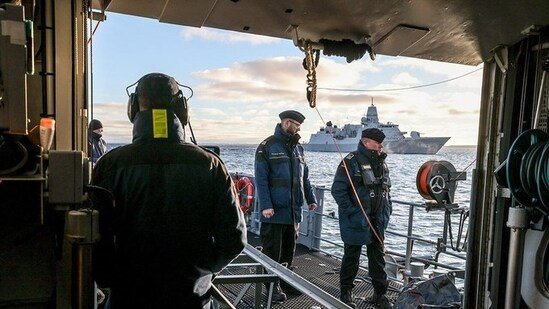
That will intensify an ongoing debate over who should be responsible for the protection and monitoring of cables. In January 2025 NATO launched Baltic Sentry, a mission to send additional frigates, maritime-patrol aircraft and drones into the area to deter sabotage. That seemed to work—for a time. “All of a sudden, the phenomenon…disappeared,” noted Admiral Giuseppe Cavo Dragone, the head of NATO’s international military committee, last summer. But it has proved difficult to keep scarce assets, like frigates, on station for long stretches. States hope to shift part of the burden to private operators, at least when it comes to monitoring. “It’s not our task to protect this infrastructure,” noted Krzysztof Jaworski, an admiral in Poland’s navy, speaking to The Economist last year. “We should step in only when the owners cannot act.”
Others argue that too much attention is being paid to the grey zone. It is a nuisance, they suggest, rather than a serious assault on Europe. “The remarkable aspect is how ineffective the sabotage campaign has been,” says a former British official who worked on the issue. “Russia [either] lacks capacity or knows how far to push,” he suggests, pointing to the vast discrepancy between the damage done to Russia in Ukraine by Western arms and the limited impact of sabotage. “Five years ago, we would have expected much more chaos and blowback.”