
Topline
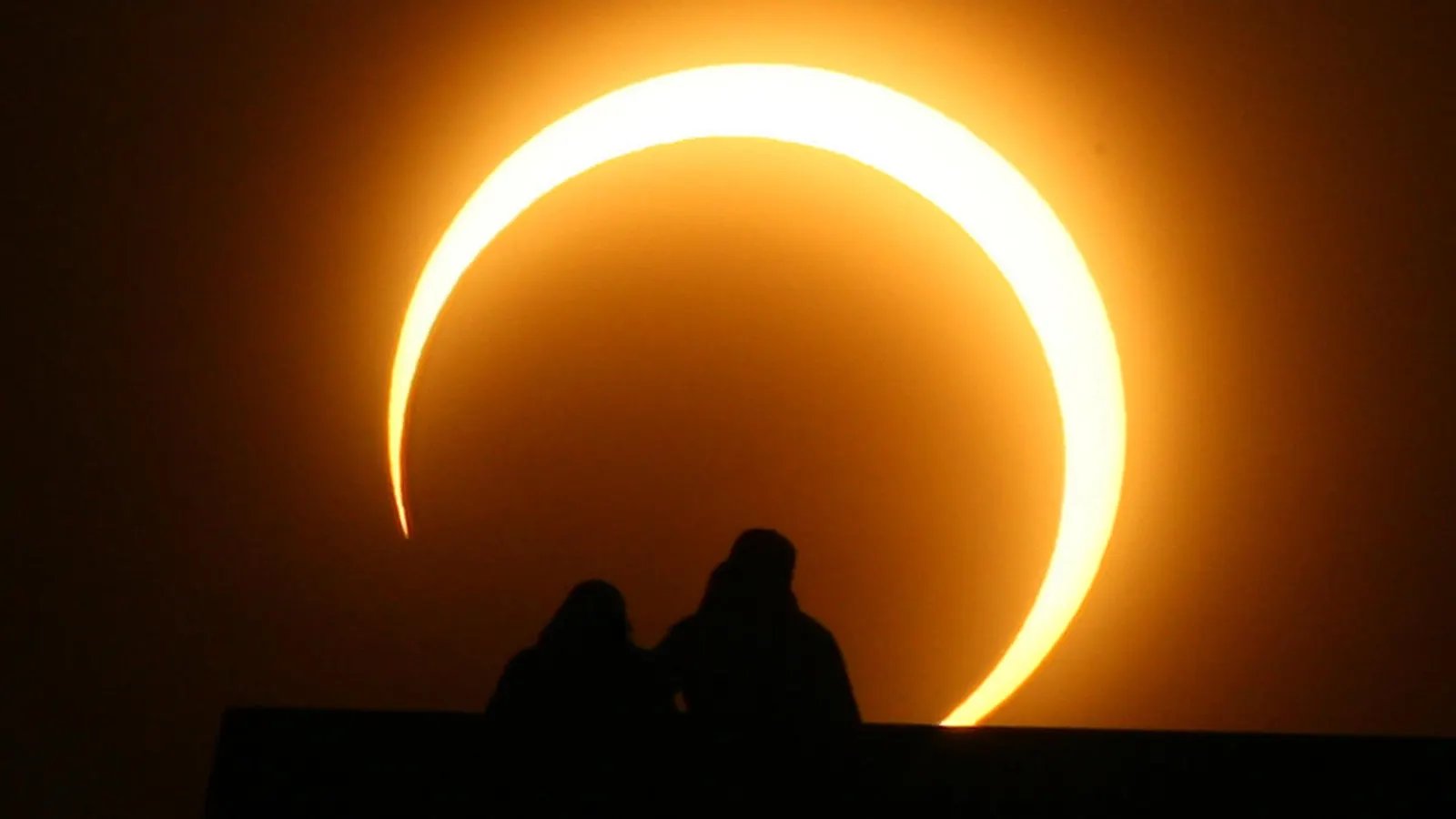
On Tuesday, Feb. 17, 2026, a dramatic annular solar eclipse — popularly known as a “ring of fire” — will appear in the skies above remote parts of Antarctica home to two scientific research stations. While the annular (meaning ring) phase will only be visible from the icy continent, skywatchers in parts of southern South America and southern Africa will see a partial eclipse. For the rest of the world, including North America, this event will go unseen. However, eclipses always come in pairs, and two weeks after the annular solar eclipse will be a total lunar eclipse — and that will be seen across North America.
A rare “ring of fire” annular solar eclipse will appear over Antarctica on Feb. 17, 2026, with partial views from parts of South America and Africa. (Photo: STR/AFP via Getty Images)
AFP via Getty Images
Key Facts
An annular solar eclipse occurs when the moon passes in front of the sun but is too far from Earth to completely cover it, leaving a brilliant “ring of fire” around the moon’s silhouette. A partial solar eclipse will be visible on either side. It’s only safe to view with eclipse glasses, even during the annular phase.
The eclipse begins on Feb. 17 at 07:01 UTC, with maximum eclipse visible in Antarctica. Partial phases will be visible just after sunrise from the southernmost tips of Chile and Argentina, and from parts of South Africa.
The new moon responsible for the eclipse on Feb. 17 has a major cultural role, setting the lunar calendar in motion, this year marking the start of both Chinese New Year’s Year Of The Fire Horse and, with the emergence of a crescent moon on Feb. 18, the Islamic fasting month of Ramadan.
What Is An Annular Solar Eclipse?
Unlike a total solar eclipse, which plunges parts of Earth into midday darkness, an annular eclipse delivers a subtler show. The moon, near apogee (its farthest point from Earth), appears slightly smaller than the sun — in this case, blocking 96% of the center of the sun’s disk to create a ring of sunlight for a maximum of 2 minutes 20 seconds.
Who Will See This Annular Solar Eclipse
The path of annularity on Feb. 17 is narrow — up to 472 miles (759 kilometers) wide — and passes almost entirely over Antarctica’s remote ice fields. From European-operated Concordia, the remotest base on Earth on the Dome C plateau, and Russian-operated Mirny in Queen Mary Land on the Davis Sea coast of Antarctica, the sun will form a perfect circle of fire in the sky. In summer, Concordia hosts about 80 people and Mirny between 50 and 200 people.
The aurora australis, photographed over Concordia station in July 2025.
ESA/IPEV/PNRA-N. Purivs/Lacrampe
Upcoming Annular Solar Eclipses
After Feb. 17, 2026, the following three “ring of fire” annular solar eclipses will be:
- Feb. 6, 2027: Chile, Argentina, Uruguay, Brazil, Cote d’Ivoire, Ghana, Togo, Benin and Nigeria.
- Jan. 26, 2028: Galápagos Islands, mainland Ecuador, Peru, Brazil, Suriname, French Guiana, Morocco and Spain.
- Jun. 1, 2030: Algeria, Tunisia, Libya, Greece, Turkey, Russia, Kazakhstan, China and Japan.